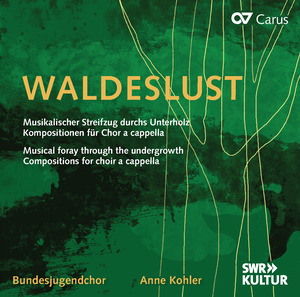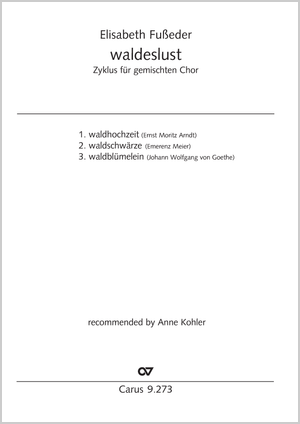
waldeslust
Cycle for mixed choir (recommended by Anne Kohler)



 Listen
(3)
Listen
(3)
- waldhochzeit
- waldschwärze
- waldblümelein
Contents

-
Composer
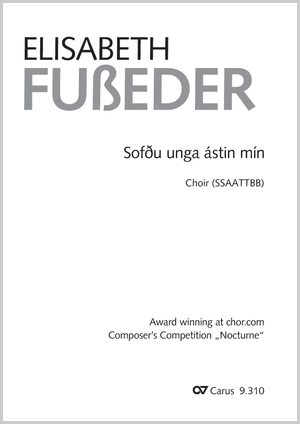
Elisabeth Fußeder
| 2000Elisabeth Fußeder was born in Munich in 2000 and made her first contacts with composer Rodolphe Haimann in her hometown of Freising. She graduated with honours from the musication vocational school for music in Nuremberg in 2018.
The composer has already been commissioned to write works for the via-nova-chor Munich, the Ensemble rechérche, the Bundesjugendchor, the festival code modern, the Bayerischer Landesjugendchor, the Basel ensemble False relationships and the extended ending and the Mädchenkantorei at Freiburg Minster, among others. In 2024, projects with the vocal ensemble Lauschwerk, the Stuttgart Philharmonic and once again the German National Youth Choir will follow. Elisabeth Fußeder's composition may-be-peace for five voices received the special prize of the Valentin Becker Competition in 2022. In 2023, in tenebris for mixed choir was honoured with a prize at the randspiele Zepernick composition competition. Her works have also won several prizes at the Jugend komponiert Bayern competition under the artistic direction of composer Minas Borboudakis.
Driven by her passion for choirs, Elisabeth Fußeder is a member of several ensembles, including founding member of the vocal sextet "Chiave", which has won several special prizes at national level. Since October 2020, she has been studying composition with Prof. Brice Pauset and aural training with Prof. Konrad Georgi at the Freiburg University of Music.
We asked the composer 6 questions, read them here in our blog: https://blog.carus-verlag.com/en/personalities/6-questions-for-elisabeth-fusseder/
Personal details
-
Songwriter / Librettist
Emerenz Meier
| 1874-1928
-
Songwriter / Librettist
Ernst Moritz Arndt
| 1769-1860
-
Songwriter / Librettist
Johann Wolfgang Goethe
| -1832Johann Wolfgang von Goethe is today a dazzling figure in world literature. He was born in Frankfurt am Main and initially studied law, but then followed his inclination towards poetry. With the drama Götz von Berlechingen and the epistolary novel The Sorrows of Young Werther, he made important contributions to the literary movement of Sturm und Drang.
From 1775 onwards, Goethe was employed at the court of Duke Carl August in Weimar. In addition to his work at court as a minister and director of the Weimar Court Theatre, he wrote his major works here, including the drama Faust, other novels and many poems, which are still a source of inspiration for musical adaptations today. His poems were a source of inspiration for composers, especially in the 19th century, such as Franz Schubert. Schubert alone set 52 of Goethe's works to music, the best known of which are probably the songs Gretchen am Spinnrade and Erlkönig. Goethe also became acquainted with several composers of the time. He was particularly enthusiastic about the young Felix Mendelssohn-Bartholdy, who also set Goethe's lines to music in the ballad Die erste Walpurgisnacht (The First Walpurgis Night). Personal details
Reviews on our website can only be submitted by customers with a registered user account. A check whether the rated products were actually purchased does not take place.
Frequent questions about this work
 There are no questions and answers available so far or you were unable to find an answer to your specific question about this work? Then click here and send your specific questions to our Customer Services!