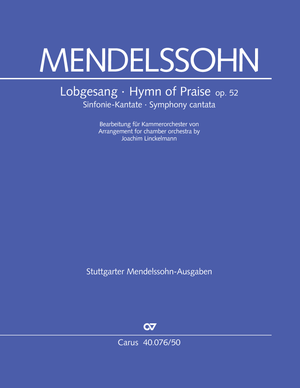
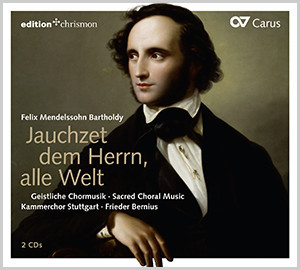
Mendelssohn describes to his friend Klingemann the 1840 work as “a ‘symphony for chorus and orchestra’ … First three symphonic movements, to which 12 choral- and solo- movements are appendaged; the words from the Psalms, and indeed all pieces, vocal and instrumental, are composed in the words ‘Everything which has breath, Praise the Lord’; one understands by this that first the instruments give praise in their own way, and then the chorus and the individual voices."
Thanks to an arrangement by J. Linckelmann (Carus 40.076/50), it is possible to perform the work in smaller settings.
Explore
 View
View
 Listen
(12)
Listen
(12)
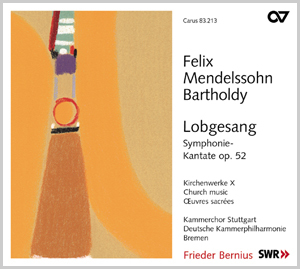
- Purchase the work as a CD or download.
- 1. Sinfonia – Maestoso con moto
- 1. Sinfonia - Allegretto un poco agitato
- 1. Sinfonia - Adagio religioso
- 2. Alles, was Odem hat (Coro e Soprano solo)
- 3. Recitativo: Saget es, die ihr erlöst seid, Arie: Er zählet unsre Tränen (Tenore solo)
- 4. Sagt es, die ihr erlöst seid (Coro)
- 5. Ich harrete des Herrn (Soprano I e II solo e Coro)
- 6. Stricke des Todes (Tenore solo)
- 7. Die Nacht ist vergangen (Coro)
- 8. Choral: Nun danket alle Gott
- 9. Drum sing‘ ich mit meinem Liede (Soprano e Tenore solo)
- 10. Ihr Völker, bringet her (Coro)
 Practise
-
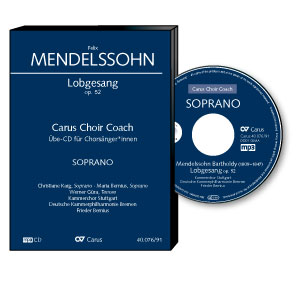
 carus music, the Choir Coach
Üben mit carus music
carus music, the Choir Coach
Üben mit carus music
-
Practice aids
-
Practice aids voice part soprano
- 2. Alles, was Odem hat (Coro e Soprano solo) (Choir Coach)
- 2. Alles, was Odem hat (Coro e Soprano solo) (Choir Coach, Slow mode)
- 4. Sagt es, die ihr erlöst seid (Coro) (Choir Coach)
- 4. Sagt es, die ihr erlöst seid (Coro) (Choir Coach, Slow mode)
- 5. Ich harrete des Herrn (Soprano I e II solo e Coro) (Choir Coach)
- 5. Ich harrete des Herrn (Soprano I e II solo e Coro) (Choir Coach, Slow mode)
- 7. Die Nacht ist vergangen (Coro) (Choir Coach)
- 7. Die Nacht ist vergangen (Coro) (Choir Coach, Slow mode)
- 8. Choral: Nun danket alle Gott (Choir Coach, soprano 1)
- 8. Choral: Nun danket alle Gott (Choir Coach, Slow mode, soprano 1)
- 8. Choral: Nun danket alle Gott (Choir Coach, soprano 2)
- 8. Choral: Nun danket alle Gott (Choir Coach, Slow mode, soprano 2)
- 10. Ihr Völker, bringet her (Coro) (Choir Coach)
- 10. Ihr Völker, bringet her (Coro) (Choir Coach, Slow mode)
-
Practice aids voice part alto
- 2. Alles, was Odem hat (Coro e Soprano solo) (Choir Coach)
- 2. Alles, was Odem hat (Coro e Soprano solo) (Choir Coach, Slow mode)
- 4. Sagt es, die ihr erlöst seid (Coro) (Choir Coach)
- 4. Sagt es, die ihr erlöst seid (Coro) (Choir Coach, Slow mode)
- 5. Ich harrete des Herrn (Soprano I e II solo e Coro) (Choir Coach)
- 5. Ich harrete des Herrn (Soprano I e II solo e Coro) (Choir Coach, Slow mode)
- 7. Die Nacht ist vergangen (Coro) (Choir Coach)
- 7. Die Nacht ist vergangen (Coro) (Choir Coach, Slow mode)
- 8. Choral: Nun danket alle Gott (Choir Coach)
- 8. Choral: Nun danket alle Gott (Choir Coach, Slow mode)
- 10. Ihr Völker, bringet her (Coro) (Choir Coach)
- 10. Ihr Völker, bringet her (Coro) (Choir Coach, Slow mode)
-
Practice aids voice part tenore
- 2. Alles, was Odem hat (Coro e Soprano solo) (Choir Coach)
- 2. Alles, was Odem hat (Coro e Soprano solo) (Choir Coach, Slow mode)
- 4. Sagt es, die ihr erlöst seid (Coro) (Choir Coach)
- 4. Sagt es, die ihr erlöst seid (Coro) (Choir Coach, Slow mode)
- 5. Ich harrete des Herrn (Soprano I e II solo e Coro) (Choir Coach)
- 5. Ich harrete des Herrn (Soprano I e II solo e Coro) (Choir Coach, Slow mode)
- 7. Die Nacht ist vergangen (Coro) (Choir Coach)
- 7. Die Nacht ist vergangen (Coro) (Choir Coach, Slow mode)
- 8. Choral: Nun danket alle Gott (Choir Coach, Tenore 1)
- 8. Choral: Nun danket alle Gott (Choir Coach, Slow mode, Tenore 1)
- 8. Choral: Nun danket alle Gott (Choir Coach, Tenore 2)
- 8. Choral: Nun danket alle Gott (Choir Coach, Slow mode, Tenore 2)
- 10. Ihr Völker, bringet her (Coro) (Choir Coach)
- 10. Ihr Völker, bringet her (Coro) (Choir Coach, Slow mode)
-
Practice aids voice part basso
- 2. Alles, was Odem hat (Coro e Soprano solo) (Choir Coach)
- 2. Alles, was Odem hat (Coro e Soprano solo) (Choir Coach, Slow mode)
- 4. Sagt es, die ihr erlöst seid (Coro) (Choir Coach)
- 4. Sagt es, die ihr erlöst seid (Coro) (Choir Coach, Slow mode)
- 5. Ich harrete des Herrn (Soprano I e II solo e Coro) (Choir Coach)
- 5. Ich harrete des Herrn (Soprano I e II solo e Coro) (Choir Coach, Slow mode)
- 7. Die Nacht ist vergangen (Coro) (Choir Coach)
- 7. Die Nacht ist vergangen (Coro) (Choir Coach, Slow mode)
- 8. Choral: Nun danket alle Gott (Choir Coach, Basso 1)
- 8. Choral: Nun danket alle Gott (Choir Coach, Slow mode, Basso 1)
- 8. Choral: Nun danket alle Gott (Choir Coach, Basso 2)
- 8. Choral: Nun danket alle Gott (Choir Coach, Slow mode, Basso 2)
- 10. Ihr Völker, bringet her (Coro) (Choir Coach)
- 10. Ihr Völker, bringet her (Coro) (Choir Coach, Slow mode)
-
 Additional material
- Purchase additional material as a download product.
-
 Digital text (without sheet music) incl. printing licence, html file, singing text, english translationhtml file, singing text, english translation (Sample)1. Sinfonia 2. Coro (e Soprano solo)
All men, all things, all that has life and breath
3. Recitativo (Tenore solo)
sing to the Lord! Hallelujah.
Praise the Lord with lute and harp,
in joyful song extol him!
And let all flesh magnify his might and his glory!
Praise thou the Lord, o my spirit,
all my soul declare, praise his great loving kindness,
and forget thou not all his benefits.Sing ye praise, all ye redeemed of the Lord,
redeemed from the hand of the foe,
from your distresses, from deep affliction,
who sat in the shadow of death and darkness,
all ye that cried in trouble unto the Lord,
sing ye praise! Give ye thanks,
proclaim aloud his goodness!
He counteth all your sorrows in the time of need,
he comforts the bereaved with his regard....
-
Digital text (without sheet music) incl. printing licence, html file, singing text, originalhtml file, singing text, original (Sample)1. Sinfonia 2. Coro (e Soprano solo)
Alles, was Odem hat,
3. Recitativo (Tenore solo)
lobe den Herrn! Halleluja!
Lobt den Herrn mit Saitenspiel,
lobt ihn mit eurem Liede!
Und alles Fleisch lobe seinen heiligen Namen!
Lobe den Herrn, meine Seele,
und was in mir ist seinen heiligen Namen,
und vergiss es nicht, was er dir Gutes getan.Saget es, die ihr erlöst seid durch den Herrn, die er aus der Not errettet hat aus schwerer Trübsal, aus Schmach und Banden, die ihr gefangen im Dunkel waret, alle, die er erlöst hat aus der Not, saget es! Danket ihm und rühmet seine Güte! Er zählet unsre Tränen in der Zeit der Not, er tröstet die Betrübten mit seinem Wort,
...
-
Digital text (without sheet music) incl. printing licence, html file, Introductory text, frenchhtml file, Introductory text, french (Sample)Texte du livret du CD Carus 83.213
R. Larry Todd
Traduction : Sylvie CoquillatEn tant que compositeur de symphonies, Félix Mendelssohn Bartholdy n’était pas lui non plus exempt de la redoutée « crainte d’influence » (« anxiety of influence » selon Harold Bloom) qui habitait plus d’un compositeur du 19ème siècle travaillant dans l’ombre de Beethoven. Pourtant, entre 1821 et 1842, Mendelssohn se montre lui-même très productif dans ce genre ; encore élève, il achève 12 symphonies pour cordes et compose 5 symphonies dans sa maturité. Il existe en outre des ébauches prometteuses des années 1840 annonçant une sixième symphonie en ut majeur. En dépit de cette puissance créatrice, les symphonies pour cordes, avec leur synthèse unique de chromatisme et de technique fuguée puisés chez Bach, une sensibilité évoquant Carl Philipp Emanuel Bach et la réserve classique de Mozart, sont normalement
...
-
Digital text (without sheet music) incl. printing licence, html file, Introductory text, englishhtml file, Introductory text, english (Sample)Text from the CD Carus 83.213
R. Larry Todd(R. Larry Todd is the author of Mendelssohn: A Life in Music, New York, 2003)
As a symphonist, Felix Mendelssohn Bartholdy was not immune to the notorious “anxiety of influence” that affected many nineteenth-century composers working in Beethoven’s shadow. Still, Mendelssohn contributed productively to the genre: between 1821 and 1842, he completed twelve student string sinfonie and five mature symphonies, not to mention some tantalizing sketches recorded in the 1840s for what would have been a sixth symphony in C major. Despite this output, the string symphonies, with their distinctive synthesis of Bachian chromaticism and fugal writing, Empfindsamkeit reminiscent of Carl Philipp Emanuel Bach, and Mozartean classical restraint, are usually regarded as retrospective juvenilia, if also remarkably precocious efforts of a twelve and thirteen-year-old musician. Similarly, the Symphony No. 1 in C minor op. 11 (1824), despite its craft and effective orchestration,
...
-
Digital text (without sheet music) incl. printing licence, html file, Introductory text, germanhtml file, Introductory text, german (Sample)Booklet-Text der CD Carus 83.213
R. Larry Todd
Übersetzung: Helga BesteAls Komponist von Sinfonien war auch Felix Mendelssohn Bartholdy nicht immun gegen die von Harold Bloom so benannte berüchtigte „anxiety of influence“, die so manchen im Schatten Beethovens arbeitenden Komponisten des 19. Jahrhunderts heimsuchte. Dennoch trug Mendelssohn zwischen 1821 und 1842 produktiv zur Gattung bei; er vollendete noch als Schüler 12 Streichersinfonien und komponierte in reiferen Jahren 5 Sinfonien. Darüber hinaus existieren vielversprechende Skizzen aus den 1840er Jahren, die auf eine sechste Sinfonie in C-Dur vorausweisen. Trotz dieser Schaffenskraft werden die Streichersinfonien mit ihrer unverkennbaren Synthese aus Bach’scher Chromatik und Fugentechnik, einer an Carl Philipp Emanuel Bach erinnernden Empfindsamkeit und der klassischen Zurückhaltung Mozarts in der Rückschau normalerweise als Jugendwerke betrachtet, wenn auch als bemerkenswert reife Anstrengungen eines zwölf bzw. dreizehn Jahre alten Komponisten. Auf ähnliche Art und Weise dokumentiert auch die erste Sinfonie in c-Moll op. 11 (1824) trotz ihres handwerklichen Könnens und effektiver Orchestrierung in einigen schwach kaschierten Anspielungen auf Beethovens Fünfte Sinfonie und
...
Purchase
Additional product information
Contents

-
Composer
Felix Mendelssohn Bartholdy
| 1809-1847Felix Mendelssohn Bartholdy (1809–1847) is regarded as one of the most important composers of the Romantic period. His compositions combine the formal clarity of the Viennese Classical period with the heightened expressiveness of the 19th century. His engagement with the music of Johann Sebastian Bach was particularly influential; he played a key role in its rediscovery through the performance of the St Matthew Passion in 1829.
Among his best-known vocal works are his two oratorios, Paulus and Elias, as well as his chorale cantata Verleih uns Frieden gnädiglich. Furthermore, Mendelssohn worked as a conductor, pianist and music teacher, and made a significant contribution to the professionalisation of the concert scene and to the development of the Leipzig Conservatoire. His work occupies a central position in 19th-century music history and combines a sense of tradition with Romantic sound aesthetics.
Personal details
Reviews
... Der Schwierigkeitsgrad für Chor und Orchester lässt sich mit dem des „Elias” vergleichen. Die Aufführungsdauer beträgt ca. 65 Minuten. Die neue Ausgabe im Carus-Verlag zeichnet sich aus durch ein informatives Vorwort, vorzügliches, sehr großzügiges Druckbild und einen ansehnlichen Preis für die in Leinen gebundene, 335 Seiten starke Partitur. Der Praktiker hätte sich lediglich die Hinzufügung von Studierbuchstaben oder -ziffern gewünscht, die für die Einstudierungsarbeit sehr hilfreich sind und bei einem Werk mit langen Sätzen wie diesem besonders nützlich wären. Das komplette Aufführungsmaterial mit Klavierauszug und Chorpartitur liegt ebenfalls im Carus-Verlag vor.
Helmut Wolf, Württembergische Blätter für Kirchenmusik. 4/1992
... Carus-Verlag has long maintained a reputation for publishing exemplary editions of choral works. This edition by Douglass Seaton is no exception. It contains a very informative foreword, a singable English translation underlaid along with the German text, and a piano, reduction of the orchestral accompaniment.
David Stein, Choral Journal, 2/1992
Reviews on our website can only be submitted by customers with a registered user account. A check whether the rated products were actually purchased does not take place.
No feedback available for this product.
Frequent questions about this work
Mendelssohn uses clarinets in A, B flat and C. Are instruments in all three keys really necessary?
Clarinets in A and B flat are found widely. Mendelssohn only uses the C clarinet (now rarer) in the Chorale (movement 8). This is notated in B flat in the part. The key of G major also works well on the B flat clarinet, and was used by Mendelssohn himself in the middle section of the ‘Allegretto un poco agitato’ of the Sinfonia of the Lobgesang on the B flat clarinet.
 There are no questions and answers available so far or you were unable to find an answer to your specific question about this work? Then click here and send your specific questions to our Customer Services!