

Explore
 View
View

Purchase
Additional product information
-
Composer
Franz Liszt
| 1811-1886Franz Liszt was born in 1811 in Raiding (formerly Hungary) and died in Bayreuth in 1886. From the age of six he took piano lessons from his father and in 1822/23 he studied with Czerny and Salieri in Vienna. He spent the years after 1823 in Paris, where his acquaintances with Rossini, Bellini, Meyerbeer, as well as Chopin, Berlioz, and Paganini had a strong influence upon him. Literarily he was also impressed by Victor Hugo. During his extended concert tours from 1838 to 1847 Liszt enjoyed great triumphs. Beginning in 1848 he then lived in Weimar, where he composed the symphonic poems and some of his most important piano works (Sonata in B minor, Piano Concerto No. 1, etc.). From 1861 he lived in Rome, where he took minor orders . Personal details
-
Editor
Michael von Hintzenstern
| 1956
Reviews
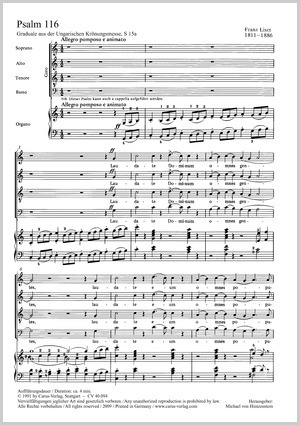
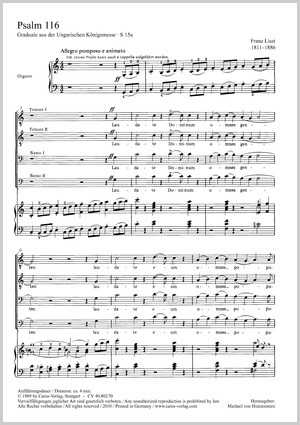
Psalm 116
Franz Liszt: Psalm 116
In 1869, Liszt added a setting of the vespers psalm ”Laudate Dominum omnes gentes” (Psalm 116/117) for male choir to his ”Hungarian Coronation Mass” (1867) as a gradual. The score for this current edition of Psalm 116 for SATB choir was edited by Michael von Hintzenstern. Reflecting Liszt’s desire to create devotional worship music lacking sentimentality, Psalm 116 is a simple work built on unison, quasi-plainsong passages which frame a majestic, grand central section. Not a difficult work, this psalm setting does, however, require the strength of a large choir capable of sustaining towering chords at very loud dynamic levels. The score also calls for the use of four soloists or half-choir. Accessible, powerful, melodious - Psalm 116 is a gratifying work for ceremonial performances.
Jerry McCoy
Quelle: Choral Journal, Sept. 1991
Reviews on our website can only be submitted by customers with a registered user account. A check whether the rated products were actually purchased does not take place.
No feedback available for this product.
Frequent questions about this work
 There are no questions and answers available so far or you were unable to find an answer to your specific question about this work? Then click here and send your specific questions to our Customer Services!