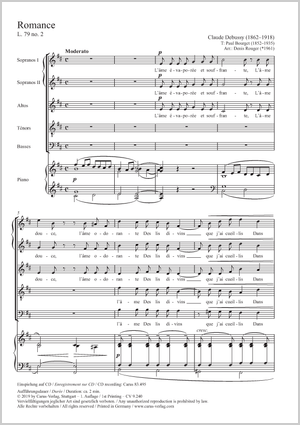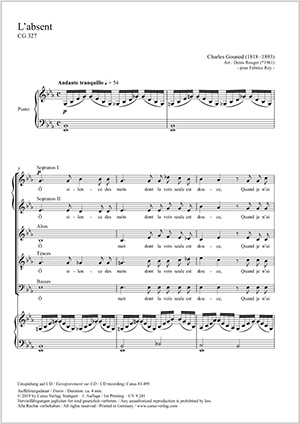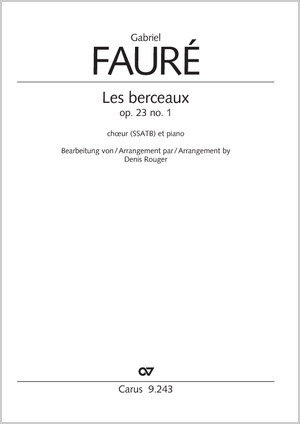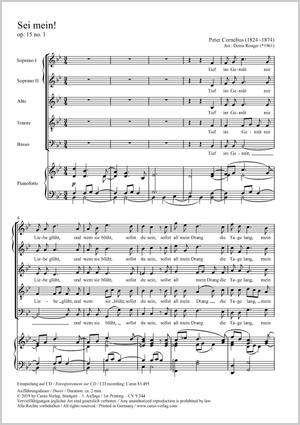
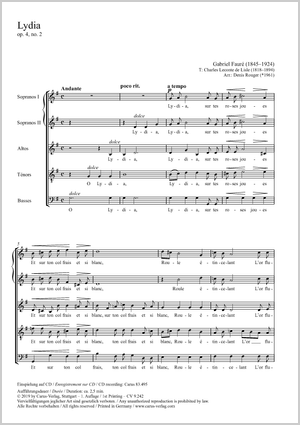
Gabriel Fauré’s original setting of Lydia contains a piano accompaniment which is largely written colla voce – following the vocal part. In Denis Rouger’s arrangement this is omitted, and by contrast the peaceful, flowing character unfolds in a purely vocal texture. The dreamy ideas, full of longing, addressed to the beloved Lydia find their expression in a melody based on the Lydian mode – that is a major scale with a raised fourth.
This art song was originally composed not for chamber choir, but for solo voice and piano. Denis Rouger has carefully adapted it to suit the requirements and expressive possibilities offered by a larger ensemble, without losing the any of the qualities of the original in the process. Each part in the choir has a melodic line drawn from the harmonic and rhythmic framework. In the process, the variety and refinement of the choral language combines with an enormous flexibility in form and expression, as French melodies or German art song demand from a soloist and pianist.
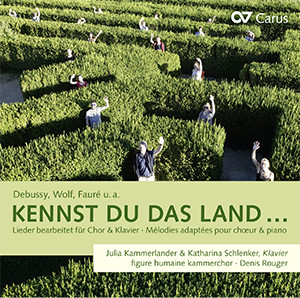
The songs have been recorded by the figure humaine chamber choir on the CD Kennst du das Land... (Carus 83.495/00).
Explore
 View
View
 Listen
(1)
Listen
(1)
- Lydia
 Practise
-
Pronouncing Aid
- Lydia
 Additional material
- Purchase additional material as a download product.
-
 Digital text (without sheet music) incl. printing licence, html file, singing text, originalhtml file, singing text, original (Sample)
Lydia, sur tes roses joues
Et sur ton col frais et si blanc,
Roule étincelant
L’or fluide que tu dénoues;Le jour qui luit est le meilleur,
Oublions l’éternelle tombe,
Laisse tes baisers de colombe
Chanter sur ta lèvre en fleur.Un lys caché répand sans cesse
Une odeur divine en ton sein ;
Les délices comme un essaim
Sortent de toi, jeune déesse.Je t’aime et meurs, ô mes amours,
Mon âme en baisers m’est ravie !
O Lydia, rends-moi la vie,
Que je puisse mourir toujours !Leconte de Lisle (1818–1894)
...
-
Digital text (without sheet music) incl. printing licence, html file, singing text, german translationhtml file, singing text, german translation (Sample)
Lydia, auf deinen rosigen Wangen
und auf deinem frischen und so weißen Hals
gleitet schimmernd
das flüssige Gold, das du löst.Der strahlende Tag ist der schönste,
lass uns das ewige Grab vergessen,
lass deine Turteltaubenküsse
auf deiner blumigen Lippe singen.Eine versteckte Lilie verströmt ununterbrochen
einen göttlichen Geruch in deinem Busen;
die Wonnen strömen wie ein Schwarm
aus dir, junge Göttin.Ich liebe dich und sterbe, oh meine Liebe,
meine Seele wird mir durch Küsse entzogen!
Oh Lydia, gib mir das Leben zurück,
damit ich immerzu sterben kann!Leconte de Lisle (1818–1894)
Übersetzung: Christiane Rouger-Ortwein...
Purchase
Additional product information
-
Composer
Gabriel Fauré
| 1845-1924French composer, 1845-1924.
He was a pupil of Camille Saint-Saëns and studied at the Paris School of Sacred Music. Fauré worked as an organist and choirmaster and gave piano lessons and recitals in Parisian salons. He was able to improvise brilliantly on the piano, which is also reflected in his compositions. He was director of the Paris Conservatoire from 1905 to 1920.
Fauré mainly wrote vocal, piano and chamber music. He is best known for his piano songs for solo voice and his Requiem, which was also performed at his own funeral service.
Personal details
-
Songwriter / Librettist
Charles Leconte de Lisle
-
Arranger
Denis Rouger
| 1961Denis Rouger gained his initial musical experience as the son of a Parisian family of musicians and during his studies at the Conservatoire National Supérieur de Musique de Paris, where he received first prizes in harmony, fugue and counterpoint.
He was a lecturer and choirmaster at the University of Paris-Sorbonne for 20 years and choirmaster at Notre-Dame de Paris Cathedral for 10 years. He is honorary conductor of the Parisian church La Madeleine. He also collaborates with numerous ensembles in Germany. He has been invited as a guest conductor by radio choirs, the Balthasar-Neumann-Chor, the Baden-Württemberg State Youth Choir and the Stuttgart Philharmonic Orchestra, among others. Concerts have taken him to Italy, the Netherlands, Canada, Russia, the United Arab Emirates and Switzerland (Lucerne Festival).
He gives master classes in Sweden, Bulgaria, France, Germany, as well as in Switzerland.
Denis Rouger has been Professor of Choral Conducting at the Stuttgart State University of Music and Performing Arts since 2011. The chamber choir he founded at the university in the fall of 2011 won first prize at the International Choir Competition in Mosbach (Germany) in 2014.
In addition to his work as a choirmaster, he composes and arranges French and German songs for choir. His arrangements on the CDs Kennst Du das Land ... and ... wo die Zitronen blühn (Carus) were well received by the press and radio. In collaboration with Carus-Verlag, he has edited the choir book Französische Chormusik, which received the German Music Edition Award “Best Edition” in 2019.
In 2016, Denis Rouger founded the figure humaine kammerchor (www.figurehumaine.de), with which he regularly gives concerts at renowned festivals.
Personal details
Reviews on our website can only be submitted by customers with a registered user account. A check whether the rated products were actually purchased does not take place.
No feedback available for this product.
Frequent questions about this work
 There are no questions and answers available so far or you were unable to find an answer to your specific question about this work? Then click here and send your specific questions to our Customer Services!