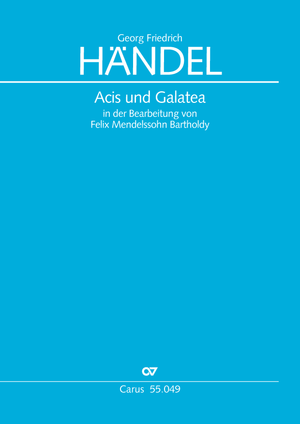

In honor of the joint commemorative years for Handel and Mendelssohn in 2009, Mendelssohn’s arrangement of Handel’s Acis and Galatea will be published in cooperation with the Handel Society of Göttingen. This setting of the love story from Greek mythology was among Handel’s most frequently performed works during the lifetime of the master. The interest in this work continued following his death, and in making their arrangements of it, no less than Wolfgang Amadeus Mozart and Felix Mendelssohn Bartholdy concerned themselves intensely with this work. Whereas the Mozart version of the oratorio was published in 1788 and found a widespread dissemination, until now Mendelssohn’s version has been handed down only in handwritten form. Yet the more recent version is no less impressive than the older one. Through the addition of various wind instruments Mendelssohn achieved an enormously colorful orchestral sound which effective illustrated the dramatic plot, and even dramatized it in some cases. The entirely spacial interpretation by the barely twenty-year-old composer is based on the text of a then unknown German translation of the original text. Initial study of the partial autograph which has been handed down shows that Fanny, Felix’s sister, also worked on the translation of the text. The singing text in the edition will be printed in both English and German.
Explore
 View
View

 Listen
(29)
Listen
(29)
- Purchase the work as a CD or download.
- Ouverture
- Coro: Oh wie reizend ist dies Tal
- Recit. (Galatea): Du grüne Flur
- Aria (Galatea): Schweig, oh luft’ger Sängerchor
- Aria (Acis): Wo find ich dich
- Recit. (Damon): Sei wachsam, Hirt
- Aria (Damon): Junger Hirt, du suchst vergebens
- Recit. (Acis): Geliebte, sieh, oh Galatea
- Aria (Acis): Lieb’ in den Blicken wohnet
- Recit. (Galatea): Oh kenntest du der Trennung bitt’re Pein
- Duetto (Galatea, Acis): Selig Glück
- Coro: Selig Glück
- Coro: Unglücksel’ge, das Geschick
- Recit. (Polyphem): Ich rase
- Aria (Polyphem): Du röter als die Kirsche
- Recit. (Polyphem, Galatea): Willst du, Schönste, nicht verweilen
- Aria (Polyphem): Wohl das Flehen will ich lassen
- Aria (Damon): Liebe kannst du nur gewinnen
- Recit. (Acis): Des Riesen Lieb
- Aria (Acis): Auf in den Kampf
- Aria (Damon): Sieh, törichter Schäfer
- Recit. (Galatea): Still, o still, du holder Knab
- Trio (Galatea, Acis, Polyphem): Den Berg verlässt die Herde
- Recit. (Acis): Hilf, Galatea!
- Coro: Weint all ihr Musen
- Aria con coro (Galatea, TTBB): Muss ich dem Teuren Klage weihn
- Recit. (Galatea): Wohlan, so üb ich Göttermacht an dir
- Aria (Galatea): Herz, der süßen Liebe Bild
- Coro: Galatea, trau’re nicht
Purchase
Additional product information
Contents

-
Composer
Georg Friedrich Händel
| 1685-1759George Frideric Handel put his exceptionally versatile compositional abilities to the test at an early age. After moving to London in 1712, where he was appointed Composer of Musick for His Majesty’s Chapel Royal in 1723, he wrote numerous masterpieces for the royal court as well as his major opere serie. For many years he enjoyed triumphant successes with his operas, which were sung by outstanding performers, with serenades, and later also with oratorios such as Saul and Israel in Egypt. Over the years Handel’s reputation grew far beyond the city where he worked; some of his choral works, particularly Messiah, have enjoyed a performance tradition which remains unbroken to this day, and are sung by choirs throughout the world. Personal details
-
Arranger
Felix Mendelssohn Bartholdy
| 1809-1847Felix Mendelssohn Bartholdy (1809–1847) is regarded as one of the most important composers of the Romantic period. His compositions combine the formal clarity of the Viennese Classical period with the heightened expressiveness of the 19th century. His engagement with the music of Johann Sebastian Bach was particularly influential; he played a key role in its rediscovery through the performance of the St Matthew Passion in 1829.
Among his best-known vocal works are his two oratorios, Paulus and Elias, as well as his chorale cantata Verleih uns Frieden gnädiglich. Furthermore, Mendelssohn worked as a conductor, pianist and music teacher, and made a significant contribution to the professionalisation of the concert scene and to the development of the Leipzig Conservatoire. His work occupies a central position in 19th-century music history and combines a sense of tradition with Romantic sound aesthetics.
Personal details
Reviews on our website can only be submitted by customers with a registered user account. A check whether the rated products were actually purchased does not take place.
No feedback available for this product.
Frequent questions about this work
 There are no questions and answers available so far or you were unable to find an answer to your specific question about this work? Then click here and send your specific questions to our Customer Services!