

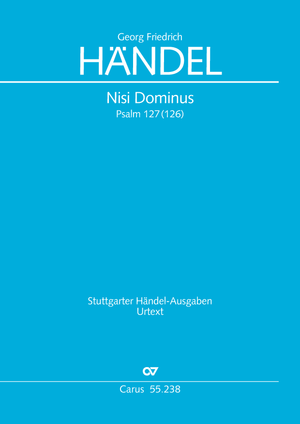
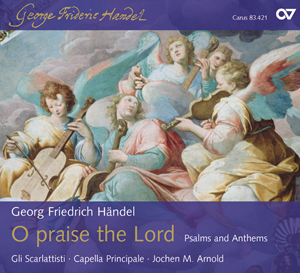
The psalm setting Nisi Dominus is in the style of the concertante polychoral motet, particularly developed in Italy in the late Baroque period. Use in a liturgical context calls for a certain conciseness and simplicity in the musical setting, nevertheless Handel’s distinctive compositional technique, with its fast-moving, long coloratura passages, is clearly recognizable. A further challenge for the choral singers is in the first movement, where there are rapid alternations between choral and solo sections.
Experience choral music. Anytime. Anywhere.
At home and out and about: Straight away your choral works will always be with you to practice! With carus music, the new choir app, you can follow the music whilst listening to a top-class recording on your smartphone or tablet, and easily practice your own choral part with the help of a coach. With carus music, your concert preparation will be easy and efficient to master – and fun!
Performers: Iris-Anna Deckert (soprano), Susan Eitrich (soprano), Franz Vitzthum (alto), Andreas Weller (tenore), Jens Hamann (basso) – Gli Scarlattisti, Capella Principale – Jochen M. Arnold
Experience choral music. Anytime. Anywhere.
At home and out and about: Straight away your choral works will always be with you to practice! With carus music, the new choir app, you can follow the music whilst listening to a top-class recording on your smartphone or tablet, and easily practice your own choral part with the help of a coach. With carus music, your concert preparation will be easy and efficient to master – and fun!
Performers: Iris-Anna Deckert (soprano), Susan Eitrich (soprano), Franz Vitzthum (alto), Andreas Weller (tenore), Jens Hamann (basso) – Gli Scarlattisti, Capella Principale – Jochen M. Arnold
Explore
 Listen
(6)
Listen
(6)
- Nisi Dominus
- Vanum est nobis
- Cum dederit dilectis
- Sicut sagittae
- Beatus vir
- Gloria Patri
 Additional material
- Purchase additional material as a download product.
-
 Digital text (without sheet music) incl. printing licence, html file, singing text, originalhtml file, singing text, original (Sample)Chor
Nisi Dominus aedificaverit domum,
in vanum laboraverunt qui aedificant eam.
Nisi Dominus custodierit civitatem,
frustra vigilat qui custodit eam. Arie TenorVarum est vobis ante lucem surgere,
surgite postquam sederitis,
qui manducatis panem doloris. Arie AltCum dederit dilectis suis somnum:
Ecce haereditas Domini, Filii,
merces fructus ventis. Arie BassSicut sagittae in manu potentis:
Ita Filii excussorum. Arie TenorBeatus vir qui implevit desiderium suum ex ipsis,
Non confundetur cum loquetur inimicis suis in porta. Chor...
-
Digital text (without sheet music) incl. printing licence, html file, singing text, english translationhtml file, singing text, english translation (Sample)Choir
Except the Lord build the house,
Aria Tenore
they labour in vain that build it:
except the Lord keep the cite,
the watchman waketh but in vain.It is vain for you to rise up early,
Aria Alto
to sit up late, to eat the bread of sorrows:For so he giveth his beloved sleep.
Aria Basso
Lo, children are an heritage of the Lord:
and the fruit of the womb is his reward.As arrows are in the hand of a mighty man;
Aria Tenore
so are children of the youth.Happy is the man that hath his quiver full of them:
Choir
they shall not be ashamed,
but they shall speak with the enemies in the gate.Glory be to the Father, and to the Son, and to the Holy Ghost.
As it was in the beginning, is now, and ever shall be, World without end. Amen.King James Bible
...
-
Digital text (without sheet music) incl. printing licence, html file, singing text, german translationhtml file, singing text, german translation (Sample)Chor
Wenn der Herr ein Haus nicht erbaut,
Arie Tenor
so mühen sich vergebens, die es erbauen.
Wenn der Herr eine Stadt nicht beschützt,
so wacht umsonst, wer sie beschützt.Vergebens ist es, dass ihr vor Sonnenaufgang aufsteht.
Arie Alt
Steht auf! Nachher sitzt ihr doch,
die ihr das Brot der Sorge kaut,Während er es denen, die er liebt, im Schlafe gibt.
Arie Bass
Siehe! das Erbe des Herrn sind Söhne,
eine Gnade die Frucht des Leibes.Wie Pfeile in der Hand des Starken,
Arie Tenor
so sind die Kinder der Aufrechten.Glücklich der Mann, dessen Sehnen durch sie erfüllt wird,
Chor
er wird nicht zugrunde gehen, wenn er mit seinen Feinden im Tore verhandelt....
Purchase
Additional product information
Contents

-
Composer
Georg Friedrich Händel
| 1685-1759George Frideric Handel put his exceptionally versatile compositional abilities to the test at an early age. After moving to London in 1712, where he was appointed Composer of Musick for His Majesty’s Chapel Royal in 1723, he wrote numerous masterpieces for the royal court as well as his major opere serie. For many years he enjoyed triumphant successes with his operas, which were sung by outstanding performers, with serenades, and later also with oratorios such as Saul and Israel in Egypt. Over the years Handel’s reputation grew far beyond the city where he worked; some of his choral works, particularly Messiah, have enjoyed a performance tradition which remains unbroken to this day, and are sung by choirs throughout the world. Personal details
-
Ensemble
Capella Principale
The Capella Principale consists of musicians of various nationalities who have joined forces under Thorsten Bleich’s direction to perform early music projects on a regular basis. Their collaborations began with the performance in 1999 of the complete works of Carlo Farina for string ensemble and basso continuo. The members of the ensemble share a mutual interest in works ranging from early baroque to modern, and great importance is attached to the question of the appropriate instruments. Many of the players also perform with noted European Baroque orchestras. Personal details
-
Ensemble
Gli Scarlattisti
The vocal ensemble Gli Scarlattisti was founded in 1995 by Jochen M. Arnold. It comprises professional singers from Germany and Switzerland. The Scarlattisti are usually accompanied by a continuo group of four instrumentalists or the Baroque orchestra Capella Principale (Director: Thorsten Bleich). The group’s first recording was released in 1998, containing the Musikalische Exequien and three motets from the Geistliche Chormusik (1648) by Heinrich Schütz. This was followed by a recording of Monteverdi’s Vespers of the Blessed Virgin in the continuo version, as well as vesper psalms by Johann Rosenmüller (Vespro Veneziano) in 2001. A recording of Scarlatti’s ten-part setting of the Stabat Mater was released in 2006 together with Arnold’s Diptychon secundum Iohannem. This was fol lowed by an internationally-acclaimed CD of Latin and English cantatas and anthems by G. F. Handel under the title O praise the Lord on the Carus label, then in 2010 by a recording of the complete motets of J. S. Bach. The ensemble regularly undertakes concert tours, and in recent years has also taken part in radio broadcasts, performed at renowned concert series (Stuttgart, Nürnberg, Berlin, Celle, Frankfurt, Torgau, St. Gallen, among others) and participated in the Deut scher Evangelischer Kirchentag (German Protestant Church Congress) in Hanover and Cologne (TV). The repertoire of Gli Scarlattisti ranges from the Renaissance to the modern. One critic described the ensemble as the “crème de la crème of the early music scene in southern Germany.” Personal details
-
Conductor
Jochen Arnold
Jochen Arnold, born 1967 in Marbach/Neckar, studied Protestant theology in Tübingen and Rome and church music in Stuttgart (advanced diploma), where his teachers included Werner Jacob (organ), and Dieter Kurz and Helmut Wolf (conducting). He was a curate and Kantor in Reutlingen, obtained a doctorate at the University of Tübingen, qualified as a university lecturer in interdisciplinary subjects on the theology of Bach’s cantatas, and since 2008 hee has been a non-faculty lecturer at the University of Leipzig. In 2004 he became director of St Michael’s Monastery Hildesheim, part of the Protestant- Lutheran Regional Church of Hanover, with a special responsibility for the theology of services, liturgy in worship, teaching how to preach, and conducting. He has extensive concert experience as conductor of the ensemble Gli Scarlattisti with numerous radio and CD productions. His repertoire ranges from the medieval to the present. Jochen Arnold also conducts the Collegium Musicum Hildesheim and the chorus of the University of Hildesheim. He lectures in choral conducting and Protestant theology. Personal details
-
Soloist - soprano
Iris-Anna Deckert
The soprano Iris-Anna Deckert studied in Augsburg, Berlin and London with, among others, Dorothea Chryst, Edith Urbanzcyk and Jessica Cash. She is an internationally sought after freelance concert singer with a wide-ranging repertoire of both oratorios and Lieder. In 1994 she was awarded the scholarship of the Deutscher Bühnenverein. She has frequently appeared at major European festivals. Her artistic versatility is documented on numerous radio and CD recordings. Personal details
-
Soloist - soprano
Susan Eitrich
The soprano Susan Eitrich studied singing with Richard Wistreich at the Institute of Early Music attached to Trossingen Musikhochschule. A diploma was followed by further studies which she completed with honors. She also attended master courses given by Richard Levitt, Emma Kirkby, Jill Feldman and others. In 2001 she was awarded a first prize at the Gorizia (Italy) singing competition. As well as performing extensively in oratorios and cantatas, Susan Eitrich gives song recitals. Her work is documented on CD and radio recordings. Personal details
-
Soloist - alto
Franz Vitzthum
FThe former Regensburger Domspatz Franz Vitzthum received his vocal studies with Kai Wessel in Cologne. He regularly appears as a guest at international festivals and has worked together with such conductors as Nicolas McGegan, Hermann Max, Marcus Creed and Philippe Herreweghe. As a much sought-after chamber musician, he performs concerts together with the lutenist Julian Behr, the Capricornus Consort Basel and his vocal ensemble Stimmwerck. Personal details
-
Soloist - tenor
Andreas Weller
-
Soloist - bass
Jens Hamann
Jens Hamann was a member of the Stuttgart Hymnus Boys’ Choir, the Kammerchor Stuttgart and the Gächinger Kantorei. After vocal studies with Rudolf Piernay in Mannheim, the baritone was awarded Saarland Radio’s “Special Early Music Award” in 2006. The world premiere recording of Michael Haydn’s Requiem (Carus 83.353), on which he sang, was honored with the 2007 MIDEM Classical Award. In the oratorio field he works with Helmuth Rilling, Georg Grün and Ralf Otto, and he has appeared as a guest at the Stuttgart European Music Festival and the Opernschlossfestspiele Hallwyl. Personal details
Reviews on our website can only be submitted by customers with a registered user account. A check whether the rated products were actually purchased does not take place.
No feedback available for this product.
Frequent questions about this work
 There are no questions and answers available so far or you were unable to find an answer to your specific question about this work? Then click here and send your specific questions to our Customer Services!