

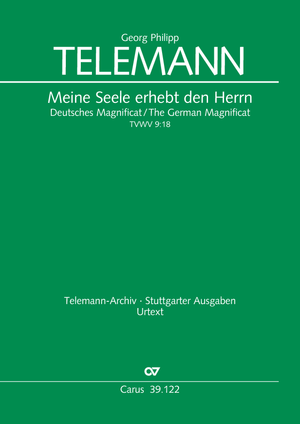
All my spirit exalts
Deutsches Magnificat TVWV 9:18
As one of the three canticles from the New Testament, the Magnificat – the Canticle of Mary – has at all times held a prominent position in church music. Telemann’s setting of Luther’s German translation of the text bears eloquent witness both to the composer’s rich imagination and to his ability to mold a variety of musical shapes into a coherent formal Baroque architecture. Four solo movements with colorfully contrasting instrumentation are juxtaposed with four emphatically homogeneous choral movements; all of the latter are in 6/8 meter and in motet setting with instruments doubling colla parte. Particularly the choral movements are characterized by lively text portrayal and a wealth of at times dramatic imagery. A work of exceptional magnetism for both listeners and choir singers!
Explore


 Listen
(8)
Listen
(8)
- Tutti: Meine Seele erhebt den Herrn
- Solo (S): Denn er hat seine elende Magd
- Tutti: Denn er hat große Dinge an mir getan
- Solo (A): Und seine Barmherzigkeit währet
- Tutti: Er übet Gewalt mit seinem Arm
- Solo (T): Die Hungrigen füllet er
- Solo (B): Wie er geredt hat unsern Vätern
- Tutti: Lob und Preis sei Gott
Purchase
Additional product information
Contents
-
Composer
Georg Philipp Telemann
| 1681-1767Telemann's extremely rich compositional output, the fruits of three quarters of a century's work, encompasses almost all genres of music; in his vocal works it ranges from songs with basso continuo accompaniment to chamber and church cantatas, and to opera. In his own assessment, church music played a central role in his output; he alone probably composed over 1,600 church cantatas, as well as cantata-style funeral music settings (such as Du aber, Daniel, gehe hin), psalm settings (for example, Deus judicium tuum) and oratorios. Throughout his works Telemann showed himself to be a progressive composer, open to new trends and keen to experiment whilst exploring new directions; not without reason was he called a forerunner of classicism. However, his compositions constitute only a part of his importance to music history: as a music publisher, the author of publications for teaching, the director of middle-class music societies and initiator of public concerts, he made a considerable contribution to creating the preconditions for the support of the musically-educated middle classes in the ensuing era of music. Personal details
-
Editor
Klaus Hofmann
| 1939
-
Continuo realization
Klaus Hofmann
| 1939
-
Translator
Jean Lunn
Reviews on our website can only be submitted by customers with a registered user account. A check whether the rated products were actually purchased does not take place.
No feedback available for this product.
Frequent questions about this work
 There are no questions and answers available so far or you were unable to find an answer to your specific question about this work? Then click here and send your specific questions to our Customer Services!