Herr, lehre uns bedenken
Kantate zum 16. Sonntag nach Trinitatis TVWV 1:763 TVWV 1:763, 1720
Special instrumentations inspired Telemann’s imagination. In the cantata “Herr, lehre uns bedenken” from 1720, he linked the opening chorus and the two arias with concertante parts for a viola d’amore. Well aware, however, that the rare string instrument would not be available everywhere, he considered a substitute solution from the outset and assigned the parts alternatively to the recorder.
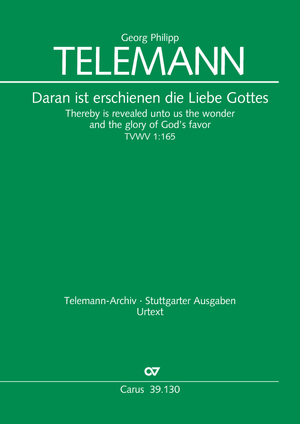
Our edition allows performance using either viola d’amore (or viola) and recorder. It thus expands the cantata repertoire by a work of exquisite instrumental scoring. Recorder players will find it especially welcome as a representative sister composition to Telemann’s similarly conceived Pentecost cantata “Daran ist erschienen die Liebe Gottes” (Carus 39.130).


-
Composer
Georg Philipp Telemann
| 1681-1767Telemann's extremely rich compositional output, the fruits of three quarters of a century's work, encompasses almost all genres of music; in his vocal works it ranges from songs with basso continuo accompaniment to chamber and church cantatas, and to opera. In his own assessment, church music played a central role in his output; he alone probably composed over 1,600 church cantatas, as well as cantata-style funeral music settings (such as Du aber, Daniel, gehe hin), psalm settings (for example, Deus judicium tuum) and oratorios. Throughout his works Telemann showed himself to be a progressive composer, open to new trends and keen to experiment whilst exploring new directions; not without reason was he called a forerunner of classicism. However, his compositions constitute only a part of his importance to music history: as a music publisher, the author of publications for teaching, the director of middle-class music societies and initiator of public concerts, he made a considerable contribution to creating the preconditions for the support of the musically-educated middle classes in the ensuing era of music. Personal details
-
Editor
Klaus Hofmann
| 1939
Reviews
Eine große Bereicherung für das Konzert- und Gottedienstrepertoire!
ChorZeit, April 2022
Reviews on our website can only be submitted by customers with a registered user account. A check whether the rated products were actually purchased does not take place.
Frequent questions about this work
 There are no questions and answers available so far or you were unable to find an answer to your specific question about this work? Then click here and send your specific questions to our Customer Services!