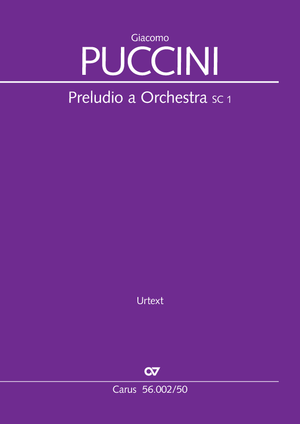
Preludio a orchestra
1876
The missing piece: Puccini's Preludio a Orchestra, one of the composer's earliest surviving works, is now at last available in an authentic, complete version! For a long time this piece was known only from a single fragmentary source with a passage missing from the middle section. But a few years ago a previously unknown manuscript was discovered in the Puccini Archive in Torre del Lago, and this was ultimately recognized as the autograph score of the Preludio a Orchestra. And it turned out that the score contains the complete work! So now Puccini's “Op. 1”, this remarkable testimony to his very early creative period, rich in formal, melodic and harmonic inventiveness, can be performed in its original form for the very first time!
The scores are available for hire and as a preprint.


-
Composer
Giacomo Puccini
| 1858-1924Giacomo Puccini came from a dynasty of church musicians who worked in the Tuscan city of Lucca. His Messa a 4 con orchestra, premiered there in 1880, seemed to point him toward a career in the same direction, but directly after this, he went to Milan Conservatoire with the aim of becoming an opera composer. His only independent orchestral works were written there as student works – the Preludio sinfonico (1882) and Capriccio sinfonico (1883), as well as some of his 16 complete surviving songs for voice and piano (Canti), which he composed, with frequent references to his operas, almost throughout his career. He achieved a breakthrough as an opera composer with Manon Lescaut (1893); between 1893 and 1904 he composed La Bohème, Tosca and Madama Butterfly, which remain his most frequently-performed works today. In recent years there has been a growing realisation that Puccini's entire output requires reappraisal. And so, he has increasingly come to be understood as a musician searching for a way forward into the modern age. Personal details
-
Editor
Michele Girardi
| 1954-2025
Reviews on our website can only be submitted by customers with a registered user account. A check whether the rated products were actually purchased does not take place.
Frequent questions about this work
 There are no questions and answers available so far or you were unable to find an answer to your specific question about this work? Then click here and send your specific questions to our Customer Services!