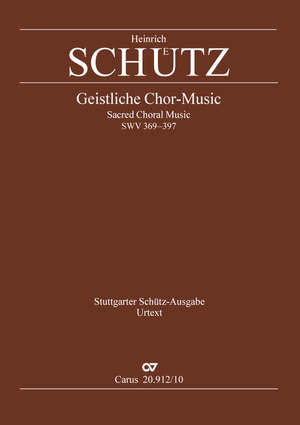
Stuttgarter Schütz-Ausgabe: Geistliche Chor-Music (Gesamtausgabe, Bd. 12)
29 Motetten für 5 bis 7 Stimmen und Generalbass (Paperback-Ausgabe) SWV 369–397 (Op. 11)
When it comes to paying tribute to Heinrich Schütz’s compositional achievement, in his art his treatment of the text and language must be mentioned first. The "Geistliche Chor-Music 1648", a collection of 29 motets for five to seven voices and one of his most important works, is characterized by the carefully thought-out musical realization of the meaning of the text. In his detailed foreword to the collection the composer presented these as models for composition without a basso continuo – it was his conviction that every young composer should obtain “the proper foundation for a good counterpoint.” Despite the strict counterpoint, stylistically speaking from an earlier era, the “Musicus poeticus” imbued his works with a strongly expressive character. The individual motets are structured differently and they differ - according to content - in their length and character.In addition to the clothbound edition of the Stuttgart Schütz Edition (Carus 20.912) the volume is now also available in a paperback edition. Separate editions available.
Explore


Purchase
Additional product information
-
Composer
Heinrich Schütz
| 1585-1672Heinrich Schütz is regarded as the first German musician of European stature. As a choirboy from 1599 at the court of Landgrave Moritz of Hessen-Kassel, he received a thorough education. In 1608 he began a law degree in Marburg, but broke this off in 1609 in order, with the support of the Landgrave, to study composition with Giovanni Gabrieli, organist at St Mark’s in Venice. In 1613 Schütz returned to Kassel, but two years later was enticed away by Elector Johann Georg I of Saxony to the Dresden court as “Organist und Director der Musica”, where he held the position of Hofkapellmeister (court Kapellmeister) from 1617 until his death. Schütz’s great cycles of vocal works marked the high point of his reputation in Germany and northern Europe. But these represent only part of Schütz’s output; individual works are represented in printed collections with works by other composers, others only survive in manuscript, and much has been lost. The Stuttgart Schütz Edition makes available Schütz’s complete oeuvre, and all works are also published in practical Urtext editions. Personal details
-
Editor
Michael Heinemann
| 1959
Reviews on our website can only be submitted by customers with a registered user account. A check whether the rated products were actually purchased does not take place.
No feedback available for this product.
Frequent questions about this work
 There are no questions and answers available so far or you were unable to find an answer to your specific question about this work? Then click here and send your specific questions to our Customer Services!