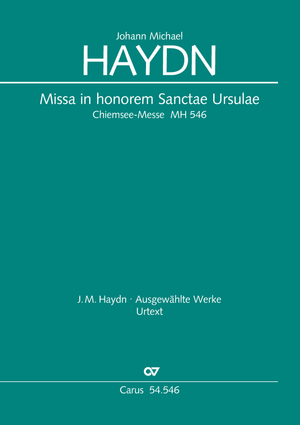
Missa in honorem Sanctae Ursulae
Chiemsee-Messe MH 546, 1793
Among Haydn’s over thirty settings of the Latin Ordinary, the Missa in honorem Sanctae Ursula occupies an outstanding position, which, according to the autograph, was completed on 5 August 1793. This Mass has been referred to as the most “Mozartian” of all his masses. With its song-like melodic character, the unity of the motivic material and the harmonius balance between festive and reflective sections this Mass is one of Haydn’s most successful and inspired works. This work, which in addition to the usual Salzburg “church trio” includes two trumpets and timpani, belongs to the category of “Missa solemnis.” The popular nickname Chiemsee-Messe is bound up with the history of the origins of the work. Haydn wrote the Mass for the musically gifted nun, Sebastiana Oswald, who belonged to the Benedictine cloister of Frauenchiemsee. This work soon found widespread acceptance beyond the originally intended sphere of its origins, as is indicated by the numerous copies found in Austrian convents.
Purchase
Additional product information
-
Composer
Johann Michael Haydn
| 1737-1806Johann Michael Haydn worked at the renowned ecclesiastical princely court in Salzburg from 1763. Stylistically, he bridged the gap between the early classical period and the Biedermeier period during his 43 years there. In accordance with his official duties, Haydn contributed to practically all the genres cultivated in the Catholic liturgy: Haydn's church music is characterised by his knowledge of the liturgical function and the musical interpretation of religious texts. Johann Michael Haydn was initially regarded by his contemporaries as equal to Joseph Haydn. It was only the rapid rise of his elder brother to become the most important instrumental composer of the time that pushed Johann Michael Haydn into the shadows, from which the joy of musical discovery in recent years has increasingly brought him out. Personal details
Reviews on our website can only be submitted by customers with a registered user account. A check whether the rated products were actually purchased does not take place.
No feedback available for this product.
Frequent questions about this work
 There are no questions and answers available so far or you were unable to find an answer to your specific question about this work? Then click here and send your specific questions to our Customer Services!