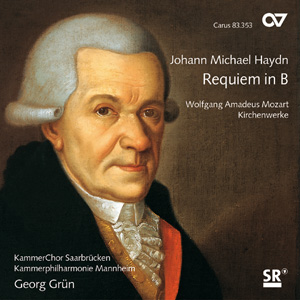
The Requiem in B flat major is Johann Michael Haydn’s second setting of the liturgical text of the Mass of the dead (another Requiem, MH 599, has since been identified as the work of Father Georg Pasterwiz) and it is also his last work, his “Opus ultimum.” On commission from Empress Maria Theresia he began the composition in 1805, but due to a serious illness he made only slow progress with the work. Like W. A. Mozart, he could not complete this Requiem. In 1839 Father Gunther Kronecker, Benedictine Father in the monastery of Kremsmünster in Upper Austria, completed the torso “in the spirit and style” of Haydn. Kronecker’s melodic writing ranges from a lyrical to a folk-song-like character. In harmonic development he shows himself to be a composer of the Viennese Biedermeier era, strongly influenced by Franz Schubert.
Explore
 Listen
(15)
Listen
(15)
- Requiem aeternam
- Kyrie
- Dies irae
- Liber scriptus
- Rex tremendae
- Recordare
- Confutatis
- Lacrimosa
- Domine Jesu
- Hostias et preces
- Sanctus
- Benedictus
- Agnus Dei
- Lux aeterna
- Cum Sanctis tuis
 Additional material
- Purchase additional material as a download product.
-
 Digital text (without sheet music) incl. printing licence, html file, singing text, originalhtml file, singing text, original (Sample)
Introitus 1. Requiem aeternam (Solo S, Coro) Requiem aeternam dona eis, Domine:
et lux perpetua luceat eis.
Te decet hymnus, Deus, in Sion,
et tibi reddetur votum in Jerusalem:
exaudi orationem meam,
ad te omnis caro veniet.
Requiem aeternam dona eis, Domine:
et lux perpetua luceat eis.2. Kyrie (Coro) Kyrie eleison.
Christe, eleison.
Kyrie eleison.Sequenz 3. Dies irae (Soli SA, Coro) Dies irae, dies illa
solvet saeclum in favilla:
teste David cum Sibylla.
Quantus tremor est futurus,
...
-
Digital text (without sheet music) incl. printing licence, html file, singing text, english translationhtml file, singing text, english translation (Sample)
Introitus 1. Requiem aeternam (Solo S, Coro) Lord, grant them eternal rest,
and let the perpetual light shine upon them.
Thou shalt have praise in Zion, oh God,
and homage shall be paid to Thee in Jerusalem.
Hear my prayer.
All flesh shall come before Thee.
Lord, grant them eternal rest,
and let the perpetual light shine upon them.2. Kyrie (Coro) Lord, have mercy upon us.
Christ, have mercy upon us.
Lord, have mercy upon us.Sequenz 3. Dies irae (Soli SA, Coro) This day, this day of wrath
shall consume the world in ashes,
as foretold David and the Sibyl.
What trembling there shall be
...
-
Digital text (without sheet music) incl. printing licence, html file, singing text, german translationhtml file, singing text, german translation (Sample)
Introitus 1. Requiem aeternam (Solo S, Coro) Gib ihnen die ewige Ruhe, Herr,
und das ewige Licht leuchte ihnen.
Dir gebührt ein Lobgesang, Gott, in Zion,
und dir erfülle man sein Gelübde in Jerusalem.
Erhöre mein Gebet.
Zu dir kommt alles Fleisch.
Gib ihnen die ewige Ruhe, Herr,
und das ewige Licht leuchte ihnen.2. Kyrie (Coro) Herr, erbarme dich.
Christus, erbarme dich.
Herr, erbarme dich.Sequenz 3. Dies irae (Soli SA, Coro) Tag des Zornes, jener Tag
legt die Welt in glühende Asche,
wie David und die Sibylle bezeugen.
Welch ein Beben wird herrschen,
...
-
Digital text (without sheet music) incl. printing licence, html file, Introductory text, frenchhtml file, Introductory text, french (Sample)Texte du CD Carus 83.353
Armin Kircher
« Tout amateur de musique et de sa littérature sait [...] que Michael Haydn, en tant que compositeur d’église, compte parmi les premiers du genre [...] », écrit avec enthousiasme le poète et compositeur romantique E. T. A. Hoffmann dans la revue musicale Leipziger Allgemeine Musikalische Zeitung (1812). Johann Michael Haydn naquit le 13 septembre 1737 à Rohrau (Basse-Autriche) et, comme son frère aîné de cinq ans Joseph, accomplit sa formation musicale à la maîtrise de la cathédrale Saint-Étienne de Vienne. Après un premier emploi auprès de l’évêque de Großwardein (aujourd’hui Oradea à la frontière roumano-hongroise), il s’établit en 1763 à Salzbourg où il resta au service de la cour des princes archévêques jusqu’à sa mort. A partir de 1780, sa création se concentra de la musique instrumentale sur le domaine vocal, surtout la musique
Traduction (abrégé) : Sylvie Coquillat...
-
Digital text (without sheet music) incl. printing licence, html file, Introductory text, englishhtml file, Introductory text, english (Sample)Text from the CD Carus 83.353
Armin Kircher
Translation (abridged): John Coombs“Everyone with knowledge of music and its literature knows [...] that Michael Haydn, as a composer for the church, is one of the finest artists in this field […],” wrote the romantic poet-composer E. T. A. Hoffmann almost euphorically in the Leipziger Allgemeine Musikalische Zeitung (1812). Johann Michael Haydn was born on 13 September 1737 at Rohrau (Lower Austria), and like his brother Joseph, who was five years older, he was trained musically at the choir school of St. Stephan’s in Vienna. After a first appointment under the Bishop of Grosswardein (now Oradea on the Romanian-Hungarian border) he went in 1763 to Salzburg, where he remained in the service of the prince-Archbishop’s Court until his death. From 1780 onwards, however, the emphasis of his compositional output was on vocal rather than instrumental music, especially
...
-
Digital text (without sheet music) incl. printing licence, html file, Introductory text, germanhtml file, Introductory text, german (Sample)Booklet-Text der CD Carus 83.353
Armin Kircher
„Jeder Kenner der Tonkunst und ihrer Literatur weiß, und wußte schon längst, daß Michael Haydn, als Kirchenkomponist, unter die ersten Künstler dieses Faches, aus jeder Zeit und jeder Nation gehört“, schreibt der romantische Dichter-Komponist E. T. A. Hoffmann geradezu euphorisch in der Leipziger Allgemeinen Musikalischen Zeitung (1812) über die Bedeutung des „Salzburger Haydn“. Geboren wurde Johann Michael Haydn am 13. September 1737 in Rohrau/Niederösterreich, und wie sein um fünf Jahre älterer Bruder Joseph wurde er im Kapellhaus zu St. Stephan in Wien musikalisch ausgebildet. Nach einer ersten Anstellung beim Bischof in Großwardein (heute Oradea, eine Stadt an der rumänisch-ungarischen Grenze), kam er 1763 nach Salzburg, wo er bis zu seinem Tod am fürsterzbischöflichen Hof bedienstet war, anfänglich als Konzertmeister, seit 1782 in der Nachfolge Mozarts
...
Purchase
Additional product information
Contents
-
Composer
Johann Michael Haydn
| 1737-1806Johann Michael Haydn worked at the renowned ecclesiastical princely court in Salzburg from 1763. Stylistically, he bridged the gap between the early classical period and the Biedermeier period during his 43 years there. In accordance with his official duties, Haydn contributed to practically all the genres cultivated in the Catholic liturgy: Haydn's church music is characterised by his knowledge of the liturgical function and the musical interpretation of religious texts. Johann Michael Haydn was initially regarded by his contemporaries as equal to Joseph Haydn. It was only the rapid rise of his elder brother to become the most important instrumental composer of the time that pushed Johann Michael Haydn into the shadows, from which the joy of musical discovery in recent years has increasingly brought him out. Personal details
Reviews on our website can only be submitted by customers with a registered user account. A check whether the rated products were actually purchased does not take place.
No feedback available for this product.
Frequent questions about this work
 There are no questions and answers available so far or you were unable to find an answer to your specific question about this work? Then click here and send your specific questions to our Customer Services!