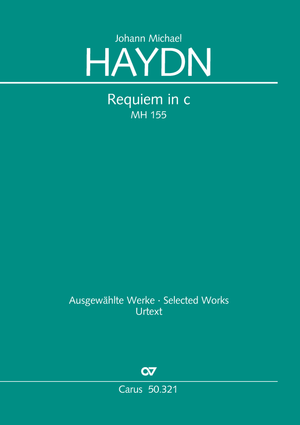
Requiem in C minor
MH 155, 1771



-
Composer
Johann Michael Haydn
| 1737-1806Johann Michael Haydn worked at the renowned ecclesiastical princely court in Salzburg from 1763. Stylistically, he bridged the gap between the early classical period and the Biedermeier period during his 43 years there. In accordance with his official duties, Haydn contributed to practically all the genres cultivated in the Catholic liturgy: Haydn's church music is characterised by his knowledge of the liturgical function and the musical interpretation of religious texts. Johann Michael Haydn was initially regarded by his contemporaries as equal to Joseph Haydn. It was only the rapid rise of his elder brother to become the most important instrumental composer of the time that pushed Johann Michael Haydn into the shadows, from which the joy of musical discovery in recent years has increasingly brought him out. Personal details
-
Editor
Charles H. Sherman
Reviews
Requiem in C Minor, Michael Haydn
Requiem in C Minor, Michael Haydn
This extended 45-minute Requiem in Latin was written for Archbishop Sigismundo in a two-week time span. The orchestra has no violas, but includes trumpets, trombones, timpani and continuo. There are nine movements and the soloists appear in seven of them, usually interspersed among the choral writing which is extensive. In Salzburg, two organs were used at that time for church music, one for the soloists and one for the tutti areas. Haydn wrote more than one Requiem, and this One, according to the editor Charles Sherman, is the ”first product of Haydn’s full maturity”. Excellent edition and repertoire for a mature choir.
Quelle: The Diapason, Feb. 1993, S. 7/8
Michael Haydn: REQUIEM IN C
Das Requiem zählt zu den bedeutendsten Kirchenwerken Michael Haydns. Es wurde anlässlich des Todes von Fürsterzbischof Sigismund, des großen Förderers von Haydn, komponiert. Bei seiner Aufführung wirkten auch Leopold und W. A. Mozart mit, und es wurde ein bleibender Eindruck für Wolfgang Amadeus, denn er nahm es als Vorbild für sein eigenes Requiem. Umfangreiche Hinweise zur Instrumentation und Aufführungspraxis des fünfundvierzigminütigen Werkes machen die hervorragende Ausgabe komplett.
Wolfgang Nickel
Quelle: Kirchenmusik im Bistum Limburg
Reviews on our website can only be submitted by customers with a registered user account. A check whether the rated products were actually purchased does not take place.
Frequent questions about this work
Die Besetzungsangabe lautet: 2 Clarini, 2 Trombe. Was ist der Unterschied zwischen Clarini und Trombe?
 There are no questions and answers available so far or you were unable to find an answer to your specific question about this work? Then click here and send your specific questions to our Customer Services!