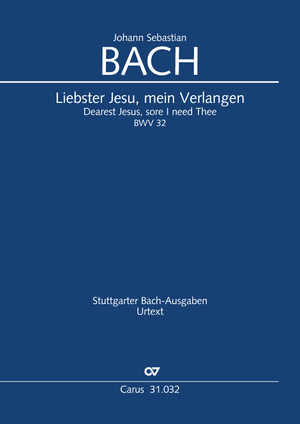
Dearest Jesus, sore I need Thee
Cantata for the 1st Sunday after Epiphany BWV 32, 1726
The text of the cantata "Dearest Jesus, sore I need Thee" for the 1st Epiphany Sunday 1726 was written by the Darmstadt poet Georg Christian Lehms. It is conceived as a dialog between Jesus and the Faithful Soul. Bach titled his cantata "Concerto in Dialogo" and accordingly, it is structured as a dialog between soprano and bass, set in the voice types that were – not only for Bach – typically used for the soul (soprano) and Jesus (bass). The cantata is based on the narrative of the twelve-year-old boy Jesus in the temple; however, in spite of closely following the gospel text, it is interpreted more widely here: it is through Jesus that the believer finds God’s dwelling. Bach creates a great arch from the opening aria full of yearning and searching through to the joyful duet "Nun verschwinden alle Plagen." He himself added the four-part closing chorale to the text model, thus communicating the sense of joyous certainty to the congregation of believers.
Explore
 View
View

 Additional material
- Purchase additional material as a download product.
-
 Digital text (without sheet music) incl. printing licence, html file, singing text, english translationhtml file, singing text, english translation (Sample)1 Aria (Soprano)
Dearest Jesus, sore I need Thee,
2 Recitativo (Basso)
tell me now, where art Thou gone?
Oh, where?
Wilt Thou be no more beside me?
Wilt Thou now no longer guide me?
Ah, my Lord, rejoice Thou me,
let me joyfully embrace Thee.How now is it that ye sought me?
3 Aria (Basso)
Wist ye not that I must be
about my Father’s bus’ness?Here my Father God abideth,
4 Recitativo (Soprano, Basso)
here is rest for troubled souls.
Here is peace and consolation,
here from Me no separation,
here have I my dwelling place.Ah, sanclified and mighty God,
...
-
Digital text (without sheet music) incl. printing licence, html file, singing text, originalhtml file, singing text, original (Sample)1 Aria (Soprano)
Liebster Jesu, mein Verlangen,
2 Recitativo (Basso)
sage mir, wo find' ich dich?
Wo, wo?
Soll ich dich so bald verlieren,
und nicht ferner bei mir spüren?
Ach, mein Hort, erfreue mich,
lass dich höchst vergnügt umfangen.Was ist’s, dass du mich gesuchet?
3 Aria (Basso)
Weißt du nicht, dass ich sein muss in dem,
das meines Vaters ist?Hier, in meines Vaters Stätte,
4 Recitativo (Soprano, Basso)
find't mich ein betrübter Geist.
Da kannst du mich sicher finden
und dein Herz mit mir verwinden,
weil dies meine Wohnung heißt.Ach, heiliger und großer Gott!
...
-
Digital text (without sheet music) incl. printing licence, html file, Introductory text, englishhtml file, Introductory text, english (Sample)Foreword of the Edition Carus 31.032
Karin Wollschläger
Translation: David KosvinerThe dialogue cantata Liebster Jesu, mein Verlangen (Dearest Jesus, sore I need Thee) BWV 32 was composed for the 1st Sunday after Epiphany, which was on 13 January 1726, and belongs to the third annual cycle of cantatas.
The Gospel reading (Luke 2:41–52) reports of Mary and Joseph’s search for their twelve-year-old son whom they then find in the temple in Jerusalem. The libretto upon which the cantata is based is taken from Gottgefälliges Kirchen-Opffer (1711) by Georg Christian Lehms (1684– 1717); it takes up the themes of longing, searching and reconciliation in the form of a dialogue between the “Soul” and “Jesus” – an allegory of the devout Christian and the incarnate divine Trinity. Therefore Bach, in the old Vox Christi tradition, logically allocates Jesus to the bass and not, as the Gospel reading about the twelveyear-old Jesus suggests, to the soprano (at Bach’s time, this would have been sung by a boy soprano). Musically logical reasons would also have caused Bach to do this as the Soul is customarily represented by a soprano, and a double allocation of this register would not only complicate the
...
-
Digital text (without sheet music) incl. printing licence, html file, Introductory text, germanhtml file, Introductory text, german (Sample)Vorwort aus der Ausgabe Carus 31.032
Karin Wollschläger
Die Dialogkantate Liebster Jesu, mein Verlangen BWV 32 wurde für den 1. Sonntag nach Epiphanias, den 13. Januar 1726 komponiert und gehört zum dritten Kantatenjahrgang. Die Evangelienlesung (Lk 2,41–52) berichtet von der Suche Marias und Josefs nach ihrem zwölfjährigen Sohn, den sie schließlich im Tempel von Jerusalem finden. Das zugrundeliegende Kantatenlibretto aus Georg Christian Lehms’ (1684–1717) Gottgefälliges Kirchen- Opffer von 17111 greift die Themen Sehnsucht, Suche und Zusammenfinden auf und hat die Gestalt eines Dialoges zwischen „Seele“ und „Jesus“ – eine Allegorie des gläubigen Christen und der Mensch gewordenen göttlichen Trinität. Folgerichtig besetzt Bach daher Jesus in alter Vox-Christi-Tradition mit dem Bass und nicht, wie es die Evangelienlesung über den zwölfjährigen Jesus nahe legt, dem Sopran, der ja zu Bachs Zeit von Knaben gesungen wurde. Auch musikalisch-logische Gründe werden Bach hierzu bewogen haben, denn schon die Seele wird üblicherweise vom Sopran dargestellt und eine Doppelbelegung dieser Stimmlage würde nicht nur die Unterscheidung von „Seele“ und „Jesus“ erschweren, sondern auch die
...
Purchase
Additional product information
-
Composer
Johann Sebastian Bach
| 1685-1750Johann Sebastian Bach is one of the most important composers of Western music history. He came from a widely ramified musical dynasty, which produced numerous musicians and organists in the Thuringian-Saxon area.
Bach vocal
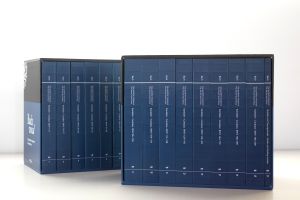
Ever since Carus-Verlag was founded in 1972, publishing the music of Johann Sebastian Bach has been a special focus for us. In the 2017 Reformation anniversary year we completed the Bach vocal project. Bach’s complete sacred vocal works are now available in modern “Urtext” editions, together with performance material. A complete edition of all the full scores is also available in a high quality box set.
Personal details
-
Editor
Hans Grischkat
| 1903-1977
-
Songwriter / Librettist
Georg Christian Lehms
-
Preface writer
Karin Wollschläger
Reviews on our website can only be submitted by customers with a registered user account. A check whether the rated products were actually purchased does not take place.
No feedback available for this product.
Frequent questions about this work
 There are no questions and answers available so far or you were unable to find an answer to your specific question about this work? Then click here and send your specific questions to our Customer Services!