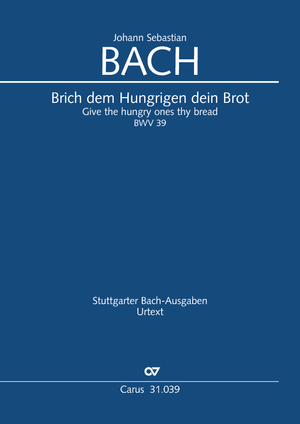
Give the hungry ones thy bread
Cantata for the 1st Sunday after Trinity BWV 39, 1726

The 1st Sunday after Trinity marked the beginning of the school year in Leipzig and thus for the Thomascantor the start of a new annual cantata cycle – completely breaking with the traditions of the time. This also explains the large-scale opening chorus of the cantata Brich dem Hungrigen dein Brot (Give the hungry ones Thy bread) written for the 1st Sunday after Trinity in 1726, whose orchestral accompaniment is entirely characterized by a sense of “breaking”: Punctuated chords wander through the voices. In complete contrast to the opening chorus, the rest of the cantata adopts a chamber-music style. All arias dispense with the string tutti; the central and most important of these, “Wohlzutun und mitzuteilen vergesset nicht” (Do thou good and help thy neighbour), is even composed as a simple continuo aria.
Explore


 Additional material
- Purchase additional material as a download product.
-
 Digital text (without sheet music) incl. printing licence, html file, singing text, english translationhtml file, singing text, english translation (Sample)??Part I 1 Coro Give the hungry ones thy bread,
and all those in misery bring to thy house;
and if thou the naked seeest,
then cover him
and hide not thyself
from thine own flesh.
And then shall thy light break forth
as the sun each morning riseth,
then thy health speedily prosper
and then shall thy righteousness
go onward before thee.
2 Recitativo (Basso) The Lord provides:
He pours His riches down on us.
Without this nothing here on earth would flourish.
All that we are is his,
he gives us all our joy.
...
-
Digital text (without sheet music) incl. printing licence, html file, singing text, originalhtml file, singing text, original (Sample)Erster Teil 1 Coro
Brich dem Hungrigen dein Brot
2 Recitativo (Basso)
und die, so im Elend sind,
führe ins Haus!
So du einen nacket siehest,
so kleide ihn,
und entzeuch dich nicht von deinem Fleisch.
Alsdenn wird dein Licht herfürbrechen
wie die Morgenröte,
und deine Besserung wird schnell wachsen,
und deine Gerechtigkeit wird für dir hergehen,
und die Herrlichkeit des Herrn
wird dich zu sich nehmen.Der reiche Gott wirft seinen Überfluss auf uns,
die wir ohn ihn auch nicht den Odem haben.
Sein ist es, was wir sind;
er gibt nur den Genuss,
doch nicht, dass uns allein...
Purchase
Additional product information
-
Composer
Johann Sebastian Bach
| 1685-1750Johann Sebastian Bach is one of the most important composers of Western music history. He came from a widely ramified musical dynasty, which produced numerous musicians and organists in the Thuringian-Saxon area.
Bach vocal
Ever since Carus-Verlag was founded in 1972, publishing the music of Johann Sebastian Bach has been a special focus for us. In the 2017 Reformation anniversary year we completed the Bach vocal project. Bach’s complete sacred vocal works are now available in modern “Urtext” editions, together with performance material. A complete edition of all the full scores is also available in a high quality box set.
Personal details
-
Editor
Ulrich Leisinger
-
Translator
Henry Drinker
Reviews
Johann Sebastian Bach: Brich dem Hungrigen dein Brot BWV 39
Johann Sebastian Bach: Brich dem Hungrigen dein Brot BWV 39
Vorliegende Kantate erklang nach heutigem Wissenstand zum ersten Mal am 23. Juni 1726 in Leipzig. Näheres ist im Vorwort zu erfahren, das auch mit der Legende aufräumt, Bach habe diese Kantate 1732 für einen Festgottesdienst zugunsten der aus Salzburg vertriebenen Protestanten geschrieben. Dass diese zweiteilige Kantate mit ihrem 218 Takte langen Eingangschor zu den besonders anspruchsvollen Kantaten gehört, braucht wohl nicht eigens betont zu werden.
Quelle: Musica Sacra 4/1999, S. 298
Reviews on our website can only be submitted by customers with a registered user account. A check whether the rated products were actually purchased does not take place.
No feedback available for this product.
Frequent questions about this work
 There are no questions and answers available so far or you were unable to find an answer to your specific question about this work? Then click here and send your specific questions to our Customer Services!