

Mass in G minor
Kyrie-Gloria-Messe (Lutherische Messe) BWV 235, Entstehungszeit vermutlich späte Leipziger Jahre
Despite their high musical qualities the Lutheran Masses, as they are known, are often overshadowed by other church works by Bach. Like the other Missae breves, the Mass in G minor, with its six-movement structure, consists largely of parodies from cantatas BWV 72, 102, and 187. The extensive choral sections of the Kyrie, and particularly the lively Gloria, require a high level of engagement from all parts to achieve a thrilling and forward-driving effect. With Bach’s Missa in g BWV 235 the coach offers not only the notes, but also the sung part. The coach is based on individual recorded parts sung by the Kammerchor Stuttgart, making practising even more enjoyable!
Experience choral music. Anytime. Anywhere.
At home and out and about: Straight away your choral works will always be with you to practice! With carus music, the new choir app, you can follow the music while listening to a top-class recording on your smartphone or tablet, and easily practice your own choral part with the help of a coach. With carus music, your concert preparation will be easy and efficient to master – and fun!
In this edition, the relevant part is highlighted by the sung voice instead of piano.
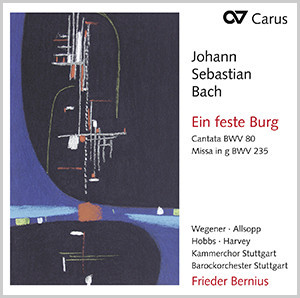
Performers: Sarah Wegener (soprano), David Allsopp (alto), Thomas Hobbs (tenore), Peter Harvey (basso) – Kammerchor Stuttgart, Barockorchester Stuttgart – Frieder Bernius
Explore
 Additional material
- Purchase additional material as a download product.
-
 Digital text (without sheet music) incl. printing licence, html file, singing text, english translationhtml file, singing text, english translation (Sample)
1. Coro Lord, have mercy on us.
Christ, have mercy on us.
Lord, have mercy on us.2. Coro Glory be to God on high.
And on earth peace to men of good will.
We praise thee. We bless thee. We adore thee. We glorify thee.3. Basso solo We give thee thanks for thy great glory.
Lord God, heavenly King,
almighty Father.4. Alto solo O Lord, the only-begotten Son, Jesus Christ,
O Lord God, Lamb of God, Son of the Father.5. Tenore solo Thou who takest away the sins of the world, receive our prayer.
Thou that sittest at the right hand of the Father, have mercy upon us.
For thou alone art the Holy One,
...
-
Digital text (without sheet music) incl. printing licence, html file, singing text, german translationhtml file, singing text, german translation (Sample)
1. Coro Herr, erbarme dich.
Christus, erbarme dich unser.
Herr, erbarme dich unser.2. Coro Ehre sei Gott in der Höhe.
Und Friede auf Erden den Menschen, die guten Willens sind.
Wir loben dich. Wir preisen dich. Wir beten dich an. Wir rühmen dich.3. Basso solo Wir danken dir, denn groß ist deine Herrlichkeit. Herr und Gott, König des Himmels,
allmächtiger Vater.4. Alto solo Herr Jesus Christus, eingeborener Sohn.
Herr und Gott, Lamm Gottes, Sohn des Vaters.5. Tenore solo Du nimmst hinweg die Sünden der Welt, nimm an unser Gebet.
Du sitzest zur Rechten des Vaters, erbarme dich unser.
Denn du allein bist der Heilige,
...
-
Digital text (without sheet music) incl. printing licence, html file, singing text, originalhtml file, singing text, original (Sample)
1. Coro Kyrie eleison.
Christe eleison.
Kyrie eleison.2. Coro Gloria in excelsis Deo.
Et in terra pax hominibus bonae voluntatis.
Laudamus te. Benedicimus te. Adoramus te. Glorificamus te.3. Basso solo Gratias agimus tibi propter magnam gloriam tuam.
Domine Deus, Rex coelestis,
Deus Pater omnipotens.4. Alto solo Domine Fili unigenite, Jesu Christe.
Domine Deus, Agnus Dei, Filius Patris....
-
Digital text (without sheet music) incl. printing licence, html file, Introductory text, englishhtml file, Introductory text, english (Sample)Text from the CD Carus 83.282
Klaus Hofmann
Translation (abridged): Elizabeth RobinsonJohann Sebastian Bach’s four Lutheran Masses (BWV 233-236) were composed towards the end of the 1730s and are so-called because they comprise just Kyrie and Gloria, as was customary in Protestant practice of the time. They are almost entirely parodies of cantata movements. With the Mass in G minor, Bach appears to have started with a plan to make full use of his cantata Es wartet alles auf dich (BWV 187) of 1726. Here, he used all the movements which were suitable for parody treatment in the mass. The opening chorus “Es wartet alles auf dich” became the final chorus with the text “Cum Sancto Spiritu in gloria Dei Patris. Amen”. The three solo arias in the cantata recur in the mass as inner movements (3–5) in the Gloria section. For the Kyrie and the opening movement of the Gloria, Bach needed two further choral pieces, and for these he drew on the opening choruses of cantatas BWV 102 and BWV 72, also written in 1726.
It goes almost without saying that Bach’s reworking is not limited to the underlay of the new text and associated modifications of the vocal parts. In two cases, in
...
-
Digital text (without sheet music) incl. printing licence, html file, Introductory text, germanhtml file, Introductory text, german (Sample)Booklet-Text der CD Carus 83.282
Klaus Hofmann
Johann Sebastian Bachs gegen Ende der 1730er Jahre entstandene vier Lutherischen Messen (BWV 233-236) – so genannt, weil sie sich nach protestantischer Praxis auf Kyrie und Gloria beschränken – bestehen fast vollständig aus Parodien von Kantatensätzen. Bei der Messe in g-Moll scheint Bach von dem Plan ausgegangen zu sein, seine Kantate Es wartet alles auf dich (BWV 187) aus dem Jahre 1726 möglichst ausgiebig zu nutzen. So hat er hier alle zur Parodierung überhaupt geeigneten Sätze (d. h. alles außer den beiden Rezitativen und dem Schlusschoral) in die Messe übergeführt. Der Eingangschor „Es wartet alles auf dich“ wurde zum Schlusschor mit dem Text „Cum Sancto Spiritu in gloria Dei Patris. Amen“. Die drei Soloarien der Kantate kehren in der Messe als Binnensätze des Gloria-Teils wieder. Für das Kyrie und den Anfangssatz des Gloria brauchte Bach noch zwei Chorstücke und griff hierfür auf die Eingangschöre der ebenfalls 1726 entstandenen Kantaten Herr, deine Augen sehen nach dem Glauben (BWV 102) und Alles nur nach Gottes Willen (BWV 72)
...
Purchase
Additional product information
Contents

-
Composer
Johann Sebastian Bach
| 1685-1750Johann Sebastian Bach is one of the most important composers of Western music history. He came from a widely ramified musical dynasty, which produced numerous musicians and organists in the Thuringian-Saxon area.
Bach vocal
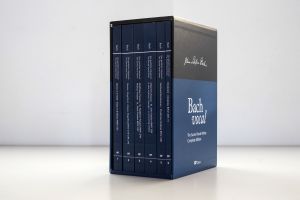
Ever since Carus-Verlag was founded in 1972, publishing the music of Johann Sebastian Bach has been a special focus for us. In the 2017 Reformation anniversary year we completed the Bach vocal project. Bach’s complete sacred vocal works are now available in modern “Urtext” editions, together with performance material. A complete edition of all the full scores is also available in a high quality box set.
Personal details
-
Choir
Kammerchor Stuttgart
The Kammerchor Stuttgart is regarded as one of the best ensembles of its kind. Over its fifty-year existence, Frieder Bernius has developed the choir into an exceptional ensemble acclaimed by audiences and press alike. This has led to invitations for the choir to perform at all the important European festivals. In Germany the chamber choir performs at festivals and in concert halls in repertoire ranging from the 17th to the 21st century. Frieder Bernius and his ensemble have received numerous accolades for their contribution to new music. The Kammerchor Stuttgart has made over 80 CDs and LPs, numerous of which have been awarded international recording prizes (including the Edison award, Diapason d’or, Gramophone Choice, Classical Internet Award, International Classical Music Award, and German Record Critics’ Award prizes). The International Federation for Choral Music has invited the ensemble to sing at the 1st, 4th and 10th World Symposia on Choral Music in Vienna, Sydney and Seoul. Regular tours of North America and Asia since 1988 and a South America tour reflect the Kammerchor Stuttgart’s international reputation. Since 1984 the top ensemble has also been invited to Israel biennially. Personal details
-
Orchestra
Barockorchester Stuttgart
The Barockorchester Stuttgart, which was founded by Bernius in 1985, specializes in 18th century music. The musicians are among the leading representatives of historical performance practice and perform exclusively on original instruments. The ensemble dedicates itself to a large extent to the revival of 18th century operas. It has performed at numerous international festivals, among others in Rome, Dresden and Göttingen. Personal details
-
Conductor
Frieder Bernius
| 1947Frieder Bernius’s work has earned great worldwide recognition. He is in demand internationally as a conductor and as a teacher. His principal artistic collaborators are the ensembles he founded himself, the Kammerchor Stuttgart, the Barockorchester Stuttgart, the Hofkapelle Stuttgart and the Klassische Philharmonie Stuttgart. As a guest conductor, he has collaborated repeatedly with, for example, the SWR Vokalensemble Stuttgart, the Deutsche Kammerphilharmonie Bremen, the Stuttgarter Kammerorchester and the Streicherakademie Bozen. Great stylistic versatility is Frieder Bernius’s hallmark. Whether he conducts vocal works by Monteverdi, Bach, Händel, Mozart, Beethoven, Fauré and Ligeti, stage music by Mendelssohn or symphonies by Haydn, Burgmüller and Schubert, his work always aims for a sound that is at once unmistakably personal and at the same time oriented towards the original period sound ideal. He devotes himself equally to the rediscovery of 18th century operas and to first performances of contemporary compositions. He is particularly interested in the musical history of southwestern Germany. Carus-Verlag has awarded Frieder Bernius a Golden CD for his complete recording of the sacred music of Felix Mendelssohn Bartholdy. The award was presented to him during the German Choir Festival in Stuttgart 2016. The sale of over 250,000 recordings, which has been acclaimed with a number of awards, has made a not insignificant contribution to what today is the obvious presence of Mendelssohn's complete œuvre in the concert repertoire. Personal details
-
Soloist - soprano
Sarah Wegener
-
Soloist - alto
David Allsopp
David Allsopp underwent the typical English training as a singer: he began as a choirboy in Rochester and was a choral scholar at King’s College, Cambridge. After completing his studies, he moved to Westminster Cathedral in London before venturing out on a freelance career. He works closely with groups such as Tenebrae, Polyphony, the Gabrieli Consort and Gallicantus. Thanks to his career path, he is just as familiar with the music of the Middle Ages, the Renaissance and the Baroque (especially Bach and Handel) as he is with the music of contemporary composers. Personal details
-
Soloist - tenor
Thomas Hobbs
In the course of his short career, the young English tenor Thomas Hobbs has already earned consider - able esteem. Still as a student, he was was awarded numerous prizes and scholarships. In addition to developing his solo career, Hobbs has sung in some of England’s leading vocal ensembles, such as The Cardinall’s Musick, The Tallis Scholars, I Fagiolini, and The Sixteen. In the genre of opera, he has performed Acis and other roles in Handel’s Acis and Galathea, Ferrando in Cosi fan tutte and, most recently, the title role in Britten’s Albert Herring at the Royal Academy Opera. During the 2010/11 season he made his debut at the English National Opera in Monteverdi’s Il ritorno d'Ulisse. Thomas Hobbs regularly gives Lieder recitals; his repertoire in cludes Vaughan- Williams’s On Wenlock Edge as well as Schubert’s Die schöne Müllerin and Schumann’s Liederkreis. He is also much in demand as a concert soloist. In 2009, he participated in the Academy of the Festival Aix-en-Provence and performed with the Camerata Salzburg under Louis Langrée. Personal details
-
Soloist - bass
Peter Harvey
Peter Harvey’s hundred or so recordings span eight centuries of music, with the High Baroque particularly well represented. He has performed and recorded all of J. S. Bach’s major vocal works and many of the cantatas. From the French Baroque, he has made many recordings of Campra, Lully, Lalande and others, including a recent solo disc with London Baroque of Rameau’s secular cantatas for bass voice. The Gabrieli Consort’s recording of Haydn’s Creation, on which Peter sings Adam, won the 2008 Gramophone Award. Peter directs the Magdalena Consort, specializing in the performance of the music of Bach with small ensembles. He is increasingly returning to the Lied repertoire, and has recently recorded Schubert’s Die Winterreise with pianist Gary Cooper. Personal details
Reviews on our website can only be submitted by customers with a registered user account. A check whether the rated products were actually purchased does not take place.
No feedback available for this product.
Frequent questions about this work
 There are no questions and answers available so far or you were unable to find an answer to your specific question about this work? Then click here and send your specific questions to our Customer Services!