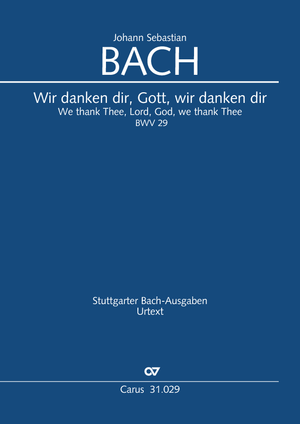
We thank Thee, Lord, God, we thank Thee, Lord
Cantata for the Town council election BWV 29, 1731
Bach’s cantata Wir danken dir, Gott, wir danken dir (We thank Thee, Lord, God, we thank Thee, Lord) of 1731, composed for the inauguration of the Leipzig town council, is one of the cantatas which has an obbligato organ part. In the introductory Sinfonia (an arrangement of the opening movement of the Partita in E for solo violin) and the final aria, the organ has a prominent solo part. The final aria is a transposed repetition of the first aria in the cantata, which frames its central section as a motto “Halleluja, Stärk und Macht sei dem allerhöchsten Namen”. However, the high point of the cantata is the magnificent choral movement which precedes the first “Halleluja”. Bach also re-used this music later in the “Gratias” and “Dona nobis pacem” sections of the Mass in B minor.
Explore
 View
View

 Additional material
- Purchase additional material as a download product.
-
 Digital text (without sheet music) incl. printing licence, html file, singing text, english translationhtml file, singing text, english translation (Sample)1 Sinfonia 2 Chorus
We thank Thee, Lord, God,
3 Aria (Tenore)
and we marvel at all Thy wonders.Halleluja, Strength and Might
4 Recitativo (Basso)
may Thy name be hight exalted!
Zion is Thy chosen site,
there hast Thou Thy dwellingplace,
there will we and our discendants know the Father’s loving grace.Praise God! for all is well!
God, our Preserver, true and tried,
our Light, our Hope, our Guide,
Protector He of high and low,
our very lives to Him we owe.
He blesses those of ev’ry station.
Here Righteousness is met with Peace,
and Truth and Mercy on a firm foundation.
What people is there anywhere,...
-
Digital text (without sheet music) incl. printing licence, html file, singing text, originalhtml file, singing text, original (Sample)1 Sinfonia 2 Chorus
Wir danken dir, Gott, wir danken dir
3 Aria (Tenore)
und verkündigen deine Wunder. (Psalm 75, 2)Halleluja, Stärk’ und Macht
4 Recitativo (Basso)
sei des Allerhöchsten Namen!
Zion ist noch seine Stadt,
da er seine Wohnung hat,
da er noch bei unserm Samen
an der Väter Bund gedacht.Gottlob! es geht uns wohl!
Gott ist noch unsre Zuversicht,
sein Schutz, sein Trost und Licht
beschirmt die Stadt und Paläste,
sein Flügel hält die Mauern feste.
Er lässt uns aller Orten segnen,
der Treue, die den Frieden küsst,
muss für und für...
-
Digital text (without sheet music) incl. printing licence, html file, Introductory text, englishhtml file, Introductory text, english (Sample)Foreword of the edition Carus 31.029
Uwe Wolf
Translation: David KosvinerThe cantata Wir danken dir, Gott, wir danken dir (We thank Thee, Lord, God, we thank Thee) BWV 29 belongs to the few cantatas in which Bach himself noted the year of composition in the score: “Bey der Raths-Wahl | 1731” (“For the council elections | 1731”). The cantata may therefore have first been ceremoniously performed in 1731 in celebration of the change of council which always took place on the Monday after St. Bartholomew’s Day (24 August). In 1731 this Monday fell on 27 August. Subsequent performances in 1739 and 1749 have been substantiated. The music of the first choral movement of the cantata also reappeared as the “Gratias” in the Gloria of the Missa BWV 232I in 1733 which was incorporated into the B minor Mass BWV 232, about fifteen years later. In that Mass it forms the basis for the “Dona nobis pacem,” the crowning conclusion of the Mass. There are, however, clear indications that the movement of the cantata as well as the movements of the Mass can be traced back to a common, but now lost prototype.
...
-
Digital text (without sheet music) incl. printing licence, html file, Introductory text, germanhtml file, Introductory text, german (Sample)Vorwort der Ausgabe Carus 31.029
Uwe Wolf
Die Kantate Wir danken dir, Gott, wir danken dir BWV 29 gehört zu den wenigen, bei denen Bach selbst in der Partitur das Jahr der Komposition vermerkt hat: „Bey der RathsWahl | 1731“. Die Kantate dürfte somit 1731 zur Feier des Ratswechsels, der jeweils am Montag nach Bartolomaei (24. August) feierlich begangen wurde, erstmals erklungen sein. 1731 fiel dieser Montag auf den 27. August. Wiederaufführungen sind für die Jahre 1739 und 1749 bezeugt. Die Musik des ersten Chorsatzes der Kantate kehrt darüber hinaus als „Gratias“ im Gloria der Missa von 1733 BWV 232 I wieder, die rund 15 Jahre später in der h-Moll-Messe BWV 232 aufging. In jener Messe bildet er dann auch die Grundlage für das Dona nobis pacem, dem krönenden Abschluss der Messe. Allerdings gibt es deutliche Indizien dafür, dass der Kantatensatz wie auch die Messsätze auf eine gemeinsame, heute verschollene Urform zurückgehen.
Die Texte der Ratswahlkantaten folgen einem vorgegebenen Muster und verbinden den Dank für die Güte Gottes im Allgemeinen (Satz 2: „Wir danken dir Gott, wir danken dir“) als auch im Besonderen (Satz 4: „Gottlob es geht uns wohl … Sein Schutz, sein
...
Purchase
Additional product information
-
Composer
Johann Sebastian Bach
| 1685-1750Johann Sebastian Bach is one of the most important composers of Western music history. He came from a widely ramified musical dynasty, which produced numerous musicians and organists in the Thuringian-Saxon area.
Bach vocal
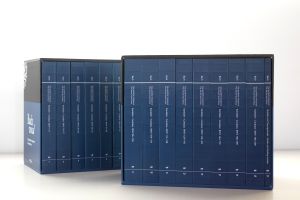
Ever since Carus-Verlag was founded in 1972, publishing the music of Johann Sebastian Bach has been a special focus for us. In the 2017 Reformation anniversary year we completed the Bach vocal project. Bach’s complete sacred vocal works are now available in modern “Urtext” editions, together with performance material. A complete edition of all the full scores is also available in a high quality box set.
Personal details
-
Editor
Uwe Wolf
| 1961As a musicologist, Dr. Uwe Wolf is particularly at home in the 17th and 18th centuries. The focus of his work ranges from the time of Monteverdi and Schütz to Bach and the generation of Bach's sons and pupils through to Viennese Classicism. He has been head of the editorial department at Carus-Verlag since October 2011. Prior to this, he worked in Bach research for over 20 years. Personal details
-
Editor
Hans Grischkat
| 1903-1977
-
Translator
Henry Drinker
Reviews on our website can only be submitted by customers with a registered user account. A check whether the rated products were actually purchased does not take place.
No feedback available for this product.
Frequent questions about this work
 There are no questions and answers available so far or you were unable to find an answer to your specific question about this work? Then click here and send your specific questions to our Customer Services!