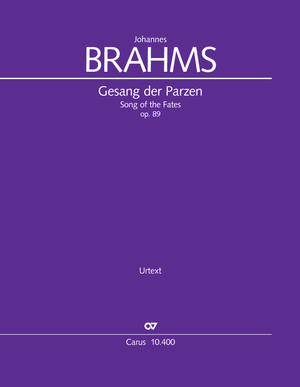
Song of the Fates
op. 89, 1882
The Three Fates, or Parcae, were the goddesses of fate in Greek-Roman mythology, and sang on themes of curse and fate. The “Parzenlied” in Goethe’s verse drama “Iphigenie auf Tauris” is concerned with these themes and became the model for Johannes Brahms’s setting. His Gesang der Parzen (Song of the Fates) op. 89 describes in thrilling, eruptive sounds the fight to overcome the mythical curse through the purity of truthful, noble actions and the power of hope.
With a duration of around 12 minutes, the work can be combined with Brahms’s Ein Deutsches Requiem (A German Requiem, Carus 27.055/00) in concert.
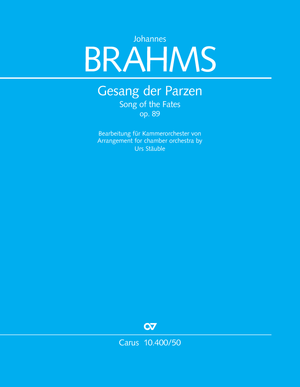
And thanks to an arrangement for chamber orchestra by U. Stäuble (Carus 10.400/50), it is possible to perform the work in smaller settings.



-
Composer
Johannes Brahms
| 1833-1897Johannes Brahms' study of musical tradition was of crucial importance to his output: he combined church modes, canonic technique, Baroque style and diction, Bach's counterpoint and Beethoven's thematic-motivic work with the harmonic and expressive achievements of Romanticism to form his own distinctive style. In this respect his choral songs and vocal quartets (e.g. the “Liebeslieder Waltzes” and “New Liebeslieder Waltzes”), often to folk song texts, in which a musical microcosm unfolds, are examplary. His “Deutsches Requiem”, available from Carus in several different versions, constitutes one of the most fascinating confessions of faith in the history of music. Personal details
-
Editor
Rainer Boss
-
Songwriter / Librettist
Johann Wolfgang Goethe
| -1832Johann Wolfgang von Goethe is today a dazzling figure in world literature. He was born in Frankfurt am Main and initially studied law, but then followed his inclination towards poetry. With the drama Götz von Berlechingen and the epistolary novel The Sorrows of Young Werther, he made important contributions to the literary movement of Sturm und Drang.
From 1775 onwards, Goethe was employed at the court of Duke Carl August in Weimar. In addition to his work at court as a minister and director of the Weimar Court Theatre, he wrote his major works here, including the drama Faust, other novels and many poems, which are still a source of inspiration for musical adaptations today. His poems were a source of inspiration for composers, especially in the 19th century, such as Franz Schubert. Schubert alone set 52 of Goethe's works to music, the best known of which are probably the songs Gretchen am Spinnrade and Erlkönig. Goethe also became acquainted with several composers of the time. He was particularly enthusiastic about the young Felix Mendelssohn-Bartholdy, who also set Goethe's lines to music in the ballad Die erste Walpurgisnacht (The First Walpurgis Night). Personal details
-
Vocal score arranger
Sven Hiemke
-
Translator
Natalia Macfarren
Reviews on our website can only be submitted by customers with a registered user account. A check whether the rated products were actually purchased does not take place.
Frequent questions about this work
 There are no questions and answers available so far or you were unable to find an answer to your specific question about this work? Then click here and send your specific questions to our Customer Services!