

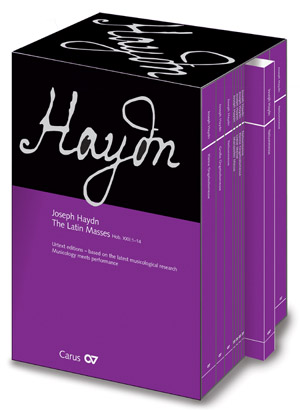
Haydn composed his first mass as a youth when he and his brother still sang as boy sopranos at St. Stephen's Cathedral in Vienna. Presumably, he wrote the two ornamented solo voices for himself and his brother. With numerous short interjections the choir joins in effectively in the jubilation of the solo sopranos – if it can hear the solo voices this is useful for finding its entry notes with certainty.
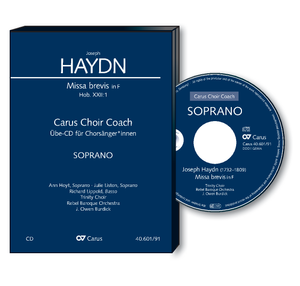
The Carus Choir Coach offers choir singers the unique opportunity to study and learn their own, individual choral parts within the context of the sound of the entire choir and orchestra. For every vocal range a separate Audio or MP3 containing each choir part is available. The Carus Choir Coach is based on recorded interpretations by renowned artists who have performed the work from carefully prepared Carus Urtext editions. Each choir part is presented in three different versions:
- Original recording
- Coach: each part is accompanied by the piano, with the original recording sounding in the background
- Coach in slow mode: the tempo of the coach slows down to 70% of the original version – through this reduction passages can be learned more effectively.
Performers: Ann Hoyt (soprano 1), Julie Liston (soprano 2), Richard Lippold (basso) – Trinity Choir, Rebel Baroque Orchestra – J. Owen Burdick.
Explore
 Additional material
- Purchase additional material as a download product.
-
 Digital text (without sheet music) incl. printing licence, html file, singing text, originalhtml file, singing text, original (Sample)Kyrie (Soli S1, S2, Coro)
Kyrie eleison,
Gloria (Coro)
Christe eleison.
Kyrie eleison.Et in terra pax hominibus bonae voluntatis.
Laudamus te, benedicimus te, adoramus te, glorificamus te.
Gratias agimus tibi propter magnam gloriam tuam.
Domine Deus, Rex coelestis, Deus Pater omnipotens.
Domine Deus, Agnus Dei, Filius Patris,
Domine Fili unigenite, Jesu Christe.
Qui tollis peccata mundi, miserere nobis,
suscipe deprecationem nostram.
Qui sedes ad dexteram Patris, miserere nobis.
Quoniam tu solus Sanctus.
Tu solus Dominus. Tu solus Altissimus.
Jesu Christe.
Cum Sancto Spiritu, in gloria Dei Patris.
Amen....
-
Digital text (without sheet music) incl. printing licence, html file, Introductory text, englishhtml file, Introductory text, english (Sample)Abridged foreword of the Edition Carus 40.601
Willi Schulze
Translation: E. D. EcholsConcerning the mass presented on this record “The Inventory and Estimation of the Artistic Articles Left by Mr Joseph Haydn Who Died on March 31, 1809” (Inventur und Schätzung der hinterlassenen Kunstsachen des am 31. März 1809 verstorbenen Herrn Joseph Haydn) notes “This was, his first mass, composed while Mr Haydn was still a student.” Thirteen more were to follow. Of the total fourteen masses included in the catalogue of Haydn’s works that J. Elßler (together with the composer) compiled, the Missa Sunt bona mixta malis is listed as being lost. H. C. Robbins Landon considers the Missa rorate coeli desuper, that has come down to us anonymously, to be another lost mass by Haydn. The last six of the remaining number were written after Haydn’s return from his second trip to England and were all commissioned for anniversaries of the name’s day of Princess Maria Josepha Hermenegild, that at the wish of Nikolaus II was to be celebrated each year with a “solemn” mass. These six last masses are formally related to Haydn’s earlier type of “missa solemnis” but go far
...
-
Digital text (without sheet music) incl. printing licence, html file, Introductory text, germanhtml file, Introductory text, german (Sample)Gekürztes Vorwort der Ausgabe Carus 40.601
Willi Schulze
„Diese war die erste Messe, welche Herr Haydn noch als Student komponierte“, heißt es zur hier herausgegebenen Messe in der Inventur und Schätzung „der hinterlassenen Kunstsachen des am 31. März 1809 verstorbenen Herrn Joseph Haydn“: Dreizehn weitere sollten folgen. Von den insgesamt vierzehn Messen, die das von J. Elßler in Zusammenarbeit mit Haydn angefertigte Werkeverzeichnis aufführt, gilt die Missa Sunt bona mixta malis als verschollen. Eine weitere als verloren angesehene glaubt H. C. Robbins Landon in der anonym überlieferten Missa Rorate Coeli desuper entdeckt zu haben. Von den übrigen wurden die letzten sechs nach Haydns Rückkehr von seiner zweiten englischen Reise geschrieben. Sie sind Auftragswerke für die Namensfeste der Fürstin Maria Josepha Hermenegild, die auf Wunsch Nikolaus II. Esterhazy alljährlich mit einer „solennen“ Messe begangen werden sollten. Die sechs letzten Messen Haydns knüpfen in der Form an den Typ der Missa solemnis seiner frühen Werke an, führen aber in Ausdruck und Gehalt weit über sie hinaus. Entstanden nach dem
...
Purchase
Additional product information
-
Composer
Joseph Haydn
| 1732-1809As Kapellmeister to Prince Esterházy, Haydn composed numerous instrumental works and various operas, as well as making important contributions to the genre of church music, including fourteen Latin masses, of which only twelve are authentic or complete; these are complemented by motets and offertories, two important Te Deum settings, two Salve Reginas, a Stabat Mater, and the different versions of the Sieben Worte des Erlösers am Kreuze. The masses were composed continually between 1749 and 1802, except for the years 1783–1795, and therefore constitute the genre with which Haydn was occupied over the longest period of time. The six (authentic or complete) masses composed before 1782 are stylistically very different, and as well as short Missae breves there are more extended masses with rich orchestral scoring; by contrast the six so-called late masses, written from 1796 onwards, form a comparatively homogeneous group of more extensive works scored for large forces. With his two great oratorios Die Schöpfung (The Creation) (1798) and Die Jahreszeiten (The Seasons) (1801) Haydn established the tradition of the German oratorio for middle-class music making. Personal details
-
Choir
Trinity Church Choir Zemun Beograd
-
Orchestra
Rebel Baroque Orchestra
-
Conductor
J. Owen Burdick
-
Soloist - soprano
Ann Hoyt
-
Soloist - alto
Julie Liston
-
Soloist - bass
Richard Lippold
Reviews on our website can only be submitted by customers with a registered user account. A check whether the rated products were actually purchased does not take place.
No feedback available for this product.
Frequent questions about this work
 There are no questions and answers available so far or you were unable to find an answer to your specific question about this work? Then click here and send your specific questions to our Customer Services!