Haydn's magnificent Creation marks something akin to the "birth" of the great German oratorio, in view of the fact that this work – which is popular all over the world –stands as a landmark between the great oratorios of Händel and Mendelssohn. The composition of the Creation was particularly associated with the music of Händel since Haydn, on his two trips to England in the first half of the 1790s, had been profoundly impressed by monumental performances in Westminster Abbey. The choral parts are not particularly difficult; however, in order to most effectively attain the effortlessness and vivaciousness of Haydn's music, each part should be perfectly rehearsed.
Simply practice. Anytime. Everywhere.
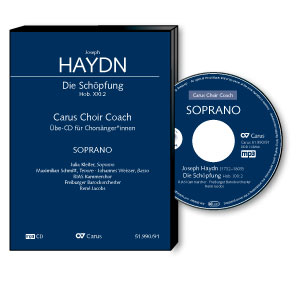
Whether at home on your tablet or PC or on the road on your smartphone: with carus music, the Choir Coach, you always have your choral works with you to practice! With the carus music choir app, you can listen to your score together with a first-class recording on any device and easily practice your own choir part with a coach. With carus music, your concert preparation is easy, efficient and fun to master!
Performers: Julia Kleiter (soprano), Maximilian Schmitt (tenore), Johannes Weisser (basso) – RIAS-Kammerchor, Freiburger Barockorchester – René Jacobs
Explore
 Additional material
- Purchase additional material as a download product.
-
 Digital text (without sheet music) incl. printing licence, html file, singing text, english translationhtml file, singing text, english translation (Sample)First Part 1. Introduction · The Representation of Chaos Recitativo (Raphael, Chorus, Uriel)
Raphael
In the beginning God created the heaven and the earth;
and the earth was without form and void;
and darkness was upon the face of the deep.Chorus
And the Spirit of God
moved upon the face of the waters.
And God said: Let there be Light,
and there was Light.Uriel
2. Aria (Uriel, Chorus)
And God saw the Light, that it was good;
and God divided the Light from the darkness.Uriel
Now vanish before the holy beams
the gloomy dismal shades of dark;
the first of days appears.
Disorder yields to order the fair place.
Affrighted fled hell’s spirits black in throngs;
...
-
Digital text (without sheet music) incl. printing licence, html file, singing text, originalhtml file, singing text, original (Sample)Erster Teil 1. Einleitung · Die Vorstellung des Chaos Recitativo (Raphael, Chor, Uriel)
Raphael
Im Anfange schuf Gott Himmel und Erde,
und die Erde war ohne Form und leer,
und Finsternis war auf der Fläche der Tiefe.Chor
Und der Geist Gottes
schwebte auf der Fläche der Wasser,
und Gott sprach: Es werde Licht,
und es ward Licht.Uriel
2. Aria (Uriel, Chor)
Und Gott sah das Licht, dass es gut war,
und Gott schied das Licht von der Finsternis.Uriel
Nun schwanden vor dem heiligen Strahle
des schwarzen Dunkels gräuliche Schatten:
der erste Tag entstand.
Verwirrung weicht, und Ordnung keimt empor.
...
-
Digital text (without sheet music) incl. printing licence, html file, Introductory text, englishhtml file, Introductory text, english (Sample)Abridged Foreword of the Edition Carus 51.990/03
Wolfgang Gersthofer
Translation: Earl RosenbaumIn the first half of the 1790s Joseph Haydn made two concert tours to England which were of decisive importance for the composition of The Creation: Not only did the monumental performances in Westminster Abbey leave a lasting impression, but on his last departure from London in August 1795 he is supposed to have been given an older oratorio libretto on the biblical story of creation, originally intended for Handel, however its existence in this form has never been documented.
Following his return to Vienna, Haydn actually did set to work on the material at once, whereby Gottfried Bernhard Freiherr van Swieten (1733–1803), who was almost the same age, would become his most important contact. Born in Leyden, in the Netherlands, since 1755 a diplomat in the service of the Habsburgs, during his last assignment abroad at the Prussian Court of Frederick the Great van Swieten became acquainted with the music of Handel and Bach, which henceforth essentially shaped his musical preferences. Even after leaving his political functions he continued to make his mark in the intellectual life of the Imperial (musical) Metropolis as what
...
-
Digital text (without sheet music) incl. printing licence, html file, Introductory text, germanhtml file, Introductory text, german (Sample)Gekürztes Vorwort der Ausgabe Carus 51.990/03
Wolfgang Gersthofer
Joseph Haydn unternahm in der ersten Hälfte der 1790er Jahre zwei Konzertreisen nach England, die für das Entstehen der Schöpfung eine ausschlaggebende Bedeutung erlangen sollten: Nicht nur hatten Monumentalaufführungen Händel’scher Oratorien in der Westminster Abbey bei ihm nachhaltigen Eindruck hinterlassen, sondern bei seiner endgültigen Abreise aus London im August 1795 soll ihm zudem ein älteres, ursprünglich für Händel bestimmtes Oratorienlibretto über die biblische Schöpfungsgeschichte zur Vertonung überreicht worden sein.
Nach Wien zurückgekehrt, machte sich Haydn tatsächlich alsbald an die Arbeit, wobei ihm der fast gleichaltrige Gottfried Bernhard Freiherr van Swieten (1733–1803) zur entscheidenden Bezugsperson werden sollte. Gebürtig aus dem niederländischen Leyden, ab 1755 Diplomat in habsburgischen Diensten, hatte van Swieten auf der letzten seiner Auslandsstationen am preußischen Hofe Friedrichs des Großen Bekanntschaft mit der Musik Händels und Johann Sebastian Bachs geschlossen, was fortan seine musikalischen Vorlieben nicht unwesentlich prägen sollte. Auch nach dem Ausscheiden aus seinen politischen Funktionen (1791)
...
Purchase
Additional product information
-
Composer
Joseph Haydn
| 1732-1809As Kapellmeister to Prince Esterházy, Haydn composed numerous instrumental works and various operas, as well as making important contributions to the genre of church music, including fourteen Latin masses, of which only twelve are authentic or complete; these are complemented by motets and offertories, two important Te Deum settings, two Salve Reginas, a Stabat Mater, and the different versions of the Sieben Worte des Erlösers am Kreuze. The masses were composed continually between 1749 and 1802, except for the years 1783–1795, and therefore constitute the genre with which Haydn was occupied over the longest period of time. The six (authentic or complete) masses composed before 1782 are stylistically very different, and as well as short Missae breves there are more extended masses with rich orchestral scoring; by contrast the six so-called late masses, written from 1796 onwards, form a comparatively homogeneous group of more extensive works scored for large forces. With his two great oratorios Die Schöpfung (The Creation) (1798) and Die Jahreszeiten (The Seasons) (1801) Haydn established the tradition of the German oratorio for middle-class music making. Personal details
-
Songwriter / Librettist
Gottfried von Swieten
| 1733-1803
-
Ensemble
Freiburger Barockorchester Consort
-
Ensemble
RIAS Kammerchor
-
Conductor
René Jacobs
-
Soloist - soprano
Julia Kleiter
-
Soloist - tenor
Maximilian Schmitt
Maximilian Schmitt, tenor, discovered his love for music as a choirboy with the Regensburger Domspatzen. He studied singing at the Berlin University of the Arts from 1999. In 2005 and 2006 he was a member of the ‘Junges Ensemble’ at the Bayerische Staatsoper in Munich, during which period he made his solo debut at the Salzburg Landestheater as Tamino in Die Zauberflöte. Maximilian Schmitt has been engaged by the Staatstheater Mannheim from the 2008-09 season. As well as his passion for opera, he is in increasing demand as a concert singer. He has performed with the Akademie für Alte Musik Berlin, Concerto Köln, Basel Chamber Orchestra, Bavarian Radio and Mitteldeutscher Rundfunk [Central German Broadcasting] Symphony Orchestras and the Swedish Radio Symphony Orchestra. In 2009 he will once again tour with Helmuth Rilling and the Bachakademie, and will be working with the Leipzig Gewandhausorchester under Riccardo Chailly. Personal details
-
Soloist - bass
Johannes Weisser
Reviews on our website can only be submitted by customers with a registered user account. A check whether the rated products were actually purchased does not take place.
No feedback available for this product.
Frequent questions about this work
 There are no questions and answers available so far or you were unable to find an answer to your specific question about this work? Then click here and send your specific questions to our Customer Services!