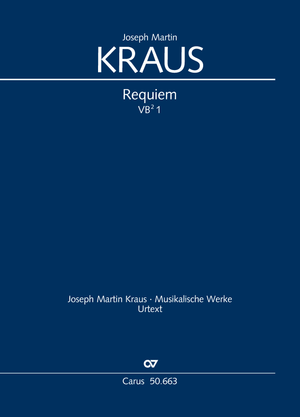
Requiem
VB 1, 1775


 Additional material
- Purchase additional material as a download product.
-
 Digital text (without sheet music) incl. printing licence, html file, singing text, english translationhtml file, singing text, english translation (Sample)Unbenanntes Dokument Introitus
1. Requiem aeternam
Requiem aeternam dona eis Domine,
et lux perpetua luceat eis.2. Te decet
Kyrie
Te decet hymnus Deus in Sion,
et tibi reddetur votum in Jerusalem,
Exaudi orationem meam, ad te omnis caro veniet.3. Kyrie
Sequentia
Kyrie eleison.4. Dies irae
...
-
Digital text (without sheet music) incl. printing licence, html file, singing text, german translationhtml file, singing text, german translation (Sample)Unbenanntes Dokument Introitus
1. Requiem aeternam
Requiem aeternam dona eis Domine,
et lux perpetua luceat eis.2. Te decet
Kyrie
Te decet hymnus Deus in Sion,
et tibi reddetur votum in Jerusalem,
Exaudi orationem meam, ad te omnis caro veniet.3. Kyrie
Sequentia
Kyrie eleison.4. Dies irae
...
-
Composer
Joseph Martin Kraus
| 1756-1792Joseph Martin Kraus was one of the most musically original contemporaries of Mozart. He was born in the same year as this famous classicist from Vienna and survived him by only one year. Other than this almost chronological coincidence these two composers share neither stylistic nor biographical traits. Born in 1756 in Miltenberg am Main, Kraus studied law in Mainz, Erfurt and Göttingen with the goal of becoming a civil servant in the service of the Elector of Mainz. Kraus already made his initial attempts at composition during his studies at the grammar school in Mannheim, and during an interruption of his studies the twenty-year-old composed church music at Buchen in the Odenwald. His father had been transferred to this town soon after Kraus was born. During his studies in Göttingen the time appeared rife for him to devote his life completely to music. A fellow student from Sweden persuaded Kraus in 1778 to move to Stockholm. After three years of hardship and privation, the success of his first opera, "Proserpine" led King Gustav III, an art enthusiast, to appoint him as Royal Music Director of the Swedish Court. This appointment was linked with the obbligation to study both musical theater and the conditions for receiving musical training in the most important centers of Europe. One of the most important stops for Kraus, as a composer, on his four-year journey (autumn 1782 through 1786) was in Vienna, where he sought out Gluck, Haydn, Albrechtsberger and Salieri, but apparently he did not visit Mozart, which says a great deal about his musical orientation. An enormous amount of work awaited Joseph Martin Kraus upon is return to Sweden. His most important task was to reorganize music and theater at the Court and to compose and perform his own works. His patron, Gustav III, was assassinated in March 1792 (Verdi used this incident as the plot of his opera "The Masked Ball"); a few months later, on 15 December 1792, Joseph Martin Kraus died of tuberculosis at the height of his creative powers. In addition to his early sacred works, the compositional output of Joseph Martin Kraus encompasses operas, stage and ballet music, Lieder, arias and cantatas with German, Swedish, Italian and French texts, symphonies and chamber music. Personal details
-
Editor
Wolfram Enßlin
Reviews
Die Musik zeichnet sich bei aller jugendlichen Unbekümmertheit und Eigenwilligkeit bezüglich der Satztechnik durch eine grosse Ensthaftigkeit und Ausdruckstärk, verbunden mit zumeit dunklen instrumentalen Klangfarben, Abruptheit, zuweilen auch Schroffheit, aus.
Musik & Liturgie, 5/2022
...absolut lohnend zum Studium wie für Aufführung.
CHOR aktuell, Juni 2022
Man möchte hoffen, dass ihre Existenz diesem ansprechenden und eindrücklichen Werk nunmehr endlich zu der Aufmerksamkeit hilft, die es verdient!
das Orchester, 04/2022
Wer also die Gattung Requiem auch jenseits der ganz bekannten Stücke kennenlernen möchte, findet in Kraus' Vertonung ein reizvolles Fenster in die aufregende Musik des 18. Jahrhunderts jenseits von Wien.
Musica sacra, April 2022
Kraus schuf hier ein Werk mit insgesamt elf Sätzen, die in bedrückender Klarheit gesetzt sind. ... Es entsteht eine Musik, die auf das Wesentliche reduziert ist und ausdrücklich den Text in den Vordergrund stellt. .... Einer der ausgesprochenen Höhepunkte des Stücks ist das zauberhafte „Benedictus“-Duett zwischen Sopran- und Altsolo. Mit einfachen, aber höchst wirkungsvollen Mitteln erreicht Kraus hier äußerste Expressivität und lässt die Gesangsstimmen mit den Streichern fast spielerisch konzertieren. Das abschließende „Lux Aeterna“ des Chores ist untypischerweise von rhythmisch markanten und synkopierten Motiven der Instrumente geprägt, fügt sich aber bestens in das Gesamtbild dieses bemerkenswerten Requiems, für dessen Wiederentdeckung wir ... dankbar sein können.
Tristan Meister, Chorzeit, Oktober 2021
... Die Musik, ob im Tutti oder in den Soloteilen, ist sehr abwechslungsreich und apart.
Württembergische Blätter für Kirchenmusik, 01/2022
... bietet sich für kleinere bis mittlere Chöre eine wunderbare Möglichkeit, die ausgetretenen Repertoirepfade zu verlassen und ein außergewöhnliches Werk eines immer noch viel zu wenig bekannten Komponisten der Klassik zu entdecken. Die musikalischen Schwierigkeiten halten sich genauso in Grenzen wie der finanzielle Aufwand für die auf Streicher und zwei Hörner beschränkte Orchesterbegleitung.
Holger Slowik, Stretta, 30.07.2021
Reviews on our website can only be submitted by customers with a registered user account. A check whether the rated products were actually purchased does not take place.
Frequent questions about this work
 There are no questions and answers available so far or you were unable to find an answer to your specific question about this work? Then click here and send your specific questions to our Customer Services!