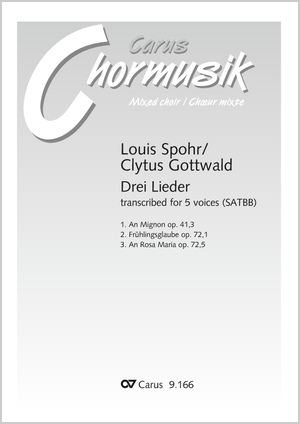
Three Songs. Vocal transcription by Clytus Gottwald
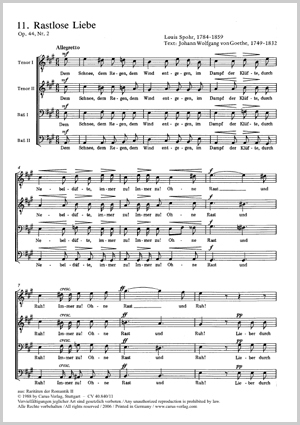
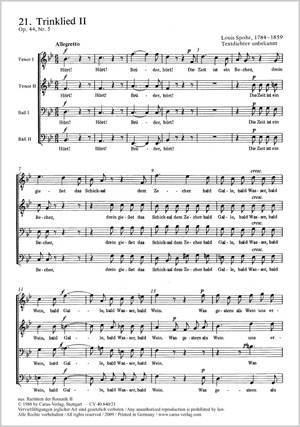
Music for unaccompanied choir features very little in the works of the violin virtuoso and composer Louis Spohr (1784–1859), although he used the chorus to great effect, particularly in his early Romantic operas. Clytus Gottwald has transcribed three of Spohr’s songs with piano accompaniment for five-part mixed choir. The texts are by Goethe, Amalia Schoppe, and Uhland. Spohr’s music, stylistically typical of a period of musical transition with its indefinable qualities, offers in a special way starting points for Gottwald’s technique of arranging, influenced as it is by contemporary music.
Gottwald’s transcriptions of songs and instrumental works for vocal ensemble, distinguished by their highly sophisticated sound, have become firmly established in choral repertoire throughout the world in recent years.
 View
View
 Additional material
- Purchase additional material as a download product.
-
 Digital text (without sheet music) incl. printing licence, html file, singing text, originalhtml file, singing text, original (Sample)Unbenanntes Dokument An Mignon
Über Tal und Fluss getragen
ziehet rein der Sonne Wagen.
Ach, sie regt in ihrem Lauf,
so wie deine, meine Schmerzen,
tief im Herzen,
immer morgens wieder auf.Kaum will mir die Nacht noch frommen,
denn die Träume selber kommen
nun in trauriger Gestalt,
und ich fühle dieser Schmerzen,
still im Herzen,
heimlich bildende Gewalt....
-
Digital text (without sheet music) incl. printing licence, html file, singing text, english translationhtml file, singing text, english translation (Sample)Unbenanntes Dokument To Mignon
Over vale and torrent far
rolls along the sun’s bright car.
Ah! he wakens in his course
mine, as thy deep-seated smart
in the heart,
ev’ry morning with new force.Scarce avails night aught to me;
e’en the visions that I see
come but in a mournful guise;
and I feel this silent smart
in my heart
with creative power arise....
Contents
-
Composer
Louis Spohr
| 1784-1859Louis Spohr, born 1784 in Braunschweig, died 1859 in Kassel. Considered one of the best violinists, conductors and composers of his time. He received violin lessons from the age of five. As early as 1799 violinist in the Brunswick court orchestra, then concertmaster in Gotha; 1812 - 1815 Kapellmeister in Vienna; from 1822 court Kapellmeister in Kassel, recommended by C. M. v. Weber. Extensive concert tours brought him together with N. Paganini, among others. He left behind over 200 works, including many a cappella choirs. His oratorio ‘Die letzten Dinge’ (1826) was highly regarded in the 19th century. Personal details
-
Arranger
Clytus Gottwald
| 1925-2023The choral conductor, composer and musicologist Clytus Gottwald (1925 - 2023) made significant contributions to contemporary choral music. As editor for New Music at Südfunk Stuttgart and founder and director of the Schola Cantorum Stuttgart, he was in productive exchange with his contemporaries, Pierre Boulez, Mauricio Kagel, György Ligeti, Luigi Nono, Karlheinz Stockhausen and many others. With his Schola Cantorum, a 16-voice chamber vocal ensemble, Gottwald decisively shaped the a cappella choral culture of the highest technical level that is taken for granted today. Clytus Gottwald's transcriptions of piano songs and instrumental pieces for unaccompanied choir are appreciated by choirs all over the world. Modelled on the style of Ligeti, his works set the highest of musical standards. Clytus Gottwald has received several awards for his services, including the Cultural Prize of Baden-Württemberg in 2009, the European Church Music Prize in 2012, and the Cross of Merit of the Federal Republic of Germany in 2014. His importance for the development of contemporary choral music cannot be overestimated. Personal details
Reviews on our website can only be submitted by customers with a registered user account. A check whether the rated products were actually purchased does not take place.
Frequent questions about this work
 There are no questions and answers available so far or you were unable to find an answer to your specific question about this work? Then click here and send your specific questions to our Customer Services!