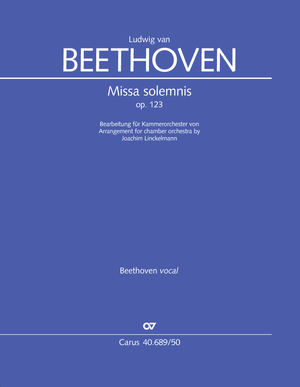
Missa solemnis
Arrangement for chamber orchestra (arr. J. Linckelmann) op. 123, 1817-1823 / 2020
Beethoven described his Missa solemnis several times as his greatest work. "Coming from the heart", it was intended to touch and move audiences. Beethoven worked long and intensively on the composition in order to give what he felt was adequate expression to the text. In its length and musical demands, the Missa solemnis goes far beyond typical liturgical settings; for good reason, the premiere took place in a concert hall.
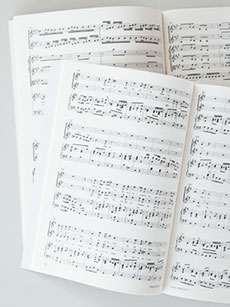
With this arrangement for chamber orchestra (flute, oboe, clarinet, bassoon, horn, trumpet, trombone, timpani and strings, plus organ ad lib), smaller choirs, as well as choirs with more limited resources of space or finance, can perform this work too. However, the symphonic character and wide dynamic range of the work remain. The scoring of 7 instead of 18 winds offers an optimal balance between transparency and orchestral sound. All the vocal parts (soloists and chorus) are identical with the original version, so that the vocal score and choral score of that version can be used.
- Major mass can also be performed by smaller choir
- Wind and brass parts of the original version reduced to just seven single instruments
- Vocal scores and choral scores from the original version can be used.
- carus plus: the work (original version) is available in the carus music app, the Choir Coach, as well as in the Carus Choir Coach series (audio only).
| Original version | Arrangement for chamber orchestra |
| Soli SATB, Coro SATB, 2 Fl, 2 Ob, 2 Clt, 2 Fg, Cfg, 4 Cor, 2 Tr, 3 Trb, Timp, 2 Vl, Va, Vc, Cb, Org | Soli SATB, Coro SATB, Fl, Ob, Clt, Fg, Cor, Tr, Trb, Timp, 2 Vl, Va, Vc, Cb, [Org] |
-
Composer
Ludwig van Beethoven
| 1770-1827Ludwig van Beethoven was without doubt one of the most influential composers in the history of music. His works formed the culmination of many genres – particularly instrumental – of Viennese classicism, and laid the foundation for the following decades. But Beethoven’s vocal works set standards too: the late Missa Solemnis is one of the most impressive choral works of its time; but his earlier Mass in C also opens up new worlds of expression for the liturgical text, and set the benchmark for the further development in the composition of the mass. And with the final chorus of the Ninth Symphony, the setting of Schiller’s Ode to Joy, Beethoven created one of the most frequently-performed and best known choral pieces of all, writing a timeless musical memorial to himself. Personal details
-
Arranger
Joachim Linckelmann
| 1964Joachim Linckelmann, born in Munich in 1964, studied flute at the Richard Strauss Conservatory in Munich and at the Würzburg University of Music. He has played the flute in various renowned orchestras in Germany and abroad and has also worked as a music designer and arranger since 1995. He has been arranging oratorios for smaller ensembles for Carus since 2009. Personal details
Reviews on our website can only be submitted by customers with a registered user account. A check whether the rated products were actually purchased does not take place.
Frequent questions about this work
 There are no questions and answers available so far or you were unable to find an answer to your specific question about this work? Then click here and send your specific questions to our Customer Services!