

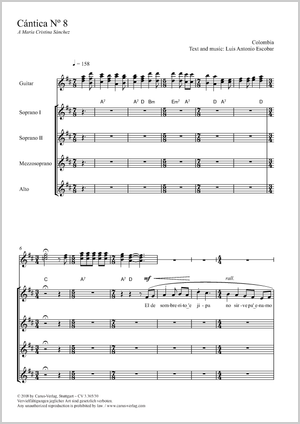
This composition belongs to Escobar’s collection of choral works entitled Cánticas Colombianas, which are inspired by the traditions and texts of the Colombian peasants, with whom he came in contact during his childhood in Villapinzón, the village where he was born. These songs are based on the poetic form of the ‘Copla,’ which combines verses of eight and seven syllables, and uses slang words and expressions from popular sayings. These, in turn, are derived from the old Castillian language. The poems have grace and humor and are courtly love texts.
Explore


 Listen
(1)
Listen
(1)
- Cántica N. 8
Purchase
Additional product information
-
Composer
Luis Antonio Escobar Segura
| 1925-1993The native of Colombia, Luis Antonio Escobar Segura, was a musician, composer, and musicologist. His early musical training was heavily infl uenced by the Arevalo family in Villapinzón and later he completed his academic training in Bogotá, United States and Germany. He was an active conductor, professor, composer and radio broadcaster, and has been linked to the national musical movement since 1954. He has also held important positions both at home in the government of Colombia and in the consular service abroad. In 1958 he received a Guggenheim Fellowship. His catalog of compositions is extensive and extremely varied and it appears in Volume 8 of the American Composers series, published by the Organization of American States (OEA) in 1962. He composed for many types of ensembles such as orchestras, soloists with orchestra, children’s and female choirs, mixed choirs, stage works, and chamber ensembles. Some of his most important works are: the Colombian Serenade, Divertimento No. 1, Concertino for Flute and Orchestra, the First Symphony (1955), Avirama (ballet, 1956) and two operas The Princess and the Pea and Gangsters, based on a text by the poet Jorge Gaitán Durán. His best known choral works are his peasant cantatas, madrigals and songs for mixed choirs, and his Cánticas Colombianas. Personal details
-
Songwriter / Librettist
Luis Antonio Escobar Segura
| 1925-1993The native of Colombia, Luis Antonio Escobar Segura, was a musician, composer, and musicologist. His early musical training was heavily infl uenced by the Arevalo family in Villapinzón and later he completed his academic training in Bogotá, United States and Germany. He was an active conductor, professor, composer and radio broadcaster, and has been linked to the national musical movement since 1954. He has also held important positions both at home in the government of Colombia and in the consular service abroad. In 1958 he received a Guggenheim Fellowship. His catalog of compositions is extensive and extremely varied and it appears in Volume 8 of the American Composers series, published by the Organization of American States (OEA) in 1962. He composed for many types of ensembles such as orchestras, soloists with orchestra, children’s and female choirs, mixed choirs, stage works, and chamber ensembles. Some of his most important works are: the Colombian Serenade, Divertimento No. 1, Concertino for Flute and Orchestra, the First Symphony (1955), Avirama (ballet, 1956) and two operas The Princess and the Pea and Gangsters, based on a text by the poet Jorge Gaitán Durán. His best known choral works are his peasant cantatas, madrigals and songs for mixed choirs, and his Cánticas Colombianas. Personal details
Reviews on our website can only be submitted by customers with a registered user account. A check whether the rated products were actually purchased does not take place.
No feedback available for this product.
Frequent questions about this work
 There are no questions and answers available so far or you were unable to find an answer to your specific question about this work? Then click here and send your specific questions to our Customer Services!