

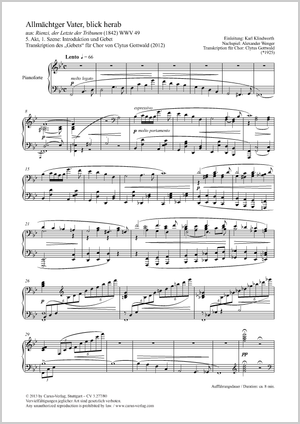
Allmächtiger Vater, blick herab. Vocal transcription of Clytus Gottwald
Prayer, from: Rienzi, der Letzte der Tribunen WWV 49, 1840
Aus: Rienzi, der Letzte der Tribunen, 5. Akt, 1. Szene. Der anfängliche Triumph Rienzis ist nicht lange von Bestand. Er überlebt ein Attentat der Adelsfamilien und begnadigt die Täter. Diese Milde rächt sich jedoch bald. Im blutigen Kampf gegen die erneut sich zusammenrottenden Patrizier verliert Rienzi trotz militärischen Erfolgs den Rückhalt im Volk. Auch Kaiser und Papst lassen ihn fallen. Nur seine Schwester hält noch zu ihm. In dieser Lage fleht er in einem Gebet zu Gott. Bearbeitung (Originalbesetzung: Solo T)
Explore


Purchase
Additional product information
-
Composer
Richard Wagner
| 1813-1883Born in 1813 in Leipzig, Richard Wagner grew up in a family very fond of theatre and he himself fell under its spell early. After failure in school and a mainly self-taught musical training (earliest compositions ~ 1830, Symphony in C 1832) 1833 initial employment as choir director in Wurzburg (completion of his first entire opera Die Feen). Start of years as a journeyman: Konigsberg, Riga, Paris, then as a court music director in Dresden, as a fugitive revolutionary in Zurich and finally as a protege of King Ludwig II. in Munich and Bayreuth, death in Venice in 1883. Personal details
-
Vocal score arranger
Karl Klindworth
| 1830-1916
-
Vocal score arranger
Alexander Wenger
-
Arranger
Clytus Gottwald
| 1925-2023The choral conductor, composer and musicologist Clytus Gottwald (1925 - 2023) made significant contributions to contemporary choral music. As editor for New Music at Südfunk Stuttgart and founder and director of the Schola Cantorum Stuttgart, he was in productive exchange with his contemporaries, Pierre Boulez, Mauricio Kagel, György Ligeti, Luigi Nono, Karlheinz Stockhausen and many others. With his Schola Cantorum, a 16-voice chamber vocal ensemble, Gottwald decisively shaped the a cappella choral culture of the highest technical level that is taken for granted today. Clytus Gottwald's transcriptions of piano songs and instrumental pieces for unaccompanied choir are appreciated by choirs all over the world. Modelled on the style of Ligeti, his works set the highest of musical standards. Clytus Gottwald has received several awards for his services, including the Cultural Prize of Baden-Württemberg in 2009, the European Church Music Prize in 2012, and the Cross of Merit of the Federal Republic of Germany in 2014. His importance for the development of contemporary choral music cannot be overestimated. Personal details
Reviews on our website can only be submitted by customers with a registered user account. A check whether the rated products were actually purchased does not take place.
No feedback available for this product.
Frequent questions about this work
 There are no questions and answers available so far or you were unable to find an answer to your specific question about this work? Then click here and send your specific questions to our Customer Services!