

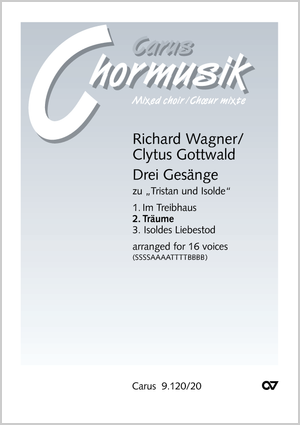
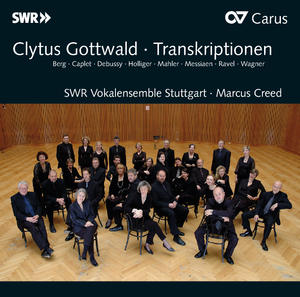
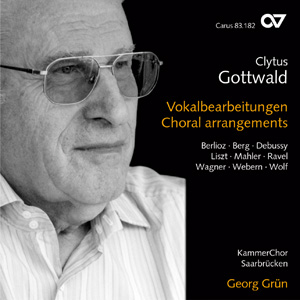
arranged by Clytus Gottwald
Explore
 View
View
 Listen
(1)
Listen
(1)
- Dreams. Transcription by Clytus Gottwald
 Additional material
- Purchase additional material as a download product.
-
 Digital text (without sheet music) incl. printing licence, html file, singing text, originalhtml file, singing text, original (Sample)Unbenanntes Dokument Träume
Sag, welch wunderbare Träume halten meinen Sinn umfangen,
dass sie nicht wie leere Schäume sind in ödes Nichts vergangen?
Träume, die in jeder Stunde, jedem Tage schöner blühn
und mit ihrer Himmelskunde selig durchs Gemüte ziehn?
Träume, die wie hehre Strahlen in die Seele sich versenken,
dort ein ewig Bild zu malen: Allvergessen, Eingedenken!
Träume, wie wenn Frühlingssonne aus dem Schnee die Blüten küsst,
dass zu nie geahnter Wonne sie der neue Tag begrüßt,
dass sie wachsen, dass sie blühen, träumend spenden ihren Duft,
sanft an deiner Brust verglühen und dann sinken in die Gruft.Mathilde Wesendonck (1828–1902)
...
-
Digital text (without sheet music) incl. printing licence, html file, singing text, english translationhtml file, singing text, english translation (Sample)Unbenanntes Dokument Dreams
Tell me, what wonderful dreams keep encircling my mind,
which, like nothing but idle froth, have dissolved in an empty void?
Dreams, which flourish more beautifully every hour, every day
and with their message from heaven pass through the soul?
Dreams, which like rays sublime sink into the soul,
to paint eternally a picture there: all forgotten, remembering!
Dreams, as spring sun kissed the blossoms from the snow,
that to a never foreseen bliss they greet the new day,
that they grow, that they blossom, dreamingly giving their fragrance,
gently fading away on your breast and then sinking into the grave.Mathilde Wesendonck (1828–1902)
Translation: Earl Rosenbaum
...
-
Digital text (without sheet music) incl. printing licence, html file, singing text, french translationhtml file, singing text, french translation (Sample)Unbenanntes Dokument Rêves
Dis-moi, quels rêves merveilleux tiennent mes sens prisonniers,
qu’ils ne sont pas comme la vaine écume disparus dans un vide
ennuyeux ?
Rêves qui à chaque heure à chaque jour fleurissent encore plus
beaux
et qui dans leur message du ciel joyeusement parcourez le coeur ?
Rêves qui tels d’augustes rayons sombrez profondément dans l’âme
pour y peindre une image éternelle : immense oubli, souvenir !
Rêves comme soleil au printemps embrassant les fleurs hors de la
neige
que, comme un délice jamais attendu, le jour nouveau les salue,
qu’ils croissent, qu’ils fleurissent, dispensent leur parfum en rêvant,...
Purchase
Additional product information
-
Composer
Richard Wagner
| 1813-1883Born in 1813 in Leipzig, Richard Wagner grew up in a family very fond of theatre and he himself fell under its spell early. After failure in school and a mainly self-taught musical training (earliest compositions ~ 1830, Symphony in C 1832) 1833 initial employment as choir director in Wurzburg (completion of his first entire opera Die Feen). Start of years as a journeyman: Konigsberg, Riga, Paris, then as a court music director in Dresden, as a fugitive revolutionary in Zurich and finally as a protege of King Ludwig II. in Munich and Bayreuth, death in Venice in 1883. Personal details
-
Songwriter / Librettist
Mathilde Wesendonck
-
Arranger
Clytus Gottwald
| 1925-2023The choral conductor, composer and musicologist Clytus Gottwald (1925 - 2023) made significant contributions to contemporary choral music. As editor for New Music at Südfunk Stuttgart and founder and director of the Schola Cantorum Stuttgart, he was in productive exchange with his contemporaries, Pierre Boulez, Mauricio Kagel, György Ligeti, Luigi Nono, Karlheinz Stockhausen and many others. With his Schola Cantorum, a 16-voice chamber vocal ensemble, Gottwald decisively shaped the a cappella choral culture of the highest technical level that is taken for granted today. Clytus Gottwald's transcriptions of piano songs and instrumental pieces for unaccompanied choir are appreciated by choirs all over the world. Modelled on the style of Ligeti, his works set the highest of musical standards. Clytus Gottwald has received several awards for his services, including the Cultural Prize of Baden-Württemberg in 2009, the European Church Music Prize in 2012, and the Cross of Merit of the Federal Republic of Germany in 2014. His importance for the development of contemporary choral music cannot be overestimated. Personal details
Reviews on our website can only be submitted by customers with a registered user account. A check whether the rated products were actually purchased does not take place.
No feedback available for this product.
Frequent questions about this work
 There are no questions and answers available so far or you were unable to find an answer to your specific question about this work? Then click here and send your specific questions to our Customer Services!