Wolfgang Amadeus Mozart: Bastien und Bastienne - Sheet music for download | Carus-Verlag

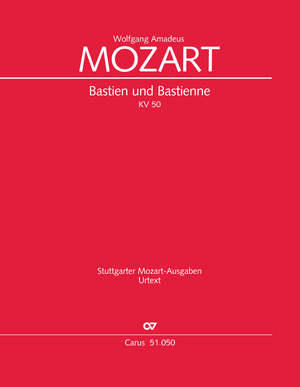
Wolfgang Amadeus Mozart Bastien und Bastienne

KV 50, 1768

Read and write feedback

The story of Bastien und Bastienne is based on the musical pastoral “Le Devin du Village” by Jean-Jacques Rousseau. The play was hugely popular in paraphrase and translation and entered the repertoires of travelling companies and children’s theaters. A shepherd succumbs to the enticements of the lady of the castle and tries to abandon his beloved. The village soothsayer appeals to his conscience and advises the abandoned Bastienne to feign coyness until Bastien shamefacedly returns to her.

Mozart’s version, composed in Vienna in the summer of 1768, is based on a text by Friedrich Wilhelm Weiskern that had been in existence since 1764. On his return to Salzburg, he undertook an ultimately unfinished revision of the work, improving the textual underlay and replacing the spoken dialogue with recitative. He also changed the vocal register of Colas and probably that of Bastien as well. The Carus edition is the first to treat these two versions separately.

Purchase
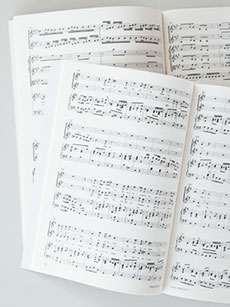
Full score Carus 51.050/00, ISMN 979-0-007-09130-9 96 pages, paperback
available
46,00 € / copy
Vocal score Carus 51.050/03, ISMN 979-0-007-09226-9 64 pages, paperback
available
23,00 € / copy
Set of parts, complete orchestral parts, for hire, also available in digital form Carus 51.050/19, ISMN 979-0-007-13362-7 23 x 32 cm, without cover
  • 1 x Set of parts, harmony parts, for hire, flute 1, flute 2, oboe 1, oboe 2, french horn 1, french horn 2 (51.050/09)
     
    7 x Individual part, violin 1, for hire (51.050/11)
     
    6 x Individual part, violin 2, for hire (51.050/12)
     
    5 x Individual part, viola, for hire (51.050/13)
     
    5 x Individual part, violoncello / double bass, for hire (51.050/14)
     
    1 x Individual part, harpsichord, for hire (51.050/49)
     
Vocal score digital (download), pdf file Carus 51.050/03-010-000, ISMN 979-0-007-35321-6 64 pages Minimum order quantity: 3 copies
available
23,00 € / copy
Full score digital (download), pdf file Carus 51.050/00-010-000, ISMN 979-0-007-26135-1 96 pages
available
41,40 € / copy
Set of parts digital (download), zip file, pdf file, complete orchestral parts, for hire Carus 51.050/19-010-000 23 x 32 cm
  • 1 x Set of parts digital (download), zip file, pdf file, harmony parts, for hire (51.050/09-010-000)
     
    7 x Individual part digital (download), pdf file, violin 1, for hire (51.050/11-010-000)
     
    6 x Individual part digital (download), pdf file, violin 2, for hire (51.050/12-010-000)
     
    5 x Individual part digital (download), pdf file, viola, for hire (51.050/13-010-000)
     
    5 x Individual part digital (download), pdf file, violoncello / double bass, for hire (51.050/14-010-000)
     
    1 x Individual part digital (download), pdf file, harpsichord, for hire (51.050/49-010-000)
     
Director’s book digital (download), pdf file Carus 51.050/81-010-000, ISMN 979-0-007-35956-0
The one-act comedy is set in the countryside and tells the story of Bastien and Bastienne, whose love is thrown into crisis by Bastien's fickleness. Bastienne laments the loss of her beloved, who is enchanted by the gifts – not so much the charms – of the noble lady from the castle. The wise village soothsayer Colas advises Bastienne to pretend that she has fallen in love with someone else. Her dismissive attitude towards Bastien has the desired effect: he now seeks Colas’ advice, as he does not want to lose Bastienne and is willing to forego the noblewoman's gold in order to keep her. Colas performs a bizarre magic ceremony for him, supposedly to win Bastienne back, but it terrifies Bastien. After advising Bastien to take better care of his true happiness, Colas then dismisses him. When the remorseful Bastien returns to Bastienne, he at first continues to meet with her defiant rejection, and even his threat to kill himself cannot soften her heart. Only when he swears to love her until death do they reconcile. Colas marries the couple, and the work ends with a song of praise for the wise “magician.”
  • As the son of the deputy Kapellmeister to the Salzburg Prince-Archbishop, Mozart was constantly surrounded by church music in his youth. On his travels Mozart became familiar with Italian church music, and later in Vienna he studied the works of Bach and Handel. After moving to Vienna he was faced with the new challenges of composing opera and piano concertos, and significantly the “C Minor Mass” KV 427, the greatest sacred work of the first Vienna years, remained unfinished. The last period of his life again shows a change of direction to church music: Mozart successfully applied to succeed the terminally ill Leopold Hoffmann as Kapellmeister at St Stephen's Cathedral, but he was unable to take up the position as he died before Hoffmann. A gem such as the “Ave verum” KV 618 and the incomplete Requiem KV 626 give us an idea of what Mozart might have achieved as a composer of sacred music if he had taken up this important position. Personal details

Reviews on our website can only be submitted by customers with a registered user account. A check whether the rated products were actually purchased does not take place.

No feedback available for this product.

Frequent questions about this work

Pencil symbol There are no questions and answers available so far or you were unable to find an answer to your specific question about this work? Then click here and send your specific questions to our Customer Services!