

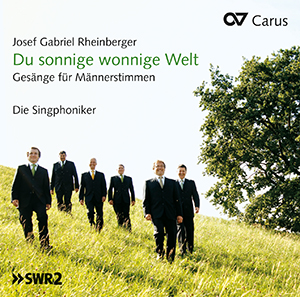
Du sonnige wonnige Welt. Gesänge für Männerstimmen
 Listen
(19)
Listen
(19)
- Im Märzen
- Du sonnige, wonnige Welt
- Singvöglein sing
- Mailied
- Der Jonas kehrt im Walfisch ein
- Schmetterling, wie freu ich mich
- Bau-Regel
- Mucker und Schlucker
- Lob des Seeweins
- Wandernde Musikanten
- Jagdmorgen
- Johannisnacht
- Waldmorgen
- Rheinfahrt
- Disputation
- Heimweh
- Friede
- Es hat geflammt
- Vollmondzauber
Contents


-
Composer
Josef Gabriel Rheinberger
| 1839-1901During the second half of the 19th century Rheinberger, who was born in 1839 in Vaduz (Liechtenstein), was a major figure of European stature. In demand as a teacher of composition and esteemed as a composer, this professor at the Munich Conservatoire and Bavarian Court Kapellmeister made his mark on a whole generation of musicians. The fact that many of his compositions were no longer performed after his death in 1901, despite their high musical qualities, was largely a result of external circumstances. The change of aesthetic orientation which began about the turn of the century led to a radical move away from the conservative-classical ideals to which Rheinberger – like Brahms – had felt himself committed. It was also a fact that Rheinberger never publicized his own works vigorously. The Josef-Rheinberger-Archiv and Carus published a complete edition of works by Josef Gabriel Rheinberger for the first time. The edition, concluded in 2009, has contributed significantly to the fact that the music of this composition teacher and Bavarian Court Kapellmeister from Munich can once again be heard around the world today. Personal details
-
Preface writer
Felix Loy
| 1963
-
Ensemble
Die Singphoniker
The German vocal ensemble “The Singphoniker” was founded three decades ago by six students at the Music Conservatory in Munich. This was at a time when, after years of oblivion – thanks to Eberhard Fechner’s documentary film – the Comedian Harmonists were rediscovered and reassessed, with their fantastic ensemble singing and inimitable arrangements. At the same time, the English group the King´s Singers began to attract a wide public in Germany with their mixed programs ranging from madrigals through contemporary music to close harmony. Right from the beginning The Singphoniker were aware that simply imitating other groups would not bring pleasure or success in the long term. Rather, the question was: is there a German tradition of vocal chamber music for male voices – apart from the narrow German patriotism then commonly found in amateur male voice choirs – which should be fostered and continued, and which is worth incorporating within the overall music of our time? Yes, indeed! The archives are full of such hidden treasures. With curiosity and in the spirit of discovery, we set off on a fascinating journey which has led to many surprises even among experts. Works such as Schubert’s part songs, for example, have formed the center of a German Romantic tradition for the Singphoniker. It is astonishing what we have discovered in terms of wonderful compositions – from Lasso to Orff (both with long associations to the Singphonic home of Munich) and from Grieg to Villa Lobos, et al. Finding their way between the riches of earlier German repertoire, the current international vocal ensemble scene, the revived and rediscovered German tradition and exciting contemporary music, the Singphoniker have developed a wideranging repertoire and an unmistakable profile among the few ensembles of vocal soloists on the international scene. The inclusion of the piano for all musical styles and periods provides an added ingredient in the group’s artistic profile and distinctiveness. Numerous prizes and awards and fruitful partnerships with many distinguished artists – including Gert Westphal, Ute Lemper and Angelika Kirchschlager – reflect their good reputation. Similarly, they work regularly with international orchestras (most recently the Gulbenkian Orchestra Lisbon, NDR Radiophilharmonie, Orquesta Nacional de España) and conductors (including Sir Lawrence Foster, Paul Daniel, Ulf Schirmer, and Howard Griffiths). A whole range of renowned contemporary composers have made exciting contributions to the ensemble’s repertoire. The members of the current group maintain this tradition with continued enthusiasm, and they are finding great pleasure in discovering new repertoire. The Singphonikers’ ensemble sound – and they have consistently rejected all technical means of enhancing this – is considered warmly sonorous, from finely balanced to cohesively powerful in equal measure, reflecting all the facets of a purely male-voice scoring from the deepest darkness to the brightest light. Personal details
Reviews
Die geschickte Auswahl, die zuverlässige Inspiration und das perfekte Handwerk des erfahrenen Vokalkomponisten sowie die frische, makellos saubere Ausführung des auf seinem Feld unschlagbaren Quintetts lassen keinen Moment langeweile aufkommen.
Mátyás Kiss, neue musikzeitung (nmz), Nr. 3/2014
[…] höchstes Maß an Klangtransparenz, die durch den geschliffenen, unmanierierten Vortrag des Ensembles noch weiter geschärft wird. Wie wir es von diesem Sextett gewohnt sind, besticht es durch große Homogenität und eine kluge Ausbalancierung der Stimmen - immer im Einklang mit den jeweiligen Texten.
pizzicato 9/2013
Es wirkt, als sei das alles von Rheinberger für eine – freilich so hochklassig wie die Singphoniker singende – solistische Besetzung geschrieben: Der behände Witz, die gestische Beweglichkeit der Musik sind bei diesem Ensemble hervorragend aufgehoben. Die fünf Vokalisten lassen keine Tümeleien zu, betonen das Frische, Geistvolle, Differenzierte – und erweisen sich als geradezu ideale Interpreten solches Repertoires.
Dr. Matthias Lange, klassik.com, 21. Juni 2013
[…] ungemein sauber, perfekt ausbalanciert […]
Armin Kaumanns, Aachener Zeitung, 8. Juni 2013
Reviews on our website can only be submitted by customers with a registered user account. A check whether the rated products were actually purchased does not take place.
Frequent questions about this work
 There are no questions and answers available so far or you were unable to find an answer to your specific question about this work? Then click here and send your specific questions to our Customer Services!