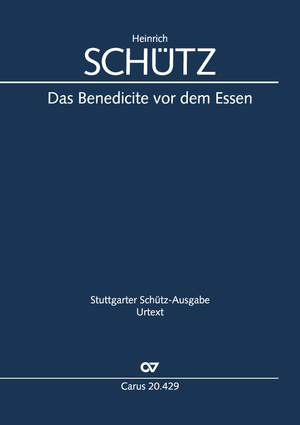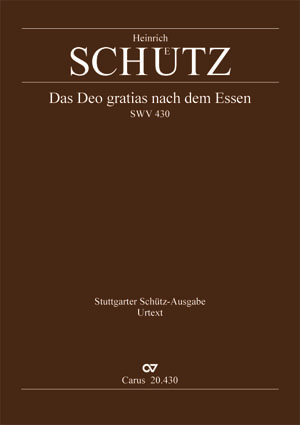
Das Deo gratias nach dem Essen
 View
View
 Additional material
- Purchase additional material as a download product.
-
 Digital text (without sheet music) incl. printing licence, html file, singing text, english translationhtml file, singing text, english translation (Sample)
11. Danket dem Herren
Das Deo gratias nach dem Essen (First Part)
The Lord be praised; for our God is gracious
and he is ever merciful,
who giveth food unto all flesh,
giveth fodder to the beast,
and the young ravens that call upon him.
The strength of a horse will afford him no pleasure,
nor the legs of a man delight him.
The Lord taketh pleasure in them that fear him
and do put their trust in his mercy.
Ps 136:1–25a; Ps 147:9–11
(Second Part)
Our Father, which art in heaven,
Hallowed be thy name.
Thy kingdom come. Thy will be done,
in earth as it is in heaven.
...
-
Digital text (without sheet music) incl. printing licence, html file, singing text, originalhtml file, singing text, original (Sample)
11. Danket dem Herren
Das Deo gratias nach dem Essen (Erster Teil)
Danket dem Herren; denn er ist sehr freundlich
und seine Güte währet ewiglich;
der allem Fleische Speise gibt,
der dem Vieh sein Futter gibt,
den jungen Raben, die ihn anrufen.
Der Herr hat kein Lust an der Stärke des Rosses,
noch Gefallen an jemands Beinen.
Der Herr hat Gefallen an denen, die ihn fürchten
und die auf seine Güte warten.
Ps 136,1–25a; Ps 147,9–11
(Zweiter Teil)
Vater unser, der du bist im Himmel!
Geheilget werde dein Nam.
Zukomm dein Reich. Dein Will gescheh,
wie im Himmel, also auch auf Erden.
...
-
Digital text (without sheet music) incl. printing licence, html file, Introductory text, englishhtml file, Introductory text, english (Sample)Text from the CD Carus 83.239
Oliver Geisler
Translation: Liz RobinsonFor “practical use”: Introduction A glance at music history always reveals more than just music. For music can also be regarded as a mirror or the essence of a whole culture. Indeed, even more importantly, studying and listening to music means learning something about societies and people. How valuable, therefore, are those works which are all too readily labelled “Gebrauchsmusik” (functional music) and consigned to oblivion in favor of the compositional high points of an era. Such works offer a glimpse into the workshops, laboratories, studies and living rooms of a society. Churches, castles and reception rooms are beautiful and imposing, but they also dazzle – because they are always designed to impress. Functional music is concerned with the everyday and with “real life.” And precisely because of this, such works are still performed today, even if they at first appear less grand.
Of the Zwölf geistliche Gesänge it is said that Schütz “sketched them in his spare time.” Evidently
...
-
Digital text (without sheet music) incl. printing licence, html file, Introductory text, germanhtml file, Introductory text, german (Sample)Booklet-Text der CD Carus 83.239
Oliver Geisler
Zum „nützlichen Gebrauch“: Einführung Ein Blick in die Musikgeschichte lässt einen immer mehr erkennen als nur Musik. Denn Musik kann auch als Spiegel oder Bündelung von Kultur insgesamt begriffen werden. Ja mehr noch: Musik zu betrachten und zu hören bedeutet, etwas über Gesellschaften zu erfahren und über Menschen. Wie wertvoll sind da jene Werke, die man als sogenannte „Gebrauchsmusik“ allzu gern zugunsten des kompositorischen Höhenkamms einer Epoche in die Versenkung schiebt! Kann man mit ihnen doch einen Blick in die Werkstätten, Experimentierstuben, Arbeits- und Wohnzimmer einer Gesellschaft erhaschen. Kirchen, Schlösser und festliche Säle sind schön und repräsentativ, sie blenden aber auch – weil sie immer schon auf Repräsentation angelegt sind. Gebrauchsmusiken haben etwas mit Alltag und dem „wahren Leben“ zu tun. Nicht zuletzt deshalb werden solche Werke auch heute noch gebraucht, auch wenn sie zunächst weniger glanzvoll
...


-
Composer
Heinrich Schütz
| 1585-1672Heinrich Schütz is regarded as the first German musician of European stature. As a choirboy from 1599 at the court of Landgrave Moritz of Hessen-Kassel, he received a thorough education. In 1608 he began a law degree in Marburg, but broke this off in 1609 in order, with the support of the Landgrave, to study composition with Giovanni Gabrieli, organist at St Mark’s in Venice. In 1613 Schütz returned to Kassel, but two years later was enticed away by Elector Johann Georg I of Saxony to the Dresden court as “Organist und Director der Musica”, where he held the position of Hofkapellmeister (court Kapellmeister) from 1617 until his death. Schütz’s great cycles of vocal works marked the high point of his reputation in Germany and northern Europe. But these represent only part of Schütz’s output; individual works are represented in printed collections with works by other composers, others only survive in manuscript, and much has been lost. The Stuttgart Schütz Edition makes available Schütz’s complete oeuvre, and all works are also published in practical Urtext editions. Personal details
-
Editor
Günter Graulich
| 1926The publisher, church musician and teacher Günter Graulich is one of the major personalities in German publishing of the post-war period. With his wife Waltraud he founded Carus-Verlag Stuttgart in 1972, which he built up from a 2-person family firm to a medium-sized business with around 60 employees. A trained church musician and Kantor for many years at the Matthäuskirche Stuttgart, he also directed the Motettenchor Stuttgart for 50 years. With his choir he made LP and CD recordings, and undertook numerous concert tours to other European countries and America. Personal details
Reviews on our website can only be submitted by customers with a registered user account. A check whether the rated products were actually purchased does not take place.
Frequent questions about this work
 There are no questions and answers available so far or you were unable to find an answer to your specific question about this work? Then click here and send your specific questions to our Customer Services!