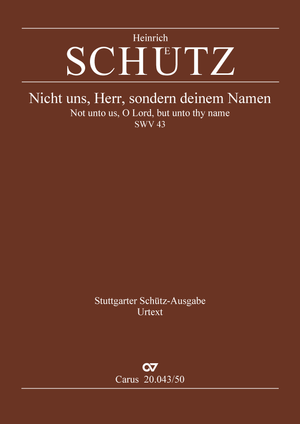
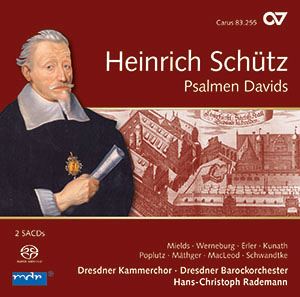
Schütz’s setting of Psalm 115 Nicht uns, Herr, sondern deinem Namen is the only one of his Psalmen Davids, published in Dresden in 1619, which begins with a unison intonation, as also found in his late works (“Schwanengesang”). The three choirs in the work have different tessituras. The middle one is scored purely for voices, whereas in the one with a high tessitura only the lowest part is sung, and conversely in the one with low tessitura only the highest part is sung – the extremes are left to cornetts and trombones. Through this artistic treatment, the effect of the widely-spaced tessitura used to achieve color is considerably enhanced. With this publication of Psalm 115 in a separate edition, the last of the Psalmen Davids is now available in a separate edition corresponding with the principles of the Stuttgart Schütz Edition.
Explore


 Listen
(1)
Listen
(1)
- Not unto us, O Lord, but unto thy name
 Additional material
- Purchase additional material as a download product.
-
 Digital text (without sheet music) incl. printing licence, html file, singing text, english translationhtml file, singing text, english translation (Sample)
Not unto us, O Lord, not unto us, but unto thy name give glory, for thy mercy, and for thy truth’s sake. Wherefore should the heathen say, Where is now their God? But our God is in the heavens: he hath done whatsoever he hath pleased. Their idols are silver and gold, the work of men’s hands. They have mouths, but they speak not: eyes have they, but they see not: They have ears, but they hear not: noses have they, but they smell not: They have hands, but they handle not: feet have they, but they walk not: neither speak they through their throat. They that make them are like unto them; so is every one that trusteth in them. O Israel, trust thou in the Lord: he is their help and their shield. O house of Aaron, trust in the Lord: he is their help and their shield. Ye that fear the Lord, trust in the Lord: he is their help and their shield. The Lord hath been mindful of us: he will bless us; he will bless the house of Israel; he will bless the house of Aaron. He will bless them that fear the Lord, both small and great. The Lord shall increase
...
-
Digital text (without sheet music) incl. printing licence, html file, singing text, originalhtml file, singing text, original (Sample)
Nicht uns, Herr, nicht uns, sondern deinem Namen gib Ehre um deine Gnad und Wahrheit. Warum sollen die Heiden sagen: Wo ist nun ihr Gott? Aber unser Gott ist im Himmel, er kann schaffen, was er will. Jener Götter aber sind Silber und Gold, von Menschen Händen gemacht. Sie haben Mäuler und reden nicht, sie haben Augen und sehen nicht, sie haben Ohren und hören nicht, sie haben Nasen und riechen nicht, sie haben Hände und greifen nicht, Füße haben sie und gehen nicht und reden nicht durch ihren Hals. Die solche machen, sind gleich also und alle, die auf sie hoffen. Aber Israel hoffe auf den Herren. Der ist ihre Hülf und Schild. Das Haus Aaron hoffe auf den Herren. Der ist ihre Hülf und Schild. Die den Herren fürchten, hoffen auf den Herren! Der ist ihre Hülf und Schild. Der Herr denket an uns und segnet uns; er segnet das Haus Israel, er segnet das Haus Aaron. Er segnet, die den Herrn fürchten, beides klein und groß. Der Herr segnet euch je mehr und mehr, euch und eure Kinder. Ihr
...
-
Digital text (without sheet music) incl. printing licence, html file, Introductory text, englishhtml file, Introductory text, english (Sample)Text from the CD Carus 83.255
Oliver Geisler
Translation: Elizabeth Robinson“intended for singing”
The “Psalmen Davids” and the art of consolation Heinrich Schütz was fortunate. In the years around 1600 the number of portents of the end of the world increased. And this would also naturally affect the Dresden court, even if it sometimes seemed to be in a world of its own. Constellations of stars, curious events, cometary impacts – all these happenings were rapidly broadcast through the mass media of the Baroque – pamphlets and articles. And the more frequently there were signs giving cause for concern, the nearer the predicted end approached. In the mid-16th century, 2046 was marked out as the end. But at the time when Schütz took up his post in Dresden, the year 1625 was regarded as the point in time when the ‘last trumpet’ would sound. None of this happened – as stated, he was fortunate,...
-
Digital text (without sheet music) incl. printing licence, html file, Introductory text, germanhtml file, Introductory text, german (Sample)Booklet-Text der CD Carus 83.255
Oliver Geisler
„zum singen gemeint“
Die Psalmen Davids und die Kunst des Zuspruchs Heinrich Schütz hatte Glück. In den Jahren um 1600 mehrten sich die Anzeichen für den Weltuntergang. Und der würde natürlich auch den Dresdner Hof betreffen, auch wenn dieser mitunter als eigener Kosmos erscheinen mochte. Sternenkonstellationen, kuriose Ereignisse, Kometeneinschläge – alle diese Geschehnisse verbreiteten sich rasant über die Massenmedien des Barock: Flugblätter und Sonderdrucke. Und je häufiger die besorgniserregenden Zeichen, desto näher rückte das prognostizierte Ende. Mitte des 16. Jahrhunderts war noch 2046 als Ende markiert. Zu jener Zeit, als Schütz in Dresden sein Amt antrat, galt das Jahr 1625 als Zeitpunkt, an dem die ‚letzte Posaune‘ erklingen würde. All das trat nicht ein – wie gesagt, er hatte Glück, aber eine Prognose bewahrheitete...
Purchase
Additional product information
-
Composer
Heinrich Schütz
| 1585-1672Heinrich Schütz is regarded as the first German musician of European stature. As a choirboy from 1599 at the court of Landgrave Moritz of Hessen-Kassel, he received a thorough education. In 1608 he began a law degree in Marburg, but broke this off in 1609 in order, with the support of the Landgrave, to study composition with Giovanni Gabrieli, organist at St Mark’s in Venice. In 1613 Schütz returned to Kassel, but two years later was enticed away by Elector Johann Georg I of Saxony to the Dresden court as “Organist und Director der Musica”, where he held the position of Hofkapellmeister (court Kapellmeister) from 1617 until his death. Schütz’s great cycles of vocal works marked the high point of his reputation in Germany and northern Europe. But these represent only part of Schütz’s output; individual works are represented in printed collections with works by other composers, others only survive in manuscript, and much has been lost. The Stuttgart Schütz Edition makes available Schütz’s complete oeuvre, and all works are also published in practical Urtext editions. Personal details
-
Editor
Uwe Wolf
| 1961As a musicologist, Dr. Uwe Wolf is particularly at home in the 17th and 18th centuries. The focus of his work ranges from the time of Monteverdi and Schütz to Bach and the generation of Bach's sons and pupils through to Viennese Classicism. He has been head of the editorial department at Carus-Verlag since October 2011. Prior to this, he worked in Bach research for over 20 years. Personal details
Reviews
... Wie von Carus gewohnt, ist die Ausgabe sehr gut lesbar und auch optisch schön ausgeführt.
Monika Fahrnberger, singende kirche, 02/2020
Monika Fahrnberger, singende kirche, 02/2020
Reviews on our website can only be submitted by customers with a registered user account. A check whether the rated products were actually purchased does not take place.
No feedback available for this product.
Frequent questions about this work
 There are no questions and answers available so far or you were unable to find an answer to your specific question about this work? Then click here and send your specific questions to our Customer Services!