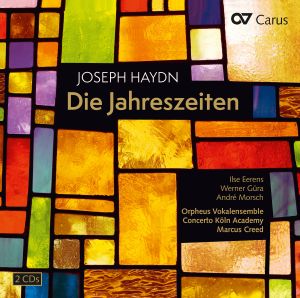
Haydn’s great late work in a modern Urtext edition. Joseph Haydn’s two late oratorios The Creation (Die Schöpfung) and The Seasons (Die Jahreszeiten) should in many ways be regarded as of equal importance. They have a close intellectual connection with each other: whilst The Creation paints a picture of the world coming into existence as in the account in Genesis, The Seasons is about the existence of the world over the course of a year, about how the meaning of creation applies in the actual life of people through the cyclical growth and decay of nature. In compositional terms, in The Seasons Haydn follows on from formal elements in The Creation in many respects, but at the same time continues these in independent, innovative ways. So here, a fresh and creative power is seen which is in no way inferior to that in Die Schöpfung.
For this edition the sources regarded as definitive, that is the original parts from the first performance and the first printed edition, have been consulted in a careful evaluation of the variant readings. In order to distinguish between the variant readings, passages and items adopted from the first printed edition are highlighted graphically. Thus a musical text is offered which can claim the greatest possible authenticity. The performance material is laid out so that various different original scorings can easily be realised. The material includes a harpsichord part for all the numbers, and a chorus score. The vocal score is based on the original reduction by August Eberhard Müller, which was specifically praised by Haydn, lightly arranged to conform with modern-day requirements.
- New Urtext edition
- Based on the sources regarded as definitive
- Graphic solution to distinguish the variant readings
- Flexible performance material for problem-free use in different original scoring options
Explore
 View
View


 Listen
(40)
Listen
(40)
- Einleitung Frühling. Recitativo (STB): Seht, wie der strenge Winter flieht
- Coro: Komm, holder Lenz
- Recitativo (B): Vom Widder strahlet jetzt
- Aria (B): Schon eilet froh der Ackermann
- Recitativo (T): Der Landmann hat sein Werk vollbracht
- Coro: Sei nun gnädig, milder Himmel
- Recitativo (S): Erhört ist unser Flehn
- Coro (STB, Coro): O, wie lieblich ist der Anblick
- Einleitung Sommer. Recitativo (TB): In grauem Schleier rückt heran
- Aria. Recitativo (SB): Der muntre Hirt versammelt nun
- Coro (STB, Coro): Sie steigt herauf, die Sonne
- Recitativo (B): Nun regt und bewegt sich alles umher
- Recitativo (T): Die Mittagssonne brennet jetzt
- Cavatina (T): Dem Druck erlieget die Natur
- Recitativo (S): Willkommen jetzt, o dunkler Hain
- Aria (S): Welche Labung für die Sinne
- Recitativo (STB): O seht! Er steiget in der schwülen Luft
- Coro: Ach! Das Ungewitter naht
- Terzetto con Coro (STB, Coro): Die düstren Wolken trennen sich
- Einleitung Herbst. Recitativo (S): Was durch seine Blüte
- Recitativo (T): Den reichen Vorrat führt er nun
- Terzetto con Coro (STB, Coro): So lohnet die Natur den Fleiß
- Recitativo (STB): Seht, wie zum Haselbusche dort
- Duetto (ST): Ihr Schönen aus der Stadt, kommt her
- Recitativo (B): Nun zeiget das entblößte Feld
- Aria (B): Seht auf die breiten Wiesen hin
- Recitativo (T): Hier treibt ein dichter Kreis
- Coro: Hört, hört das laute Getön
- Recitativo (STB): Am Rebenstocke blinket jetzt
- Coro: Juchhe! Juchhe! Der Wein ist da
- Einleitung Winter. Recitativo. Cavatina (SB): Nun senket sich das blasse Jahr
- Recitativo (T): Gefesselt steht der breite See
- Aria (T): Hier steht der Wandrer nun
- Recitativo (STB): So wie er naht
- Coro (S, Coro): Knurre, schnurre, knurre
- Recitativo (T): Abgesponnen ist der Flachs
- Coro (S, Coro): Ein Mädchen, das auf Ehre hielt
- Recitativo (B): Vom dürren Oste dringt
- Aria (B): Erblicke hier, betörter Mensch
- Coro (STB; Coro): Dann bricht der große Morgen an
 Additional material
- Purchase additional material as a download product.
-
 Digital text (without sheet music) incl. printing licence, html file, Introductory text, englishhtml file, Introductory text, english (Sample)Abridged foreword of the Edition Carus 51.980
Ernst Herttrich
Translation: Gudrun and David KosvinerThe premiere of The Creation on 30 April 1798 at the Palais Schwarzenberg in Vienna was the greatest success Haydn had ever experienced, so it was only natural that he and his librettist Gottfried van Swieten embarked on a new, similar project soon afterwards. When the first public performance of The Creation took place on 19 March 1799, causing a veritable storm of enthusiasm among the so-called “general public,” Haydn was already working on “a new great work after Thomson’s Seasons, which the worthy Privy Councillor Freyherr van Swieten had arranged metrically, and of which he had already completed the first section, Spring.” At any event, this was the announcement in the Allgemeine Musikalische Zeitung (AMZ) published by Breitkopf & Härtel a few days after said performance (24 March 1799). Breitkopf probably received the corresponding information from Georg August Griesinger, who acted as the Viennese liaison between Haydn and the publishing house.
By this time – if one may believe a letter from the Countess Charlotta of Schleswig-Holstein-Gottorf dated 17 March
...
-
Digital text (without sheet music) incl. printing licence, html file, Introductory text, germanhtml file, Introductory text, german (Sample)Gekürztes Vorwort der Ausgabe Carus 51.980
Ernst Herttrich
Die Uraufführung der Schöpfung am 30. April 1798 im Palais Schwarzenberg in Wien war der größte Erfolg, den Haydn bis dahin erlebt hatte. Es war also nur natürlich, dass er und sein Textdichter Gottfried van Swieten danach rasch ein neues, ähnlich geartetes Projekt in Angriff nahmen. Als am 19. März 1799 die erste öffentliche Aufführung der Schöpfung stattfand und beim sogenannten „großen Publikum“ regelrechte Begeisterungsstürme auslöste, saß Haydn bereits an der Arbeit an „ein[em] neuen grossen Werk, welches der würdige Herr Geheimrath Freyherr van Swieten nach Thomsons Jahreszeiten metrisch bearbeitet, und wovon er bereits die erste Abtheilung, den Frühling, fertig hat“. Das ließ zumindest die bei Breitkopf & Härtel erscheinende Allgemeine Musikalische Zeitung (AMZ) wenige Tage nach besagter Aufführung, am 24. März 1799, verlauten. Den entsprechenden Hinweis dürfte Breitkopf von Georg August Griesinger erhalten haben, der als Wiener Verbindungsmann zwischen Haydn und dem Verlag fungierte.
Wenn man einem Brief der
...
-
Digital text (without sheet music) incl. printing licence, html file, singing text, originalhtml file, singing text, original (Sample)THE SEASONS The Spring 1. Overture · Recitativo
The Overture paints the passage from the winter to the spring.
Simon
Behold where surly winter flies!
Far to the north he passes off.
He calls his ruffian blast,
they soon the forest, hill and vale,
with dreadful roarings quit.Lukas
Behold, from craggy rocks the snows
in livid torrents melted run!Hanne
2. Coro
Forth fly the tepid airs,
and from the southern shores allure
the messenger of spring.Chorus of country people
Come, gentle spring, ethereal mildness, come!
And from her wintry grave bid drowsy nature rise.Women and girls
See, gentle spring delightful comes!
Her soft and balmy breath we feel,
the joy of renovated life.The men
As yet the year is unconfirm’d,
and oft, and oft returning winter’s blast,
or black envenom’d fog the bud
and bloom destroys, the bud and bloom destroys.All
Come, gentle spring, ethereal mildness, come!
And smiling on our plains descend;
O come, gentle spring, o come while music wakes around,
O come, and smiling...
-
Digital text (without sheet music) incl. printing licence, html file, singing text, english translationhtml file, singing text, english translation (Sample)DIE JAHRESZEITEN Der Frühling 1. Einleitung · Recitativo
Die Einleitung stellt den Übergang vom Winter zum Frühling vor
Simon
Seht, wie der strenge Winter flieht!
Zum fernen Pole zieht er hin.
Ihm folgt, auf seinen Ruf,
der wilden Stürme brausend Heer
mit grässlichem Geheul.Lukas
Seht, wie vom schroffen Fels der Schnee
in trüben Strömen sich ergießt!Hanne
2. Coro
Seht, wie vom Süden her,
durch laue Winde sanft gelockt,
der Frühlingsbote streicht!Chor des Landvolks
Komm, holder Lenz!
Des Himmels Gabe, komm!
Aus ihrem Todesschlaf
erwecke die Natur.Weiber und Mädchen
Er nahet sich, der holde Lenz.
Schon fühlen wir den linden Hauch;
bald lebet alles wieder auf.Die Männer
Frohlocket ja nicht allzufrüh!
Oft schleicht in Nebel eingehüllt,
der Winter noch zurück und streut
auf Blüt und Keim sein starres Gift.Alle
Komm, holder Lenz!
Des Himmels Gabe, komm!
Auf unsre Fluren senke dich!
Komm, holder Lenz, o komm,...
Purchase
Additional product information
Contents
-
Composer
Joseph Haydn
| 1732-1809As Kapellmeister to Prince Esterházy, Haydn composed numerous instrumental works and various operas, as well as making important contributions to the genre of church music, including fourteen Latin masses, of which only twelve are authentic or complete; these are complemented by motets and offertories, two important Te Deum settings, two Salve Reginas, a Stabat Mater, and the different versions of the Sieben Worte des Erlösers am Kreuze. The masses were composed continually between 1749 and 1802, except for the years 1783–1795, and therefore constitute the genre with which Haydn was occupied over the longest period of time. The six (authentic or complete) masses composed before 1782 are stylistically very different, and as well as short Missae breves there are more extended masses with rich orchestral scoring; by contrast the six so-called late masses, written from 1796 onwards, form a comparatively homogeneous group of more extensive works scored for large forces. With his two great oratorios Die Schöpfung (The Creation) (1798) and Die Jahreszeiten (The Seasons) (1801) Haydn established the tradition of the German oratorio for middle-class music making. Personal details
-
Editor
Ernst Herttrich
-
Songwriter / Librettist
Gottfried van Swieten
| 1733-1803
Reviews
... Die vorliegende, in jeglicher Hinsicht gewichtige Partitur ist gebunden und wirkt so, als könne sie mehrere Aufführungen schadlos überstehen, auch grafisch macht die Ausgabe einen perfekten Eindruck.
Kirchenmusik im Bistum Limburg, 01/2021
Kirchenmusik im Bistum Limburg, 01/2021
Reviews on our website can only be submitted by customers with a registered user account. A check whether the rated products were actually purchased does not take place.
No feedback available for this product.
Frequent questions about this work
Which sources is the Carus Urtext edition of Die Jahreszeiten (The Seasons) based on?
1.) On the original copies of the parts which were used for the first performances, conducted by Haydn himself.
2.) On the first printed edition of the score dating from 1802.
What are the special features of the Carus edition?
1.) The original parts are regarded as the most important source; but the first printed edition, which can partly be regarded as the “ final authorised version”, has also been consulted in a meticulous evaluation of the variant readings. Items adopted from the first printed edition are highlighted graphically, so that the two sources can be differentiated.
2.) A detailed Critical Report with commentary on doubtful variant readings is included. At the same time, important differences between readings are made visible as ossia versions directly in the music, so that an overview can be had at a glance.
Is there a harpsichord part for the complete work?
Yes. Both the sources as well as contemporary performance practice indicate that a harpsichord/fortepiano was used both in the recitatives and elsewhere in other numbers. In line with this, the performance material for our edition contains a basso continuo realization for all the numbers in the work. So, the keyboard instrument can be used throughout, or just in particular selected numbers or passages, according to taste.
Is a contrabassoon required for a performance?
No, but the Carus edition contains a contrabassoon part for use in performances where a contrabassoon is available. The basis for this are the parts from the original performance material. There is no evidence that Haydn actually authorized these, but this cannot be ruled out.
Are three trumpets necessary for a performance?
The 3rd trumpet can also be omitted. It only appears in the final chorus of the work and largely functions there to reinforce the 2nd trumpet in unison, apart from a few measures at the end of the movement. The 3rd trumpet part is also printed in these measures in the trumpet II part in our edition. So the 2nd trumpet has the option of playing the 3rd trumpet part if no 3rd trumpeter is available.
Did you know ...
... that “Die Jahreszeiten” (The Seasons) is the penultimate complete work which Haydn composed (followed only by the Harmoniemesse)? And that this late work contains many astonishingly innovative features? Here, for example, by creating overarching formal structures – with sequences of numbers in varied scorings – Haydn abandons the traditional sequence of recitative–aria–chorus. The instrumental introductions to the four parts – each one a musical treasure in itself – are new and unusual of their kind. And thus in “Die Jahreszeiten” (The Seasons), Haydn goes beyond the formal traditions of oratorio as found in “Die Schöpfung” (The Creation).
 There are no questions and answers available so far or you were unable to find an answer to your specific question about this work? Then click here and send your specific questions to our Customer Services!