

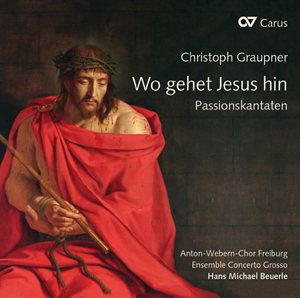
Wo gehet Jesus hin. Passionskantaten
 Listen
(29)
Listen
(29)
- 1. Dictum (Coro): Wir wissen, dass Trübsal Geduld bringet
- 2. Recitativo (Tenore): Ein Kind der Finsternus
- 3. Duetto. Largo (Tenore, Basso): Ach Jesu, lass Dich mein’ erbarmen!
- 4. Choral (Coro): Ich weiß, Du hast meiner noch nicht vergessen
- 5. Recitativo (Soprano): So gehen Gläubige den Heiland an
- 6. Aria. Vivace (Soprano): Herr, ich schreie! Willst Du schweigen?
- 7. Choral (Coro): Es hat kein Unglück je so lang gewähret
- 1. Accompagnato (Basso): Wo gehet Jesus hin?
- 2. Coro. Aria (Coro): Ach, saurer Gang
- 3. Choral. Allabreve (Coro): Herzliebster Jesu, was hast Du verbrochen
- 4. Recitativo (Soprano): Das Fleisch ist leider blind
- 5. Aria. Vivace (Soprano): Jesu, öffne mir die Augen
- 6. Recitativo (Basso): Der Geist hat alle Willigkeit in dieser Zeit
- 7. Choral. Allabreve (Coro): Dies alles, ob’s für schlecht zwar ist zu schätzen
- 1. Dictum (Basso, Tenore): Freund, warum bist Du kommen?
- 2. Recitativo accompagnato (Soprano): Ach Jesu, wie so wehe
- 3. Aria. Affettuoso (Soprano): Aller Jammer, alle Plagen
- 4. Recitativo (Basso): Ihr, die ihr euch nach Christo nennt
- 5. Aria (Basso): Der Herr ist treu
- 6. Recitativo accompagnato (Alto): Ihr Freunde Jesu, wacht
- 7. Choral (Coro): Herr, lass Dein bitter Leiden
- 1. Dictum (Coro): Mein Gott! Mein Gott! Warum hast Du mich verlassen?
- 2. Recitativo (Basso): Ach große Not, ach schwere Klage!
- 3. Aria (Basso): Gott will den einz’gen Sohn verlassen
- 4. Choral (Coro): Nun, was du, Herr, erduldet
- 5. Recitativo (Tenore): Ich weiß, o Jesu, all Dein Leiden
- 6. Aria. Duetto (Alto, Tenore): Stirb, mein Herz, dem eitlen Wesen
- 7. Recitativo (Basso): Verlass die Welt
- 8. Choral (Coro): Erscheine mir zum Schilde
Contents
-
Composer
Christoph Graupner
| 1683-1760
-
Preface writer
Hans Michael Beuerle
-
Ensemble
Anton-Webern-Chor Freiburg
The Anton-Webern-Chor Freiburg is a professional vocal ensemble consisting of 8 to 24 singers, according to the program. In spite of its name, the Anton-Webern-Chor is not an ensemble specializing in new music. On the contrary – and entirely in the spirit of the compositional thinking of its namesake which was firmly rooted in tradition –, it cultivates the entire range of vocal ensemble music from renaissance to avant-garde. This versatility in no way implies foregoing a thorough study of the epochal-stylistic and foundations of performance practice for each particular composition; rather it corresponds with the experience that a widening of the angle of historical perception is just as conducive to the understanding and emotional comprehension of the music, and indeed equally necessary as focusing on each specific piece. Accordingly, the Anton-Webern-Chor has not only studied intensely such a variety of works as, for example, Monteverdi’s Marian Vespers, Bach’s B Minor Mass, Mozart’s Requiem, Rossini’s Petite Messe, Brahms’ a cappella works, Webern’s cantatas and choral compositions by Ligeti, Nono, Zender, Holliger and Rihm; from time to time, there were also programs in which musical works from several centuries were performed in multifaceted reflection of each other. Frequently, literary texts provided the axis of such reflections. One of the consequences of this content-based concept was – and remains – the opportunity, apart from concertizing in the customary environment, to explore ever new forms of performance and communication and in so doing, collaborate with artists from neighboring genres. Personal details
-
Ensemble
Ensemble Concerto Grosso
Ensemble Concerto Grosso led by concertmaster Swantje Hoffmann consists of instrumental soloists from the foremost German baroque orchestras. The trumpeter Reinhold Friedrich initiated the founding of the ensemble, which together with the Anton-Webern-Chor Freiburg performed Bach’s B Minor Mass in several concerts two years ago, conducted by Hans Michael Beuerle and the ensemble continues to collaborate closely with him. A particular interest of the Ensembles Concerto Grosso, founded in 2006, is the regular performance – along with the central baroque repertoire – of compositions by composers which have been unjustly forgotten or rarely played: Thus it presented a program of instrumental compositions by Samuel Endler, Christoph Graupner’s Vice-Kapellmeister at the Darmstadt court. Numerous successful concerts in renowned venues such as the Schleswig-Holstein Music Festival, the Ludwigsburger Schlossfestspiele, the Philharmonic halls in Essen and Cologne as well as the Festspielhaus Baden-Baden have extended and consolidated the ensemble’s reputation. Personal details
-
Conductor
Hans Michael Beuerle
-
Soloist - soprano
Gunhild Lang-Alsvik
Gunhild Lang-Alsvik, born in Trondheim, studied voice in Oslo (Barbro Marklund-Petersone and Håkan Hagegård), where she graduated in 2005. She continued her studies with Evelyn Tubb at the Schola Cantorum Basiliensis, specializing in the performance of early music. Although as a singer her primary interest lies in the field of baroque and classical music, she also enjoys singing romantic repertoire, and occasionally, contemporary music. She is in great demand as a soloist, concertizing throughout Europe. Recently she has performed at, among other venues, the Zurich Tonhalle, the Herkulessaal in Vienna and for the Jeunesse subscription concerts in Austria. Personal details
-
Soloist - soprano
Sonja Bühler
Soprano Sonja Bühler studied voice at Rowan University, USA (M. Stieber) and at the Hochschule für Musik in Freiburg (T. Sato-Schöllhorn). She performs as a concert and opera singer in the USA, Europe, South America and Asia and is a freelance member of the SWR Vokalensemble and the Bayerische Rundfunkchor. Her performances with the Anton-Webern-Chor have included, among others, the role of Bathseba in the premiere of the chamber opera König David by Uroš Rojko (directed by M. Günther) in Freiburg. In October of this year she was heard in Bruckner’s F minor Mass at the Musiktage St. Peter (directed by Morten Schuldt-Jensen). Sonja Bühler’s repertoire ranges from renaissance to contemporary music. Personal details
-
Soloist - soprano
Felicitas Fuchs
Felicitas Fuchs received her musical and vocal training at the Guildhall School of Music and Drama in London. She also attended master classes with, among others, Dietrich Fischer-Dieskau, Kurt Widmer, Cecilia Bartoli and Emma Kirkby. Since winning the Bayerische Rundfunk Lied competition ’La Voce’ in 2006, she has been active as a lieder singer, concerts and opera. Some significant performances include: Haydn The Seasons in Osaka, Pamina in The Magic Flute at the Gärtnerplatz Theater in Munich, Mozart’s Requiem in the Philharmonic Hall St. Petersburg, the leading role in the world premiere and tour of Andrew Schultze’s new work Stille Sprache in Australia, Singapore and Europe. Personal details
-
Soloist - alto
Barbara Ostertag
Barbara Ostertag from Freiburg/Breisgau studied musicology and voice. She is in demand both as soloist and as voice teacher. Her oratorio repertoire ranges from Bach’s passions, Handel’s Messiah and Rossinis Petite Messe to Martin’s Golgotha. She has performed several convincing Lieder recitals accompanied by piano and guitar and is frequently heard on the opera stage. She also sings in a number of professional vocal ensembles apart from the Anton-Webern-Chor, especially the Balthasar-Neumann- Chor and the new music ensemble Schola Heidelberg. Barbara Ostertag has been invited to sing at several festivals at home and abroad, including in Australia and South Korea. Personal details
-
Soloist - countertenor
Julien Freymuth
Julien Freymuth, born in Colmar, was educated in Versailles (Centre de Musique Baroque and Conservatoire). Both as ensemble singer and as soloist he worked together with the conductors G. Leonhardt, T. Koopman, P. Herreweghe, J. Rifkin, C. Rousset, H. Niquet, H. M. Beuerle and B. Haller. In the latter’s Chapelle Rhénane he performed, among others, in concerts and a CD recording of Bach’s St. John Passion. In addition to France and Germany he has concertized in Austria, Italy, Poland, Portugal, Spain, the Netherlands and Switzerland. Coming projects include a China tour with French baroque music and a program of cantatas by Vivaldi, Caldara and J. S. Bach. Personal details
-
Soloist - tenor
Michael Feyfar
Michael Feyfar received his first singing training in the Knabenkantorei Basel. He studied in Bern, Karls ruhe (D. Litaker) and at the Schola Cantorum Basiliensis (G. Türk). Michael Feyfar’s repertoire encompasses music from early baroque to contemporary and includes Lieder, oratorio and opera. Thus, he recently performed the Winterreise as well as Janacek’s Zápisníník zmizelého (The Diary of one who disappeared), recorded by the SWR. He is in great demand as Evangelist in Bach’s passions and regularly performs in free opera productions, such as Orphée in Gluck’s Orphée et Euridice (Baroque Opera Schloss Waldegg), in G. F. Haas’s chamber opera Das Schwarz (Lucerne Festival) as well as in other roles, e. g., as ?ekalinskij in Pique Dame at the Basel Theater. Personal details
-
Soloist - bass
Markus Flaig
| 1971
Reviews
Alles Ersteinspielungen, für die in diesen Wochen durchaus schon mal die Bach’schen Bestseller im Schrank bleiben können. Chor und Ensemble agieren mit klar konturierten Registern zur Umsetzung eleganter vokaler Linien (mit einer geradezu erlesenen Deutung der intensiven Choräle). Deutlich hör- und spürbar wird vor allem aber auch, dass Christoph Graupner sich nicht hinter den „Promis“ seiner Zeit zu verstecken brauchte, sondern eine hohe eigene Erfindungsgabe einbringen konnte.
Kirchenzeitung/Bistumspresse, Ausgabe 2013.11 - 17. März 2013
Beuerle, der Anton-Webern-Chor Freiburg und das Ensemble Concerto Grosso: Sie gestalten die Funde schlank und sehr klar. So muss es sein, denkt man beim Hören oft. Text, Musik und Darbietung bilden hier ein geschlossenes Ganzes. Interpretationen mit Referenzcharakter.
(Johannes Adam, Badische Zeitung, 23. Juni 2012)
Lively performances.
(BBC Music Magazine, Mai 2012)
… Hans Michael Beuerle, den vorzüglichen Gesangssolisten, dem sehr genau artikulierenden Anton-Webern-Chor Freiburg und dem differenziert musizierenden Ensemble Concerto Grosso ist eine in jeglicher Hinsicht hervorragende Einspielung der Kantaten zu verdanken.
(Ingeborg Allihn, Musik & Kirche, Mai/Juni 2012)
… Die Einspielung unter Hans Michael Beuerle lässt keine Wünsche offen - außer dem, noch mehr von diesem Komponisten zu hören.
(Kirchenmusikalische Mitteilungen Erzdiözese Freiburg, Mai 2012)
Welcome rediscovery.
(BBC Radio, 7. April 2012)
Der Dirigent Hans Michael Beuerle ist bislang eher Insidern bekannt - denen allerdings als ein sehr solider Musiker. Gerade diesen unbekannten Werken begegnet er mit großer Ernsthaftigkeit und deutet sie bis ins Detail aus. Zurückgreifen kann er dabei auf einen erstklassig eingestellten Anton-Webern-Chor, ein exquisites Solistenensemble und sein sehr ambitioniert und auf Klangschönheit bedachtes Ensemble „Concerto Grosso”.
(MDR Figaro, 4. April 2012)
… Das Ensemble singt erzählerisch, textnah, mit einer schönen Agogik, und weiß Graupner Musik punktgenau zu differenzieren. … Genauso feinfühlig ist die Artikulation des Ensembles Concerto Grosso, sodass wir es insgesamt mit einer homogenen, durchdachten und emotional gestalteten Interpretation von vier kaum bekannten Graupner-Werken zu tun haben. …
(pizzicato, April 2012)
Concise, compact, undemonstrative but not at all cold … performed with care and thoughtfulness. …
(Jonathan Woolf, musicweb-international.com, 12. März 2012)
Der Anton-Webern-Chor Freiburg … demonstriert den höchsten Stand des barocken Kammerchorsingens. …
(Richard Lorber, Fono Forum, April 2012)
… Beuerle und seine Mitstreiter plädieren mit einem differenzierten Ansatz für die Musik Christoph Graupners und spüren den variantenreichen Sätzen mit Feingefühl nach. …
(Dr. Matthias Lange, www.klassik.com, 4. März 2012)
… Die CD ist äußerst hörenswert, da sie mit ihrem Überschwang und ihrer Lebensfreude jeglichen Winter-Blues vertreibt. Graupners intelligente und gewitzte Kompositionen sind eine perfekte, geistreiche Unterhaltung, die von Azzolini, Wezel und dem Ensemble il capriccio kongenial umgesetzt wird.
(Christiane Bayer, klassik.com, 27. Februar 2011)
Reviews on our website can only be submitted by customers with a registered user account. A check whether the rated products were actually purchased does not take place.
Frequent questions about this work
 There are no questions and answers available so far or you were unable to find an answer to your specific question about this work? Then click here and send your specific questions to our Customer Services!