

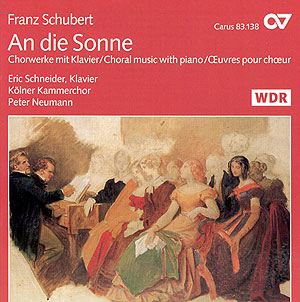
An die Sonne. Chormusik mit Klavier
 Listen
(9)
Listen
(9)
- Prayer
- Psalm 23
- O sun, you queen of all the world
- Gott im Ungewitter
- Gott, der Weltschöpfer
- Hymne an den Unendlichen
- Soft approaching, in the silence of darkness
- He is gone on the mountain
- Mirjams Siegesgesang
Contents

-
Composer
Franz Schubert
| 1797-1828Throughout most of his life Franz Schubert was concerned with church music. When he was eleven he was chosen as treble soloist at his local church in the Vienna suburb of Lichtenthal and soon afterwards he was admitted to the choir of the Imperial Court Chapel, directed by Antonio Salieri. Soon he also began to compose; his earliest surviving sacred pieces date from 1812. During his lifetime his church music achieved a comparatively wide degree of acceptance but after his death, most notably, his smaller works were unjustly forgotten. The Carus programme encompasses Schubert’s complete sacred compositions and it is intended to emphasize the wide range of his works in this area. Many of the smaller liturgical compositions are published here for the first time in separate editions. What is to be discovered is a fascinating œuvre, rooted in the ‘stile antico’ of Antonio Salieri and in the compositions of the Viennese classical masters, but whose exquisite lyricism and harmonic subtlety reveal a typically Schubertian world of expression: works with great power of conviction and exceptional musical beauty. Personal details
-
Preface writer
Thomas Synofzik
| 1966
-
Ensemble
Kölner Kammerchor
-
Conductor
Peter Neumann
| 1940-2025In recent years Peter Neumann, born in Karlsruhe, has made a name for himself particularly as a conductor of Handel’s music. This is demonstrated both by the concert series “250 Years Handel Oratorios” which he initiated – performing nine music dramas in accordance with Handel’s concert schedule of 1749–1752 – and by his numerous CD recordings. He has performed masterworks from vocal and orchestral music in the European musical capitals and at many renowned festivals, ranging from Monteverdi’s L’Orfeo and Vespers for the Blessed Virgin (Palais Garnier, Paris) through J. S. Bach’s passions (last in Moscow, Oslo and Versailles) and Mass in B minor (BBC Proms) to Debussy’s Le Martyre de Saint Sébastien at the MusikTriennale in Cologne. 2010, Peter Neumann and his ensembles Kolner Kammerchor and Collegium Cartusianum were guests at the Rheingau Music Festival with Schumann’s Das Paradies und die Peri and at the Schumann Festival in Dusseldorf as well as the Leipzig Bach Festival in 2011. In June 2012 he made his highly acclaimed debut at the Cologne Opera with Handel’s Alcina. As a guest conductor, Neumann has collaborated with, among others, ChorWerkRuhr, the Netherlands Chamber Choir, the SWR Vokalensemble Stuttgart, the NDR Choir, the Schola Cantorum Tokyo, the Concertgebouw Orchestra Amsterdam, the Jerusalem Symphony Orchestra, the Junge Deutsche Philharmonie and Concerto Koln. Highlights of his extensive discography include the complete recording of Mozart’s masses (Gramophone “Crown of Crowns”), Schutz’s Musical Vesper, Schumann’s Missa sacra (Diapason d’Or) and recordings of Bach’s St. John Passion and Handel’s Alexander’s Feast and Brockes Passion (Carus). Personal details
-
Soloist - soprano
Dorothea Röschmann
-
Soloist - mezzo-soprano
Christiane Buchmann
-
Soloist - piano
Eric Schneider
Reviews
Franz Schubert: An die Sonne
Franz Schubert: An die Sonne
Schubert was not really a choral guy, but his natural affinity for the voice, his matchless genius for songwriting, and his associations with singers not surprisingly led to his composition of a number of works for choir. Most have the raw cast of functionality, of formula (pleasant as it may be), or even of belonging to a simpler genre--a song or hymn. And as you listen to these pieces for chorus and piano--some quite ambitious in length and structure--you may not be so impressed with their invention or complexity as you are with their sincerity of conception and expression. This sincerity also applies to the excellent Köln Kammerchor’s performances, which unfailingly treat these works for mixed choir and soloists, SATB quartet, and women’s chorus with affection and consummate professionalism. Although Brahms had far more to offer in this medium, Schubert brings an exuberance and skilled compositional technique to these settings, whether a Psalm--the beloved No. 23 for four-part women’s choir--or a cantata--the heavily-wrought, wrenchingly dramatic Mirjams Siegesgesang.
This production, from 1996, is fortunate to have the services of soprano Dorothea Röschmann, who over the past 10 years has become one of the world’s foremost opera and lieder singers, and her solo contributions here, while not extensive, are notable. As usual, the Köln Kammerchor shows a consistently well-formed interpretive foundation and impeccable ensemble singing. The sound is a bit too dense and „busy”--textures congeal rather than spin in distinct threads, so we tend to hear a clump of sound rather than a layered blend. But overall we’re given a faithful, idiomatic presentation of nine of Schubert’s lesser-known but meaningful works, one of which, the cantata Mirjams Siegesgesang, he intended to orchestrate before death overtook him at age 31. As usual for Carus, texts are given in German only.
David Vernier
Quelle: Classics today
Reviews on our website can only be submitted by customers with a registered user account. A check whether the rated products were actually purchased does not take place.
Frequent questions about this work
 There are no questions and answers available so far or you were unable to find an answer to your specific question about this work? Then click here and send your specific questions to our Customer Services!