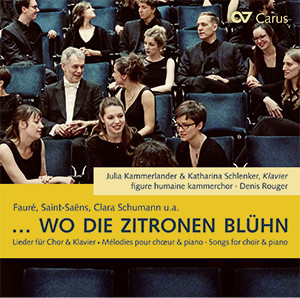
...wo die Zitronen blühn (figure humaine kammerchor)


 Listen
(21)
Listen
(21)
- L'invitation au voyage
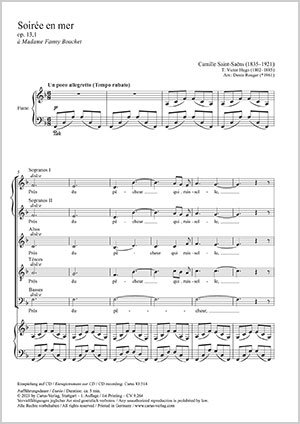
- Soirée en mer
- Adieux de l'hôtesse arabe
- Rêve d'amour
- Tristesse
- Chanson du pêcheur
- Soupir
- Im dunkeln Schoß
- Liebeszauber
- Ich hab in deinem Auge
- O Lust!
- Bergeslust
- Im Herbste
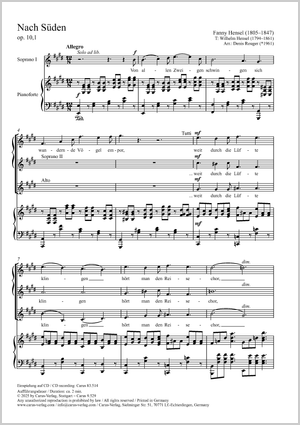
- Nach Süden
- Verschwiegene Liebe
- Der Feuerreiter
- Extase
- Notre amour
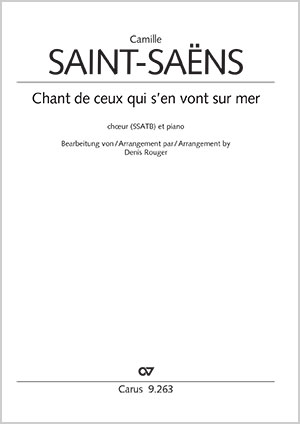
- Chant de ceux qui s'en vont sur mer
- Au pays où se fait la guerre
- Les Djinns
 Practise
-
Pronouncing Aid
- Chant de ceux qui s'en vont sur mer
- Soirée en mer
- Tristesse
- Notre amour
- L'invitation au voyage
- Rêve d'amour
 Additional material
- Purchase additional material as a download product.
-
 Digital text (without sheet music) incl. printing licence, html file, singing text, originalhtml file, singing text, original (Sample)Chant de ceux qui s'en vont sur mer
Adieu, patrie ! L’onde est en furie.
Adieu, patrie, Azur !
Adieu, maison, treille au fruit mûr,
Adieu, les fleurs d’or du vieux mur !
Adieu, patrie ! Ciel, forêt, prairie !
Adieu, patrie, Azur !
Adieu, patrie ! L’onde est en furie.
Adieu, patrie, Azur !
Adieu, fiancée au front pur,
Le ciel est noir, le vent est dur.
Adieu, patrie ! Lise, Anna, Marie !
Adieu, patrie, Azur !
Adieu, patrie ! L’onde est en furie.
Adieu, patrie, Azur !
Notre œil, que voile un deuil futur,
Va du flot sombre au sort obscur !
Adieu, patrie ! Pour toi mon cœur prie.
Adieu, patrie ! Azur !
Victor Hugo (1802–1885)...
-
Digital text (without sheet music) incl. printing licence, html file, singing text, originalhtml file, singing text, original (Sample)Soirée en mer
Près du pêcheur qui ruisselle,
Quand tous deux, au jour baissant,
Nous errons dans la nacelle,
Laissant chanter l’homme frêle
Et gémir le flot puissant ;Sous l’abri que font les voiles
Lorsque nous nous asseyons,
Dans cette ombre où tu te voiles
Quand ton regard aux étoiles
Semble cueillir des rayons ;Quand tous deux nous croyons lire
Ce que la nature écrit,
Réponds, ô toi que j’admire !
D’où vient que mon coeur soupire ?
D’où vient que ton front sourit ?Dis, d’où vient qu’à chaque lame,
Comme une coupe de fiel,
La pensée emplit mon âme ?
C’est que moi je vois la rame...
-
Digital text (without sheet music) incl. printing licence, html file, singing text, german translationhtml file, singing text, german translation (Sample)Gesang derer, die aufs Meer hinausziehen Adieu, Vaterland! Die Wellen toben.
Adieu, Vaterland, Azur!
Adieu, Haus, Weinlaube voller reifer Früchte,
Adieu, güldene Blumen auf der alten Mauer!
Adieu, Vaterland! Himmel, Wald, Wiese!
Adieu, Vaterland, Azur!
Adieu, Vaterland! Die Wellen toben.
Adieu, Vaterland, Azur!
Adieu, Verlobte mit der reinen Stirn,
der Himmel ist schwarz, der Wind ist ungestüm.
Adieu, Vaterland! Lise, Anna, Marie!
Adieu, Vaterland, Azur!
Adieu, Vaterland! Die Wellen toben.
Adieu, Vaterland, Azur!
Unser Auge, das eine zukünftige Trauer trübt, wandert
von der dunklen Flut zum finsteren Schicksal!
Adieu, Vaterland! Für dich betet mein Herz.
Adieu, Vaterland, Azur!
...
-
Digital text (without sheet music) incl. printing licence, html file, singing text, german translationhtml file, singing text, german translation (Sample)Abend auf dem Meer
Nahe dem durchnässten Fischer,
wenn wir beide, während der Tag sich neigt,
im Kahn dahingleiten,
und den schwachen Mann singen
die mächtige Woge rumoren hören;unter dem Schutz der Segel,
wenn wir uns in jenen Schatten setzen,
in den du dich hüllst,
wenn dein Blick von den Sternen
die Strahlen zu pflücken scheint;wenn wir alle beide zu lesen glauben,
was die Natur schreibt,
antworte, oh du, die ich bewundere!
Wie kommt es, dass mein Herz seufzt?
Wie kommt es, dass deine Stirn lächelt?Sage, wie kommt es, dass bei jeder Welle
gleich einem Kelch voller Bitterkeit
Gedanken meine Seele füllen?
Es rührt daher, dass ich das Ruder sehe,...
-
Digital text (without sheet music) incl. printing licence, html file, singing text, german translationhtml file, singing text, german translation (Sample)Unbenanntes Dokument Tristesse
Avril est de retour,
La première des roses,
De ses lèvres micloses,
Rit au premier beau jour,
La terre bienheureuse
S’ouvre et s’épanouit ;
Tout aime, tout jouit.
Hélas ! j’ai dans le cœur une tristesse affreuse.Les buveurs en gaîté,
Dans leurs chansons vermeilles,
Célèbrent sous les treilles
Le vin et la beauté ;...
-
Digital text (without sheet music) incl. printing licence, html file, singing text, german translationhtml file, singing text, german translation (Sample)Unbenanntes Dokument
Unsere Liebe ist etwas Leichtes,
wie die Düfte, die der Wind
von den Spitzen des Farns nimmt,
damit man sie im Traum riecht;
– unsere Liebe ist etwas Leichtes!Unsere Liebe ist etwas Bezauberndes,
wie die Lieder des Morgens,
in denen keinerlei Reue klagt,
in denen eine unbestimmte Hoffnung schwingt;
– unsere Liebe ist etwas Bezauberndes!Unsere Liebe ist etwas Heiliges,
wie die Geheimnisse des Waldes,
in dem eine unbeachtete Seele erschauert,...
-
Digital text (without sheet music) incl. printing licence, html file, singing text, originalhtml file, singing text, original (Sample)Unbenanntes Dokument
Notre amour est chose légère,
Comme les parfums que le vent
Prend aux cimes de la fougère,
Pour qu'on les respire en rêvant ;
– Notre amour est chose légère !Notre amour est chose charmante,
Comme les chansons du matin,
Où nul regret ne se lamente,
Où vibre un espoir incertain ;
– Notre amour est chose charmante !Notre amour est chose sacrée,
Comme les mystères des bois,
Où tressaille une âme ignorée,...
-
Digital text (without sheet music) incl. printing licence, html file, singing text, german translationhtml file, singing text, german translation (Sample)Einladung zur Reise
Mein Kind, meine Schwester,
denk nur, wie lieblich es wäre,
dorthin zu gehen, um zusammen zu leben,
in aller Ruhe zu lieben,
zu lieben und zu sterben
in dem Land, das dir gleicht!Die feuchten Sonnen
dieser trüben Himmel
haben für meinen Geist
den so geheimnisvollen Zauber
deiner verräterischen Augen,
die durch ihre Tränen hindurch glänzen.Dort ist alles nur Ordnung und Schönheit,
Pracht, Ruhe und Wonne.Sieh auf jenen Kanälen
die Schiffe schlafen,
deren Gelüste hin und her schweifen;
um dein kleinstes Begehren
zu stillen,
kommen sie vom Ende der Welt.Die untergehenden Sonnen
bekleiden die Felder,
die Kanäle, die ganze Stadt,
mit Jazinth und Gold;
die Welt entschlummert
in einem warmen Licht!Dort ist alles nur Ordnung und Schönheit,
Pracht, Ruhe und Wonne.Charles Baudelaire (1821–1867)
Übersetzung: Christiane Rouger-Ortwein (*1977)
...
-
Digital text (without sheet music) incl. printing licence, html file, singing text, originalhtml file, singing text, original (Sample)L’invitation au voyage
Mon enfant, ma sœur,
Songe à la douceur
D’aller là-bas vivre ensemble,
Aimer à loisir,
Aimer et mourir
Au pays qui te ressemble !Les soleils mouillés
De ces ciels brouillés
Pour mon esprit ont les charmes
Si mystérieux
De tes traîtres yeux,
Brillant à travers leurs larmes.Là, tout n’est qu’ordre et beauté,
Luxe, calme et volupté.Vois sur ces canaux
Dormir ces vaisseaux
Dont l’humeur est vagabonde ;
C’est pour assouvir
Ton moindre désir
Qu’ils viennent du bout du monde.Les soleils couchants
Revêtent les champs,
Les canaux, la ville entière,
D’hyacinthe et d’or ;
Le monde s’endort
Dans une chaude lumière !Là, tout n’est qu’ordre et beauté,
Luxe, calme et volupté !Charles Baudelaire (1821–1867)
...
-
Digital text (without sheet music) incl. printing licence, html file, singing text, german translationhtml file, singing text, german translation (Sample)Liebestraum
Wenn es eine bezaubernde Wiese gibt,
die der Himmel wässert,
der zu jeder Jahreszeit
blühende Blumen entspringen,
auf der man mit vollen Händen
Lilien, Geißblatt und Jasmin pflückt,
dann möchte ich daraus den Weg machen,
auf den dein Fuß sich setzt!Wenn es eine liebende Brust gibt,
die für die Ehre einsteht,
deren zärtliche Hingabe
nichts Verdrießliches an sich hat,
wenn diese edle Brust immerzu
für eine ehrenwerte Absicht schlägt,
dann möchte ich daraus das Kissen machen,
auf das deine Stirn sich legt!Wenn es einen Liebestraum gibt,
nach Rose duftend,
in dem man jeden Tag
liebliche Dinge findet,
einen Traum, den Gott segnet,
in dem sich die Seele mit der Seele vereint,
oh, dann möchte ich daraus das Nest machen,
in das dein Herz sich legt!Victor Hugo (1802–1885)
Übersetzung: Christiane Rouger-Ortwein (*1977)
...
-
Digital text (without sheet music) incl. printing licence, html file, singing text, originalhtml file, singing text, original (Sample)Rêve d’amour
S’il est un charmant gazon
Que le ciel arrose,
Où naisse en toute saison
Quelque fleur éclose,
Où l’on cueille à pleine main
Lys, chèvrefeuille et jasmin,
J’en veux faire le chemin
Où ton pied se pose !S’il est un sein bien aimant
Dont l’honneur dispose,
Dont le tendre dévouement
N’ait rien de morose,
Si toujours ce noble sein
Bat pour un digne dessein,
J’en veux faire le coussin
Où ton front se pose !S’il est un rêve d’amour
Parfumé de rose,
Où l’on trouve chaque jour
Quelque douce chose,
Un rêve que Dieu bénit,
Où l’âme à l’âme s’unit,
Oh ! j’en veux faire le nid
Où ton cœur se pose !Victor Hugo (1802–1885)
...
Contents


-
Choir
figure humaine kammerchor
figure humaine – the human face – is the inner guiding principle and name of the chamber choir of young musicians from Stuttgart which was founded in 2016. They are all united by the desire to perform choral music of a high chamber music standard. The musical focus of their work is on French and German music of the 19th to 21st centuries. A specialty of the choir and its leader and founder Denis Rouger are arrangements of French art songs, which in this way may make their way into the ears and hearts of European audiences. In addition to a reverence to the work of the poet Paul Èluard and the composer Francis Poulencs, the name of the choir also encompasses the power of each individual for the sound of the choir and for musical as well as humanistic interpretation. In addition to its Stuttgart season, the choir has been invited to several cities and festivals: the Festival for European Church Music Schwäbisch Gmünd, the festivals in Konstanz and Lorch as well as the Ludwigsburger Schlossfestspiele. In France, figure humaine has performed, among others, at the festival Les rencontres musicales in Vézelay in Bourgogne. The ensemble also collaborates with the Stuttgart Philharmonic Orchestra and with Carus-Verlag in the creation of choral anthologies with accompanying CDs. figure humaine is supported by the city of Stuttgart and the state of Baden-Württemberg. Personal details
-
Conductor
Denis Rouger
| 1961Denis Rouger gained his initial musical experience as the son of a Parisian family of musicians and during his studies at the Conservatoire National Supérieur de Musique de Paris, where he received first prizes in harmony, fugue and counterpoint.
He was a lecturer and choirmaster at the University of Paris-Sorbonne for 20 years and choirmaster at Notre-Dame de Paris Cathedral for 10 years. He is honorary conductor of the Parisian church La Madeleine. He also collaborates with numerous ensembles in Germany. He has been invited as a guest conductor by radio choirs, the Balthasar-Neumann-Chor, the Baden-Württemberg State Youth Choir and the Stuttgart Philharmonic Orchestra, among others. Concerts have taken him to Italy, the Netherlands, Canada, Russia, the United Arab Emirates and Switzerland (Lucerne Festival).
He gives master classes in Sweden, Bulgaria, France, Germany, as well as in Switzerland.
Denis Rouger has been Professor of Choral Conducting at the Stuttgart State University of Music and Performing Arts since 2011. The chamber choir he founded at the university in the fall of 2011 won first prize at the International Choir Competition in Mosbach (Germany) in 2014.
In addition to his work as a choirmaster, he composes and arranges French and German songs for choir. His arrangements on the CDs Kennst Du das Land ... and ... wo die Zitronen blühn (Carus) were well received by the press and radio. In collaboration with Carus-Verlag, he has edited the choir book Französische Chormusik, which received the German Music Edition Award “Best Edition” in 2019.
In 2016, Denis Rouger founded the figure humaine kammerchor (www.figurehumaine.de), with which he regularly gives concerts at renowned festivals.
Personal details
-
Soloist - soprano
Hannah Gries
Hannah Gries was born in Limburg in 1996. She began her vocal training at a young age, first with the mezzo-soprano Alison Browner and later with the soprano Sabine Götz in Mannheim. In addition to numerous choral activities she has become a much sought-after concert singer. Her repertoire includes various masses and cantatas by Schubert, Mozart, Bach, Haydn or Telemann, including for example the solo cantata Jauchzet Gott in allen Landen by J. S. Bach. In addition, works such as Handel’s Messiah (also in the version by Mozart), as well as Haydn’s Creation, are now part of her repertoire. In June 2017, she made her debut as First Boy in the new production of the Magic Flute at the University of Stuttgart under the direction of UMD Veronika Stoertzenbach. In 2018, she was heard together with the pianist Andreas Frese in Mirjam’s Siegesgesang by Franz Schubert in the Weilburger Schlosskonzerte. The young soprano is also active abroad, both in choirs and as a soloist, for example in Austria, England, Israel and Korea. In 2014, Hannah Gries won the scholarship of the Kreissparkasse Limburg for young talented musicians. Since October 2015, she has been studying for a BA in singing at the Staatliche Hochschule für Musik und Darstellende Kunst Stuttgart with Ulrike Sonntag. Personal details
-
Artist
figure humaine kammerchor
figure humaine – the human face – is the inner guiding principle and name of the chamber choir of young musicians from Stuttgart which was founded in 2016. They are all united by the desire to perform choral music of a high chamber music standard. The musical focus of their work is on French and German music of the 19th to 21st centuries. A specialty of the choir and its leader and founder Denis Rouger are arrangements of French art songs, which in this way may make their way into the ears and hearts of European audiences. In addition to a reverence to the work of the poet Paul Èluard and the composer Francis Poulencs, the name of the choir also encompasses the power of each individual for the sound of the choir and for musical as well as humanistic interpretation. In addition to its Stuttgart season, the choir has been invited to several cities and festivals: the Festival for European Church Music Schwäbisch Gmünd, the festivals in Konstanz and Lorch as well as the Ludwigsburger Schlossfestspiele. In France, figure humaine has performed, among others, at the festival Les rencontres musicales in Vézelay in Bourgogne. The ensemble also collaborates with the Stuttgart Philharmonic Orchestra and with Carus-Verlag in the creation of choral anthologies with accompanying CDs. figure humaine is supported by the city of Stuttgart and the state of Baden-Württemberg. Personal details
-
Soloist - horn
Miriam Zimmermann
-
Soloist - horn
Eveline Balz
-
Soloist - horn
Tz-Shiuan You
-
Soloist - piano
Katharina Schlenker
-
Soloist - piano
Julia Kammerlander
Julia Kammerlander, born in Stuttgart, began her piano studies with Klaus Hellwig in Berlin and later continued her studies with Péter Nagy in Stuttgart, where she completed her master’s degree with top marks in 2017. After winning a scholarship at the Deutscher Musikwettbewerb in the category piano, Julia Kammerlander became a participant in the national selection of Concerts by Young Artists in the 2012/13 season; this was followed by active concert activity throughout Germany. Among the orchestras with which she has performed as a soloist are the Landesjugendorchester Baden-Württemberg and Berlin, the Südwestdeutsche Kammerorchester Pforzheim, the Stuttgarter Kammerorchester and the Stuttgarter Philharmoniker. Julia Kammerlander is a passionate and sought-after chamber musician. As a member of various duos and ensembles, she has most recently appeared at the Sommets Musicaux de Gstaad and Jeunes Talents Paris festivals, the Leipzig Bach Festival, the Gezeitenkonzerte der Ostfriesischen Landschaft, the Mecklenburg-Vorpommern Festival and the Ludwigsburg Schlossfestspiele. Recordings of her concerts have been broadcast by Deutschlandfunk, NDR, SWR and HR. Since 2016, she has been the pianist for the chamber choir figure humaine. Personal details
Reviews on our website can only be submitted by customers with a registered user account. A check whether the rated products were actually purchased does not take place.
Entitled "Scents of the Faraway", this is a varied programme of choral pieces from the early, high and late Romantic periods. The solo and choral songs of the French composer Gabriel Fauré, who is otherwise only widely known for his Requiem, come into their own on several occasions. Thanks to the convincing five-part Fauré arrangements by Denis Rouger, the Paris-born choirmaster succeeds in winning over listeners to the artistic mélodie treasure of his home country. As a Frenchman, Denis Rouger not only brings the culture of his country to Germany, but also an outstanding reputation as a conductor, as the Fauré mélodies open up one tableau after another with exquisite poem settings, which his chamber choir performs as if they were soloists and which he directs with dedication. High quality, "worth savouring"... In every aspect of the performance, the programme is brilliant at a high level, expressive and rich in meaning, almost always accompanied by the excellent musicianship of Katharina Schlenker on the piano.
Under the consistently confident direction of the former chef de chœur of Notre-Dame de Paris Cathedral, this is a convincing programme at the highest level.
(adapted from a review of the live programme on this CD)
Frequent questions about this work
 There are no questions and answers available so far or you were unable to find an answer to your specific question about this work? Then click here and send your specific questions to our Customer Services!