

Christus
Oratorio fragament. Part I: The Birth of Christ; Part II: The Passion of Christ MWV A 26 (op. 97), 1847
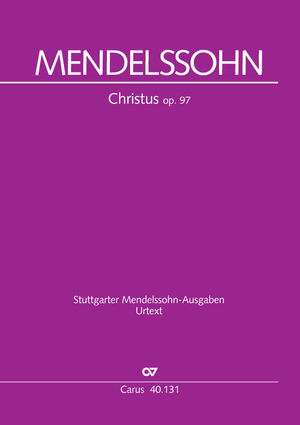
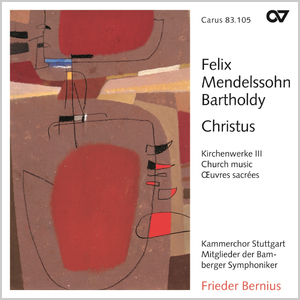
Christus is a fragment of an oratorio which Mendelssohn never completed. He had probably planned a third section to follow the two sections Die Geburt Christi and Das Leiden Christi. Das Leiden Christi essentially comprises compact choral sections which alternate with short recitatives. In having the choir represent the crowds demanding Jesus' crucifixion, the work repeatedly recalls Bach's St. Matthew Passion. Two choral groups frequently sing in dialog and interrupt each other with “hin und her” ("near and far") and “kreuzige, kreuzige” ("crucify"). There is no time to read the notes or count the beats – the entries must fit together!
The Carus Choir Coach offers choir singers the unique opportunity to study and learn their own, individual choral parts within the context of the sound of the entire choir and orchestra. For every vocal range a download containing each choir part is available. The Carus Choir Coach is based on recorded interpretations by renowned artists who have performed the work from carefully prepared Carus Urtext editions. Each choir part is presented in three different versions:
- Original recording
- Coach: each part is accompanied by the piano, with the original recording sounding in the background
- Coach in slow mode: the tempo of the coach slows down to 70% of the original version – through this reduction passages can be learned more effectively.
Performers: Dorothea Rieger (soprano), Monika Meier-Schmid (soprano), Isolde Assenheimer (alto), Mechthild Seitz (alto), Stephan Dürr (tenore), Bernhard Scheffel (tenore), Johannes Happel (baritone), Cornelius Hauptmann (basso), Adolph Seidel (basso) – Kammerchor Stuttgart, Bamberger Symphoniker – Frieder Bernius
Explore
 Listen
(5)
Listen
(5)
- Christus: Geburt Christi
- Christus: Leiden Christi
- Rezit. (Soprano): Da Jesus geboren war
- Terzett (Tenore, 2 Bassi): Wo ist der neugeborne König der Juden
- Chor: Es wird ein Stern aus Jakob aufgehn
 Practise
-
 carus music, the Choir Coach
Üben mit carus music
carus music, the Choir Coach
Üben mit carus music
-
Practice aids
-
Practice aids voice part soprano
- Chor: Es wird ein Stern aus Jakob aufgehn (Choir Coach)
- Chor: Es wird ein Stern aus Jakob aufgehn (Choir Coach, Slow mode)
-
Practice aids voice part alto
- Chor: Es wird ein Stern aus Jakob aufgehn (Choir Coach)
- Chor: Es wird ein Stern aus Jakob aufgehn (Choir Coach, Slow mode)
-
Practice aids voice part tenore
- Terzett (Tenore, 2 Bassi): Wo ist der neugeborne König der Juden (Choir Coach)
- Terzett (Tenore, 2 Bassi): Wo ist der neugeborne König der Juden (Choir Coach, Slow mode)
- Chor: Es wird ein Stern aus Jakob aufgehn (Choir Coach)
- Chor: Es wird ein Stern aus Jakob aufgehn (Choir Coach, Slow mode)
-
Practice aids voice part basso
- Terzett (Tenore, 2 Bassi): Wo ist der neugeborne König der Juden (Choir Coach, Basso 1)
- Terzett (Tenore, 2 Bassi): Wo ist der neugeborne König der Juden (Choir Coach, Slow mode, Basso 1)
- Terzett (Tenore, 2 Bassi): Wo ist der neugeborne König der Juden (Choir Coach, Basso 2)
- Terzett (Tenore, 2 Bassi): Wo ist der neugeborne König der Juden (Choir Coach, Slow mode, Basso 2)
- Chor: Es wird ein Stern aus Jakob aufgehn (Choir Coach)
- Chor: Es wird ein Stern aus Jakob aufgehn (Choir Coach, Slow mode)
-
 Additional material
- Purchase additional material as a download product.
-
 Digital text (without sheet music) incl. printing licence, html file, singing text, english translationhtml file, singing text, english translation (Sample)The birth of Christ 1. Recitative (Soprano)
When Jesus our Lord was born in Bethlehem, in the land of Judea, behold, from the east to the city of Jerusalem there came wise men, and said:
2. Trio (Tenor, Basso I/II)Say, where is he born the king of Judea? For we have seen his star, and are come to adore him.
3. ChorusThere shall a star from Jacob come forth,
and a sceptre from Israel rise up,
and dash in pieces princes and nations.
As bright the star of morning gleams,
so Jesus sheddeth glorious beams
of light and consolation!
Thy Word, O Lord, radiance darting,
truth imparting, gives salvation.
Thine be praise and adoration!...
-
Digital text (without sheet music) incl. printing licence, html file, singing text, originalhtml file, singing text, original (Sample)Die Geburt Christi 1. Rezitativ (Sopran)
Da Jesus geboren ward zu Bethlehem im jüdischen Lande, da kamen die Weisen vom Morgenlande gen Jerusalem und beteten ihn an.
2. Terzett (Tenor, Bass I/II)Wo ist der neugeborne König der Juden? Wir haben seinen Stern gesehn und sind gekommen, ihn anzubeten.
3. ChorEs wird ein Stern aus Jakob aufgehn
und ein Szepter aus Israel kommen
und wird zerschmettern Fürsten und Städte.
Wie schön leuchtet der Morgenstern!
O welch ein Glanz geht auf vom Herrn,
uns Licht und Trost zu geben!
Dein Wort, Jesu, ist die Klarheit,
führt zur Wahrheit und zum Leben.
Wer kann dich genug erheben?...
-
Digital text (without sheet music) incl. printing licence, html file, Introductory text, englishhtml file, Introductory text, english (Sample)Foreword of the Edition Carus 40.131
R. Larry Todd
The oratorio Christus has remained among Mendelssohn’s most enigmatic works, raising innumerable questions since his death in November 1847 that have so far eluded answers in the scholar ly literature. Left unfinished, the project appeared in print in 1852 as Mendelssohn’s Op. 97, the twenty-sixth in a series of posthumous works. It included a trio for male soloists, several recitatives and choruses, and a setting of the chorale “Er nimmt auf seinen Rücken.” Understandably enough, the editors of the first edition divided these numbers into two parts: “The Birth of Christ” (Trio of the Wise Men and Chorus “Es wird ein Stern aus Jakob aufgeh’n”) and “The Passion of Christ” (alternating recitatives and choruses for the audience with Pilate and the procession to Golgatha, concluding with the chorus “Ihr Töchter Zions, weint über euch selbst,” and the chorale). But the ultimate position of the fragments in the oratorio remains unclear; indeed, Mendelssohn himself seems not to have specified a bipartite division (versus, say, a tripartite ordering, with a third section for the Resurrection), and, furthermore, does not appear to have used the title Christus for what
...
-
Digital text (without sheet music) incl. printing licence, html file, Introductory text, germanhtml file, Introductory text, german (Sample)Vorwort der Ausgabe Carus 40.131
R. Larry Todd
Übersetzung: Helga BesteDas Oratorium Christus ist und bleibt eines der rätselhaftesten Werke Mendelssohns, das seit dem Tod des Komponisten im November 1847 unzählige Fragen aufwirft, die die Forschungsliteratur bis heute nicht beantworten kann.
Das unvollendete Werk erschien 1852 als Mendelssohns op. 97 erstmals im Druck. Es war die 26. Veröffentlichung in einer Reihe mit postumen Werken. Mendelssohn hinterließ unter anderem ein Terzett für drei Männerstimmen, mehrere Rezitative und Chöre und eine Vertonung des Chorals „Er nimmt auf seinen Rücken“. Die Herausgeber der ersten Ausgabe unterteilten diese Nummern verständlicherweise in zwei Teile: „Die Geburt Christi“ (Terzett der Weisen aus dem Morgenland) und Chor „Es wird ein Stern aus Jakob aufgehn“ und „Die Passion Christi“, bestehend aus Rezitativen und Chören im Wechsel für die Anhörung bei Pilatus und den Gang nach Golgatha, der mit dem Chor „Ihr Töchter Zions, weint über euch selbst“ schließt, sowie dem Choral. Doch die eigentliche Positionierung der Fragmente im Oratorium bleibt ungeklärt, Mendelssohn selbst scheint sich auch nicht auf eine Zweiteiligkeit festgelegt zu haben (im Gegensatz,
...
Purchase
Additional product information
Contents


-
Composer
Felix Mendelssohn Bartholdy
| 1809-1847Felix Mendelssohn Bartholdy (1809–1847) is regarded as one of the most important composers of the Romantic period. His compositions combine the formal clarity of the Viennese Classical period with the heightened expressiveness of the 19th century. His engagement with the music of Johann Sebastian Bach was particularly influential; he played a key role in its rediscovery through the performance of the St Matthew Passion in 1829.
Among his best-known vocal works are his two oratorios, Paulus and Elias, as well as his chorale cantata Verleih uns Frieden gnädiglich. Furthermore, Mendelssohn worked as a conductor, pianist and music teacher, and made a significant contribution to the professionalisation of the concert scene and to the development of the Leipzig Conservatoire. His work occupies a central position in 19th-century music history and combines a sense of tradition with Romantic sound aesthetics.
Personal details
Reviews on our website can only be submitted by customers with a registered user account. A check whether the rated products were actually purchased does not take place.
No feedback available for this product.
Frequent questions about this work
 There are no questions and answers available so far or you were unable to find an answer to your specific question about this work? Then click here and send your specific questions to our Customer Services!