

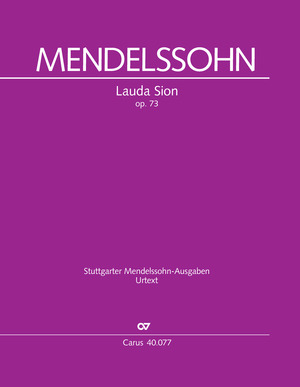
Mendelssohn’s setting of the liturgical sequence Lauda Sion is relatively unknown. This is partly because it was written at the same time as Elijah, and partly because he never conducted it himself, and it was only published after his early death. With this work it is deep breaths and good support which are required above all, in order to sustain well through the long phrases and arrive triumphantly at the end without losing any radiance.
Simply practice. Anytime. Everywhere.
Whether at home on your tablet or PC or on the road on your smartphone: with carus music, the Choir Coach, you always have your choral works with you to practice! With the carus music choir app, you can listen to your score together with a first-class recording on any device and easily practice your own choir part with a coach. With carus music, your concert preparation is easy, efficient and fun to master!
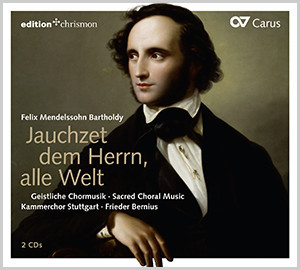
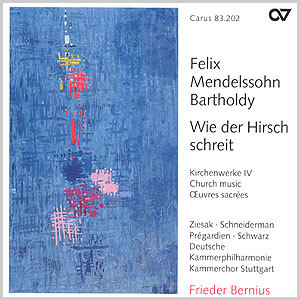
Performers: Ruth Ziesak (soprano), Helene Schneidermann (alto), Christoph Prégardien (tenore), Gotthold Schwarz (basso) – Kammerchor Stuttgart, Deutsche Kammerphilharmonie Bremen – Frieder Bernius
Explore
 Listen
(8)
Listen
(8)
- Coro: Lauda Sion Salvatorem
- Coro: Laudis thema specialis
- Soprano Solo e coro: Sit laus plena, sit sonora
- Quartetto: In hac mensa novi Regis
- Coro: Docti sacris institutis
- Coro: Sub diversis speciebus
- Soprano Solo: Caro cibus, sanguis potus
- Soli e Coro: Sumit unus, sumunt mille
 Additional material
- Purchase additional material as a download product.
-
 Digital text (without sheet music) incl. printing licence, html file, singing text, english translationhtml file, singing text, english translation (Sample)1. Lauda Sion Salvatorem (Coro)
Praise Jehovah, bow before Him,
2. Laudis thema specialis (Coro)
O be joyful, saints adore Him,
in chorus His deeds proclaim.
He is good in his salvation,
ever magnify His name,
he is mighty in creation.By His providence directed
3. Sit laus plena, sit sonora (Soprano solo e Coro)
we are guided and protected,
we receive our daily bread:
He sustaineth all that liveth,
all that we enjoy, He giveth;
from His name we all are fed.Sing of judgment, sing of mercies,
bless the Lord in sacred verses,
praise His name in holy mirth.
For he sitteth before the cherubim,
let the people tremble and worship Him,...
-
Digital text (without sheet music) incl. printing licence, html file, singing text, german translationhtml file, singing text, german translation (Sample)1. Lauda Sion Salvatorem (Coro)
Preise, Sion, den Regierer,
2. Laudis thema specialis (Coro)
deinen Retter, deinen Führer,
lobsing ihm mit Harfenton.
Singe Psalmen, singe Lieder,
Alle Lande, fallet nieder,
sammelt euch um seinen Thron.Ziel der Sehnsucht, Ziel des Strebens,
3. Sit laus plena, sit sonora (Soprano solo e Coro)
Brot der Weihe, Brot des Lebens,
unser Lied an diesem Tag.
Das zuerst in dieser Stunde,
seine Jünger in der Runde,
Er, der Herr, den Zwölfen brach.
Ziel der Sehnsucht, Brot der Weihe,
unser Lied an diesem Tag.Schallt sein Lob mit vollen Chören,
tuet kund mit allen Ehren
dieses Tages Herrlichkeit....
-
Digital text (without sheet music) incl. printing licence, html file, singing text, originalhtml file, singing text, original (Sample)1. Lauda Sion Salvatorem (Coro)
Lauda Sion Salvatorem, lauda ducem
2. Laudis thema specialis (Coro)
et pastorem, in hymnis et canticis.
Quantum potes, tantum aude: quia major omni laude,
nec laudare sufficis.Laudis thema specialis,
3. Sit laus plena, sit sonora (Soprano solo e Coro)
panis vivus et vitalis
hodie proponitur.
Quem in sacrae mensa coenae,
turbae fratrum duodenae
datum non ambigitur.
Laudis thema, panis vivus
hodie proponitur.Sit laus plena, sit sonora,
sit jucunda, sit decora
mentis jubilatio.
Dies enim solemnis agitur,
in qua mensae prima recolitur...
-
Digital text (without sheet music) incl. printing licence, html file, Introductory text, frenchhtml file, Introductory text, french (Sample)Text du livret du CD Carus 83.202
Thomas Schmidt-Beste
Traduction (abrégé) : Jean Paul MénièreLa musique spirituelle pour chœurs occupe une place importante dans la production de Felix Mendelssohn Bartholdy (1809–1847). Le catalogue de ses œuvres ne compte pas moins de 67 compositions, publiées ou non, qui vont de très simples et brèves pièces pour chœurs jusqu’aux deux oratorios monumenteaux Paulus et Elias. Il est facile de comprendre cet aspect de la production du compositeur lorsqu’on jette un bref regard sur sa biographie : Après l’abandon de la religion juive et la conversion de la famille Mendelssohn au christianisme en 1816 (d’abord les enfants, les parents en suivent 1822) le compositeur grandit dans le milieu culturel et musical de Berlin, fortement imprégné par le protestantisme. Son professeur, Carl Friedrich Zelter, jouait, en outre, en tant que directeur de la Singakademie, Berlin, à laquelle appartint également le jeune Mendelssohn, un rôle capital dans les efforts entrepris pour ramener à la vie l’art « classique » des anciens maîtres de la musique spirituelle. Les œuvres de Georges Frédéric Haendel et de Jean Sébastien Bach, dont le style et le phrasé passaient
...
-
Digital text (without sheet music) incl. printing licence, html file, Introductory text, englishhtml file, Introductory text, english (Sample)Text from the CD Carus 83.202
Thomas Schmidt-Beste
Translation (abridged): John CoombsSacred choral music occupies an important place among the works of Felix Mendelssohn Bartholdy (1809–1847); the catalogue of his sacred compositions includes no fewer than 67 published and unpublished works, ranging from brief and straightforward choruses to the two monumental oratorios St. Paul and Elijah. A glance at the biography of the composer makes this understandable: following conversion to Christianity of the originally Jewish Mendelssohn family (the children were converted in 1816 and the parents in 1822) the composer grew up in the Protestant-influenced musical culture of Berlin. His teacher Carl Friedrich Zelter, as director of the Berlin Singakademie (to which the young Mendelssohn belonged), was one of the leading figures in the movement of that period whose aim was to breathe new life into the “classical” art of the old masters of church music. Of prime importance were the works of George Frideric Handel and Johann Sebastian Bach, whose stylistic and compositional artistry were considered “pure” and “ideal” examples of church music. Thus Mendelssohn grew up with a concept of sacred music which was directed toward such
...
-
Digital text (without sheet music) incl. printing licence, html file, Introductory text, germanhtml file, Introductory text, german (Sample)Booklet-Text der CD Carus 83202
Thomas Schmidt-Beste
Im Schaffen Felix Mendelssohn Bartholdys (1809–1847) nimmt die geistliche Chormusik einen großen Stellenwert ein – das Werkverzeichnis führt nicht weniger als 67 veröffentlichte und unveröffentlichte Werke auf, die von kurzen, ganz einfachen Chorsätzen bis zu den beiden monumentalen Oratorien Paulus und Elias reichen. Ein Blick auf die Biographie des Komponisten macht dies verständlich: Nach dem Übertritt der ursprünglich jüdischen Familie Mendelssohn zum Christentum – im Jahr 1816 erst der Kinder und 1822 dann der Eltern – wuchs der Komponist in der protestantisch geprägten Musikkultur Berlins auf; sein Lehrer Carl Friedrich Zelter war zudem als Leiter der Berliner Singakademie (deren Mitglied auch der junge Mendelssohn war) eine der treibenden Kräfte im Bestreben, die „klassische“ Kunst der alten Meister der Kirchenmusik in der Praxis zu neuem Leben zu erwecken. An erster Stelle standen hier die Werke Georg Friedrich Händels und Johann Sebastian Bachs, deren Stil und Satzkunst für eine „reine“ und „ideale“ Kirchenmusik als vorbildhaft galten.
So formte sich auch bei Mendelssohn ein Ideal der geistlichen Musik, das stark an Werten wie
...
Purchase
Additional product information
Contents

-
Composer
Felix Mendelssohn Bartholdy
| 1809-1847Felix Mendelssohn Bartholdy (1809–1847) is regarded as one of the most important composers of the Romantic period. His compositions combine the formal clarity of the Viennese Classical period with the heightened expressiveness of the 19th century. His engagement with the music of Johann Sebastian Bach was particularly influential; he played a key role in its rediscovery through the performance of the St Matthew Passion in 1829.
Among his best-known vocal works are his two oratorios, Paulus and Elias, as well as his chorale cantata Verleih uns Frieden gnädiglich. Furthermore, Mendelssohn worked as a conductor, pianist and music teacher, and made a significant contribution to the professionalisation of the concert scene and to the development of the Leipzig Conservatoire. His work occupies a central position in 19th-century music history and combines a sense of tradition with Romantic sound aesthetics.
Personal details
-
Choir
Kammerchor Stuttgart
The Kammerchor Stuttgart is regarded as one of the best ensembles of its kind. Over its fifty-year existence, Frieder Bernius has developed the choir into an exceptional ensemble acclaimed by audiences and press alike. This has led to invitations for the choir to perform at all the important European festivals. In Germany the chamber choir performs at festivals and in concert halls in repertoire ranging from the 17th to the 21st century. Frieder Bernius and his ensemble have received numerous accolades for their contribution to new music. The Kammerchor Stuttgart has made over 80 CDs and LPs, numerous of which have been awarded international recording prizes (including the Edison award, Diapason d’or, Gramophone Choice, Classical Internet Award, International Classical Music Award, and German Record Critics’ Award prizes). The International Federation for Choral Music has invited the ensemble to sing at the 1st, 4th and 10th World Symposia on Choral Music in Vienna, Sydney and Seoul. Regular tours of North America and Asia since 1988 and a South America tour reflect the Kammerchor Stuttgart’s international reputation. Since 1984 the top ensemble has also been invited to Israel biennially. Personal details
-
Ensemble
Deutsche Kammerphilharmonie Bremen
-
Conductor
Frieder Bernius
| 1947Frieder Bernius’s work has earned great worldwide recognition. He is in demand internationally as a conductor and as a teacher. His principal artistic collaborators are the ensembles he founded himself, the Kammerchor Stuttgart, the Barockorchester Stuttgart, the Hofkapelle Stuttgart and the Klassische Philharmonie Stuttgart. As a guest conductor, he has collaborated repeatedly with, for example, the SWR Vokalensemble Stuttgart, the Deutsche Kammerphilharmonie Bremen, the Stuttgarter Kammerorchester and the Streicherakademie Bozen. Great stylistic versatility is Frieder Bernius’s hallmark. Whether he conducts vocal works by Monteverdi, Bach, Händel, Mozart, Beethoven, Fauré and Ligeti, stage music by Mendelssohn or symphonies by Haydn, Burgmüller and Schubert, his work always aims for a sound that is at once unmistakably personal and at the same time oriented towards the original period sound ideal. He devotes himself equally to the rediscovery of 18th century operas and to first performances of contemporary compositions. He is particularly interested in the musical history of southwestern Germany. Carus-Verlag has awarded Frieder Bernius a Golden CD for his complete recording of the sacred music of Felix Mendelssohn Bartholdy. The award was presented to him during the German Choir Festival in Stuttgart 2016. The sale of over 250,000 recordings, which has been acclaimed with a number of awards, has made a not insignificant contribution to what today is the obvious presence of Mendelssohn's complete œuvre in the concert repertoire. Personal details
-
Soloist - soprano
Ruth Ziesak
-
Soloist - alto
Helene Schneiderman
-
Soloist - tenor
Christoph Prégardien
As one of the outstanding lyric tenors of today, Christoph Pregardien is highly regarded as a lieder singer. He specializes in lieder and oratorio and his repertoire encompasses all periods. Christoph Pregardien and his accompanist Michael Gees received the MIDEM Classical Award 2009 for their recording of Schubert’s “Die schone Mullerin”. Personal details
-
Soloist - bass
Gotthold Schwarz
Gotthold Schwarz received his first musical training at the Dresden Kirchenmusikschule and at the Hochschule für Musik Felix Mendelssohn Bartholdy in Leipzig. This bass studied singing with Gerda Schriever and conducting with Max Pommer and Hans-Joachim Rotzsch. He appears regularly throughout Europe with such celebrated artists as Frieder Bernius, Peter Schreier and Philippe Herreweghe. In additoin to his extensive concert activity, some of it in the USA, he has given courses in the interpretation of Bach’s works. Numerous CD and radio productions document his wide repertoire, which along with concert and opera singing includes song recitals featuring literature ranging from the baroque era to the present day. Personal details
Reviews on our website can only be submitted by customers with a registered user account. A check whether the rated products were actually purchased does not take place.
No feedback available for this product.
Frequent questions about this work
 There are no questions and answers available so far or you were unable to find an answer to your specific question about this work? Then click here and send your specific questions to our Customer Services!