Motets

Motets by Johann Sebastian Bach

Bach’s motets have long been some of his best-known compositions. They are scored for between four and eight parts, with the eight-part works scored for double choir. These are expansive compositions for special occasions, mainly for funerals. In recent years the well-known six motets have been joined by an early motet, very probably by Bach, Ich lasse dich nicht BWV Anh. 159. The chorale movement O Jesu Christ, meins Lebens Licht BWV 118 also belongs to the group of motets, although it also requires obbligato instruments.
Two versions survived: 1st version composed 1736/37, 2nd version in the first half of the 1740s. The versions differ only in instrumentation, and both are integrated in this edition. Johann Sebastian Bach’s funeral composition O Jesu Christ,...

Full score

more
The popularity of Johann Sebastian Bach’s motets is matched by the problematic manner in which they have been handed down to us. The autograph scores and parts used by Bach have been preserved for only two motets. For the remaining motets we...

Collection

more
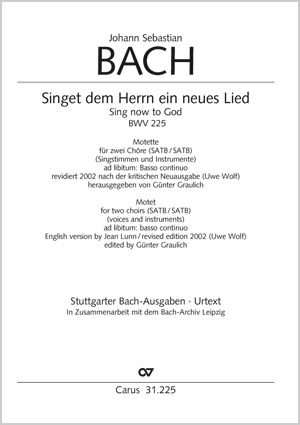
Unlike most of the other Bach motets Singet dem Herrn ein neues Lied (Sing now to God) was probably not composed for a funeral service, but more likely for a happy occasion, perhaps an anniversary. Further information does not survive, only...

Full score, German/English

more
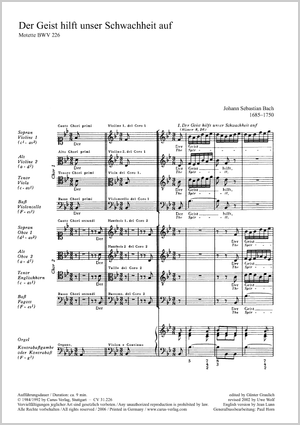
In 1729 Bach composed the double-choir motet Der Geist hilft unser Schwachheit auf  (The Spirit makes our weakness strong) for the funeral of Johann Heinrich Ernesti, his direct predecessor as Rector of St Thomas’s School. Ernesti had...

Full score, German/English

more
For many choral singers Jesu, meine Freude (Jesu, my salvation) BWV 227 is not just a motet by Bach, but the motet par excellence. Bach’s motets as a whole have to be described as exceptional works, but even amongst these this is an...

Full score, German/English

more
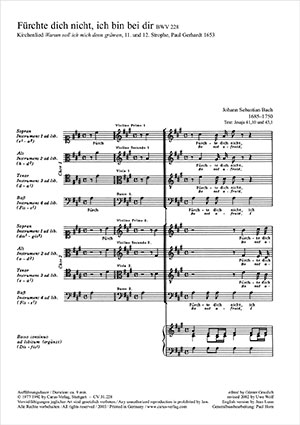
The motet Fürchte dich nicht, ich bin bei dir has long posed various puzzles for Bach scholars. Nothing is known about the occasion or date of its composition, and the musical text itself only survives in contradictory and partially incorrect...

Full score, German/English

more
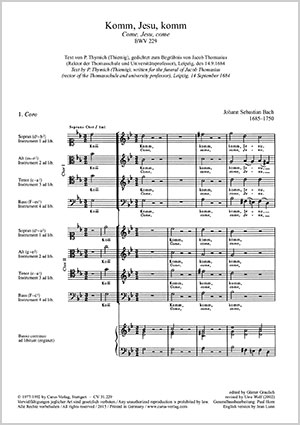
In 1684 Johann Schelle, the Kantor of St. Thomas’s, set to music Komm, Jesu, komm , a five-part choral aria written by Paul Thymich for the funeral of the Rector of St. Thomas’s ( Carus 1.036/00 ). Almost 50 years later, Schelle’s...

Full score, German/English

more
The popular motet Lobet den Herrn, alle Heiden  (Praise ye the Lord, all ye nations) is one of the biggest puzzles in Bach research. There are several things which do not quite fit together and the sources – all dating from the 19th...

Full score, German/English

more
The motet Ich lasse dich nicht, du segnest mich denn was included in the first edition of the six motets of Johann Sebastian Bach in 1802/03 and was only later replaced, firstly by the motet Lob und Ehre und Weisheit by Georg Gottfried Wagner,...

Full score, German/English

more