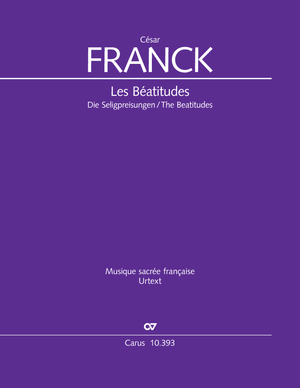
The Beatitudes
Oratorio op. 25 / CFF 185, 1869–1879
César Franck (1822–1890) is now regarded as one of the most important French composers and organists of his time. “Les Béatitudes”, his monumental oratorio setting the text from Jesus’s Sermon on the Mount (Matthew 5,3ff.), is regarded as his most important work and is on an equal footing with the great oratorios of the 19th century. But Franck himself did not live to hear the extremely successful first performance in summer 1891.
Through its symmetrical dramatic structure, the work conveys the idea of a great arch. A short prologue is followed by eight movements in which the words of Christ are contrasted with earthly scenes. The choir has an important role as commentator on the events. The conclusion of the work is an overwhelming hymn – the entry into paradise.
With this Carus edition, the “Béatitudes” is published in a modern, thoroughly-researched Urtext edition for the first time. The orchestral scoring is typical of the French orchestra of the time. Both the number of soloists and the size of choir required can be reduced by skilful allocation of the roles. The score offers many practical performance suggestions, based on the editors own experience in trying these out. A new vocal score, prepared with ease of playability in mind, replaces the historic reprint edition previously available from Carus. Ambitious amateur choirs can also perform this magnificent work.
 View
View


 Practise
-
Pronouncing Aid
- Prologue
- Bienheureux les pauvres d'esprit
- Bienheureux ceux qui sont doux
- Bienheureux ceux qui pleurent
- Bienheureux ceux qui ont faim et soif de la justice
- Heureux les miséricordieux
- Bienheureux ceux qui ont le coeur pur
- Bienheureux les pacifiques
- Bienheureux ceux qui souffrent persécution pour la justice
 Additional material
- Purchase additional material as a download product.
-
 Digital text (without sheet music) incl. printing licence, html file, singing text, originalhtml file, singing text, original (Sample)Unbenanntes Dokument
Prologue
Ténor solo
En ce temps-là, sur la terre,
si grande était la misère
que pas un cœur n’espérait.
Tous les hommes étaient ou bourreaux ou victimes ;
chargé de maux et de crimes,
le vieux monde se mourait.
quand, au-dessus des cris de haine et de détresse,
une voix s’éleva, douce comme le miel,
et les déshérités, oubliant leur tristesse,
levèrent les yeux vers le ciel.
Sur la montagne sainte, autour du divin Maître,
...
-
Digital text (without sheet music) incl. printing licence, html file, singing text, german translationhtml file, singing text, german translation (Sample)Unbenanntes Dokument
Prolog
Tenor solo
Zu jener Zeit war auf Erden
die Not so groß,
dass kein Herz mehr Hoffnung hatte.
Alle Menschen waren Schlächter oder Opfer,
beladen mit Verbrechen und Bosheit,
lag die alte Welt im Sterben,
als, über all dem Geschrei von Hass und Not,
eine Stimme sich erhob, süß wie Honig,
und die Verzweifelten und Verlassenen vergaßen
ihre Trübsal und erhoben ihre Augen gen Himmel.
Auf dem heiligen Berg, rund um den göttlichen Herrn,
...
-
Digital text (without sheet music) incl. printing licence, html file, singing text, english translationhtml file, singing text, english translation (Sample)Unbenanntes Dokument
Prologue
Tenor solo
At that time, on earth,
so great was the misery
that no heart had hope.
All men were either slayers or victims;
burdened with evils and crimes,
the old world was dying
when, above the cries of hatred and distress,
a voice rose, sweet as honey,
and the impoverished, forgetting their sadness,
lifted their eyes to heaven.
On the holy mountain, around the divine Master,
...
-
Digital text (without sheet music) incl. printing licence, html file, Introductory text, germanhtml file, Introductory text, german (Sample)Unbenanntes Dokument Vorwort der Ausgabe Carus 10.393/03
Hans Christoph Becker-Foss und Thomas Ohlendorf
César Franck (1822–1890), gebürtig im belgischen Liège, studierte in Paris und wirkte dort von 1859 bis zu seinem Tod an der Cavaillé-Coll-Orgel der Kirche Sainte-Clotilde. 1871 war er Mitbegründer der Société nationale de Musique, später wurde er deren Präsident. 1872 berief man ihn zum Professor für Orgel ans Pariser Konservatorium. Zu seinen Schülern zählten bekannte Persönlichkeiten der französischen Musikgeschichte wie Ernest Chausson, Vincent d’Indy, Gabriel Pierné, Charles Tournemire, Louis Vierne und für kurze Zeit auch Claude Debussy. Franck gilt als Vater der französisch-romantischen Orgel-Sinfonik. Sein Schaffen zeugt von nie versiegender Inspiration und umfasst neben den Orgelwerken großartige, dennoch kaum aufgeführte Opern sowie Oratorien, Messen, Lieder, Orchester- und Kammermusik. Seine Sinfonie in d-Moll ist ein Gipfelwerk ihrer Gattung. Das von Liszt etablierte Genre der sinfonischen Dichtung führte Franck zu einem Höhepunkt. Leider sind viele von Francks kompositorischen Kostbarkeiten so gut wie unbekannt
...
-
Digital text (without sheet music) incl. printing licence, html file, Introductory text, englishhtml file, Introductory text, english (Sample)Unbenanntes Dokument Foreword of the Edition Carus 10.393
Hans Christoph Becker-Foss and Thomas Ohlendorf
Translation: Gudrun and David KosvinerCésar Franck (1822–1890), a native of Liège, Belgium, studied in Paris and was active there at the Cavaillé-Coll organ of the Church of Sainte-Clotilde from 1859 until his death. In 1871 he was a co-founder of the Société nationale de Musique, later becoming its president. In 1872 he was appointed professor of organ at the Paris Conservatoire. His students included well-known personalities from French music history such as Ernest Chausson, Vincent d’Indy, Gabriel Pierné, Charles Tournemire, Louis Vierne and also, for a short while, Claude Debussy. Franck is considered the father of French Romantic organ symphonic music. Franck’s oeuvre bears witness to never-ending inspiration and, in addition to the organ works, includes magnificent yet rarely performed operas as well as oratorios, masses, songs, orchestral and chamber music. His Symphony in D minor is a crowning example of its genre. The genre of the “symphonic poem” established by Liszt was brought to culmination by Franck.
...
Contents
-
Composer
César Franck
| 1822-1890Der Vater erkannte früh seine Begabung und gab ihn 1831 zur musikalischen Ausbildung an das Konservatorium Lüttich in Belgien. Vier Jahre später zog die Familie nach Paris, wo der fünfzehnjährige César ebenfalls am Konservatorium aufgenommen wurde und in die Klavierklasse Pierre-Joseph-Guillaume Zimmermanns kam. Auch besuchte er die Klassen in Kontrapunkt bei Aimé Ambroise Simon Leborne, Komposition bei Henri-Montan Berton und Orgel bei François Benoist. In dieser Zeit entstanden seine ersten kammermusikalischen Werke, wie die 3 trios concertants für Violine, Violoncello und Klavier. 1858 wurde er Titularorganist in der Ste. Clotilde-Kirche in Paris, für welche er ein eigenes Repertoire komponierte. Darunter befindet sich u.a. das Oratorium über Die Sieben Worte Jesu am Kreuz 1859, welches beim Carus-Verlag erhältlich ist.
Personal details
-
Editor
Thomas Ohlendorf
-
Editor
Hans Christoph Becker-Foss
-
Songwriter / Librettist
Joséphine-Blanche Colomb
-
Translator
Birgit Haberhausen
-
Translator
Gudrun und David Kosviner
Reviews
Die Partitur bietet zahlreiche Hinweise für eine praktikable Realisierung, basierend auf der eigenen Erprobung durch den Herausgeber. […] Auch ein ambitionierter Laienchor kann dieses grandiose Werk aufführen.
Kirchenmusikalische Mitteilung. Diözese Rottenburg-Stuttgart, Nr. 150 November 2022
Ein solide informierendes Vorwort und die Übersetzung des literarisch nicht allzu bedeutenden, jedoch dramaturgisch wirkungsvoll angelegten französischen Gesangstexts von Josephine-Blanche Colomb (1833-92) sind beigegeben. ... Es ist sehr zu begrüßen, dass statt einer Wiederauflage des - optisch natürlich viel schöneren - Erstdrucks der Partitur eine kritische Neuausgabe vorliegt...
Neue Musik Zeitung, Jan 2023, 71. Jahrgang
Ein dankbares und lohnendes Werk für Oratorienchöre.
Schweizer Musikzeitung, Dez 2022
Das Vorwort … ein ausführlicher Kritischer Bericht sowie wertvolle Details im Druckbild (z.B. die dt. Übersetzung der gesungenen Texte auf jeder Seite des Klavierauszugs) geben Zeugnis von der intensiven Auseinandersetzung der Herausgeber mit dem Werk und der Praxisnähe der Edition.
Musica Sacra, 142. Jahrgang, Nr. 6, 1. Dez 2022
Die Partitur bietet zahlreiche Hinweise für eine praktikable Realisierung, basierend auf der eigenen Erprobung durch den Herausgeber. Ein neuer, im Hinblick auf gute Spielbarkeit erstellter Klavierauszug löst die bisher bei Carus erhältliche historische Reprint-Ausgabe ab.
Kirchenmusikalischen Mitteilungen, Nr. 150, Nov 2022
Es ist also wirklich an alles gedacht, sodass dem Werk mit dieser Ausgabe eine größere Verbreitung zu wünschen ist, als dies bislang der Fall war, reiht es sich doch auf Augenhöhe ein in die großen romantisch-oratorischen Werke wie beispielsweise die Requien von Verdi oder Brahms.
Württembergische Blätter für Kirchenmusik, 4/2022
Die Herausgeber der vorliegenden, höchst informativen Urtext-Ausgabe machen in der fundiert recherchierten Partitur Vorschläge, wie mit dieser Fülle an verschiedenen Rollen umzugehen ist... Dem gut spielbaren Klavierauszug ist die deutsche Übersetzung des Librettos beigefügt, zahlreiche Aussprachehilfen erleichtern die sicherlich mühsame Einstudierung.
Chorzeit, März 2022
Die Partitur bietet zahlreiche Hinweise für eine praktikable Realisierung, basierend auf der eigenen Erprobung durch die Herausgeber.
Musik & Liturgie, 4/2022
Herausgekommen ist eine 368 Seiten starke Partitur auf Grundlage des französischen Originaltexts, ein minutiöser Kritischer Bericht und ein dreisprachiges, informatives Vorwort. Kurzum: Vor uns liegt eine knapp drei Zentimeter dicke, großformatige Partitur mit dem wahrscheinlich wichtigsten französischen Oratorium des 19. Jahrhunderts.
Musik und Kirche, März/April 2022
Pünktlich zum 200. Geburtstag des Komponisten 2022 bringt der Carus-Verlag eine Neuausgabe von Francks „Les Béatitudes“ heraus, die als die erste wissenschaftliche bzw. erste moderne Ausgabe überhaupt bezeichnet werden kann. Das 1879 vollendete Werk, das zweifellos einen der bedeutendsten französischen Beiträge zur Gattung Oratorium darstellt und von Franck als Höhepunkt seines Schaffens angesehen wurde, ist leider wenig bekannt. Den Herausgebern Hans Christoph Becker-Foss und Thomas Ohlendorf liegt es spürbar am Herzen, dies zu ändern. So kommt zu dem kritischen Bericht und der Übersetzung ein ausführliches dreisprachiges Vorwort, das u.a. wertvolle Hinweise zur praktischen Realisierung enthält. Abgerundet wird die Edition durch einen neuen Klavierauszug und das komplette Aufführungsmaterial. Die Gestaltung des Umschlags in kräftigem Dunkelviolett wirkt für die Seligpreisungen sehr passend, die Ausgabe ist insgesamt handwerklich und gestalterisch sauber ausgeführt. Die Jury möchte mit ihrer Auszeichnung würdigen, dass der Carus-Verlag immer wieder und besonders in so schwierigen Zeiten den Mut aufbringt, solche Raritäten der Oratorienliteratur neu zu editieren.
Best Edition 2021/22, Jurybegründung, Oktober 2022
Reviews on our website can only be submitted by customers with a registered user account. A check whether the rated products were actually purchased does not take place.
Frequent questions about this work
How many harps are required?
How important is the organ part?
The choir lineup seems enormous. Which choir can even realize such a cast?
How demanding is the chorus part?
How many soloists are required?
 There are no questions and answers available so far or you were unable to find an answer to your specific question about this work? Then click here and send your specific questions to our Customer Services!