Psalm 150
Alleluja. Laudate Dominum FWV 69, 1884
The present setting of Psalm 150 from 1884 is one of César Franck’s late works. It shows the highly individual elements of the composer’s style in concentrated form: a consciously symphonic idiom, bold and unmistakable harmonies, largely characterized by their chromaticism and unusual concepts of form. The popularity of this work has largely been hindered by the need for large instrumental resources for so short a piece.
Organ version: The work can also be performed with choir and organ only. The organ excerpt published here is based on an organ arrangement by Salomon Jadassohn published in connection with the first edition of 1896. The French-German text underlay is also from the first edition; the Latin text has been additionally underlaid in this edition.
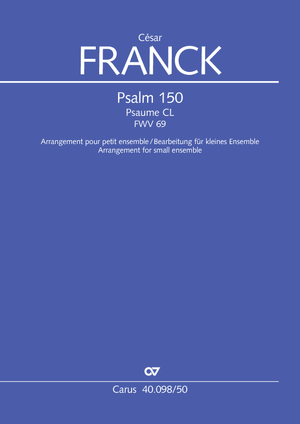
Thanks to an arrangement by A. Landgraf (Carus 40.098/50), it is possible to perform the work in smaller settings.


-
Composer
César Franck
| 1822-1890César Franck (1822–1890), a native of Liège, Belgium, studied in Paris and was active there at the Cavaillé-Coll organ of the Church of Sainte-Clotilde from 1859 until his death. In 1871 he was a co-founder of the “Société nationale de Musique”, later becoming its president. In 1872 he was appointed professor of organ at the Paris Conservatoire. His students included well-known personalities from French music history such as Ernest Chausson, Vincent d’Indy, Gabriel Pierné, Charles Tournemire, Louis Vierne and also, for a short while, Claude Debussy. In early July 1890 Franck had an accident with a horse-drawn omnibus, from the consequences of which he never recovered. He died on 8 November. Franck’s successors at Sainte-Clotilde were G. Pierné and (from 1898) Ch. Tournemire, one of Olivier Messiaen’s teachers. Personal details
-
Editor
Wolfgang Hochstein
| 1950
Reviews on our website can only be submitted by customers with a registered user account. A check whether the rated products were actually purchased does not take place.
Frequent questions about this work
 There are no questions and answers available so far or you were unable to find an answer to your specific question about this work? Then click here and send your specific questions to our Customer Services!