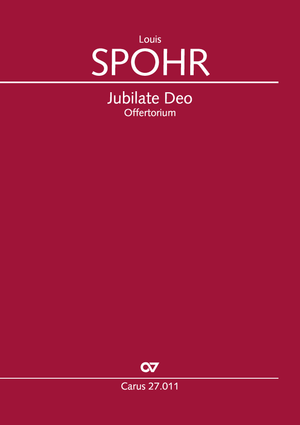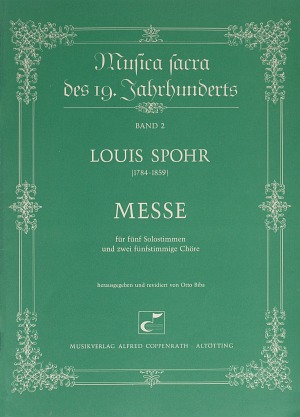
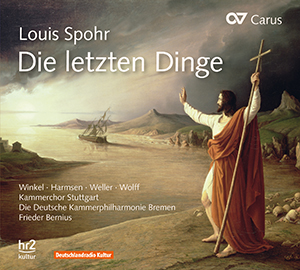
Louis Spohr‘s oratorio The Last Judgment is one of his most successful works and one of the most important contributions to the repertoire of the oratorio. The premiere on Good Friday 1826 was a huge success. It is based on the theologically most significant portions of the Revelations of John in the New Testament, which Friedrich Rochlitz compiled for the libretto. In collaboration with Rochlitz Spohr vividly portrayed in music the visions of death and eternity. The composition is suffused by a positive, comforting fundamental attitude of joyful anticipation.
The work is especially suitable for the end of the church year. It is captivating on account of its masterful instrumentation, excellent use of chromaticism, large-scale solo recitatives and accessible choral passages filled with heartfelt sensitivity on the one hand, and exciting drama on the other.
Carus has published the first critical edition of the oratorio.
Explore
 View
View


 Listen
(19)
Listen
(19)
- Purchase the work as a CD or download.
- Ouverture
- Soli (SB) e Coro: Preis und Ehre ihm
- Recitativo (TB): Steige herauf
- Solo (T) e Coro: Heilig, heilig, heilig
- Recitativo (ST): Und siehe, ein Lamm
- Solo (S) e Coro: Das Lamm, das erwürget ist
- Recitativo (T) e Coro: Und alle Kreatur
- Recitativo (AT): Und siehe, eine große Schar
- Soli (SATB) e Coro: Heil! Dem Erbarmer Heil!
- Sinfonia
- Recitativo (B): So spricht der Herr
- Duetto (ST): Sei mir nicht schrecklich
- Coro: So ihr mich von ganzem Herzen
- Recitativo (T): Die Stunde des Gerichts
- Coro: Gefallen ist Babylon
- Soli (SATB) e Coro: Selig sind die Toten
- Recitativo (SA): Sieh, einen neuen Himmel
- Recitativo (T) e Quartetto (SATB): Und siehe, ich komme bald
- Soli (SATB) e Coro: Groß und wunderbarlich
 Additional material
- Purchase additional material as a download product.
-
 Digital text (without sheet music) incl. printing licence, html file, singing text, english translationhtml file, singing text, english translation (Sample)
1. Overture (Andante grave Allegro)
Part I
2. Soli (Soprano, Basso) e Coro Praise his awful name, who was, and is, and is to come:
Rev. 1:4
Praise to him who giveth immortality: All glory and majesty surround his throne. Worship and adore him,
1:5
Praise glory to God.
5:13
Mighty he cometh to judgment, for he shall judge the world in righteousness, and he shall judge his people with his truth. Fear thou not, O Man, for thy Redeemer liveth; he that died is risen, and he shall live to all eternity, and he shall reign, and shall conquer all his enemies.
1:17–18
Praise his awful name…
...
-
Digital text (without sheet music) incl. printing licence, html file, singing text, originalhtml file, singing text, original (Sample)1. Ouvertüre (Andante grave Allegro) Erster Teil 2. Soli (Soprano, Basso) e Coro
Preis und Ehre ihm, der da ist, der da war und der da kommt!
Offb 1,4Preis und Ehre ihm, dem Erstling der Erstandenen, dem Beherrscher der Könige der Erde. Ihm, der uns geliebet und durch sein Blut gereinigt hat,
3. Recitativo (Tenore, Basso)
1,5
Preis, Ehre und Ruhm!
5,13
Siehe, er kommt in den Wolken, und ihn wird sehen jegliches Auge, und wehklagen werden die Geschlechter der Erde. Fürchte dich nicht: Ich bin’s, der Erste und der Letzte und der Lebendige. Ich war tot, und siehe, ich bin lebendig in alle Ewigkeit und habe die Schlüssel der Hölle und des Todes.
1,17–18
Preis und Ehre ihm ...
Ich weiß nun dein Tun: Du hast Böses nicht ertragen und geduldet um meines Namens willen. Aber deine erste Liebe hast du verlassen und bist gefallen von deiner Höhe. So ändre deinen Sinn und tu die ersten Werke!
2,2–5
Sei getreu bis in den Tod, so will ich dir die Krone des Lebens geben.
2,10
Preis und Ehre ihm...Steige herauf, ich will dir zeigen, was
...
-
Digital text (without sheet music) incl. printing licence, html file, Introductory text, englishhtml file, Introductory text, english (Sample)Text from the CD Carus 83.294
Dieter Zeh
Translation: J. Bradford Robinson, David Kosviner“The Last Judgement […] we consider as one of the greatest musical productions of the age. […] This sublime oratorio will add immensely to his reputation […].” This is the praise lavished on the work by an English critic in 1830 (quoted in Clive Brown’s biography of Spohr); it reflects the high esteem in which Louis Spohr was held in England, and, indeed, also on the Continent.
At its premiere in Kassel in 1826, the oratorio was greeted with similar enthusiasm; at the age of 38, Spohr – who was born in Braunschweig and had held posts in Gotha, Vienna and Frankfurt – was appointed court Kapellmeister in Kassel in 1822, a position he held until 1857. His reputation as a violin virtuoso, composer, conductor and instrumental teacher was formidable, so that he was regarded as one of the most important and influential
...
-
Digital text (without sheet music) incl. printing licence, html file, Introductory text, germanhtml file, Introductory text, german (Sample)Booklet-Text der CD Carus 83.294
Dieter Zeh
„Die letzten Dinge […] halten wir für eines der größten Musikwerke unserer Zeit. […] Dieses vorzügliche Oratorium wird seinen Ruhm immens vergrößern […].“ So rühmt ein englischer Kritiker (zitiert in Clive Browns Spohr-Biographie) 1830 das Werk und gibt damit wider, welche Wertschätzung Louis Spohr in England, aber auch auf dem Kontinent erfuhr.
Ähnlich begeistert wurde das Oratorium bei der Uraufführung 1826 in Kassel aufgenommen, wo der 38-jährige, in Braunschweig geborene Spohr nach Anstellungen in Gotha, Wien und Frankfurt 1822 auf die dortige Hofkapellmeisterstelle berufen wurde, die er bis 1857 innehatte. Sein Ruf als Violinvirtuose, Komponist, Dirigent und Instrumentallehrer war überragend, und so zählte er in der Frühromantik zu den bedeutendsten richtungsweisenden
...
Purchase
Additional product information
Contents

-
Composer
Louis Spohr
| 1784-1859Louis Spohr, born 1784 in Braunschweig, died 1859 in Kassel. Considered one of the best violinists, conductors and composers of his time. He received violin lessons from the age of five. As early as 1799 violinist in the Brunswick court orchestra, then concertmaster in Gotha; 1812 - 1815 Kapellmeister in Vienna; from 1822 court Kapellmeister in Kassel, recommended by C. M. v. Weber. Extensive concert tours brought him together with N. Paganini, among others. He left behind over 200 works, including many a cappella choirs. His oratorio ‘Die letzten Dinge’ (1826) was highly regarded in the 19th century. Personal details
-
Editor
Dieter Zeh
| 1942
-
Editor
Irene Schallhorn
Reviews
Untitled Document
... So entstand die kongeniale Partitur eines Werkes, das trotz seines geistlichen Textes keineswegs an die Kirche als Aufführungs ort gebunden ist, dem Chor eine überaus dankbare Rolle zuweist und Spohr von seiner allerbesten Seite zeigt: in einem melodisch ausgerichteten, mit köstlicher Chromatik angereicherten und auch kontrapunktisch versiert strukturierten Satz. Die Neuausgabe in bewährter Carus-Qualität wird im Notenregal den 1987 in New York erschienenen wohlfeilen Reprint der Erstausgabe ersetzen.
Michael Kube, FONO FORUM, 01/09
... Diese Komposition wäre doch eine überzeugende Programmidee für ein abendfüllendes Konzert am Ende des Kirchenjahres.
Singende Kirche, Heft 3, 2008
Reviews on our website can only be submitted by customers with a registered user account. A check whether the rated products were actually purchased does not take place.
No feedback available for this product.
Frequent questions about this work
 There are no questions and answers available so far or you were unable to find an answer to your specific question about this work? Then click here and send your specific questions to our Customer Services!