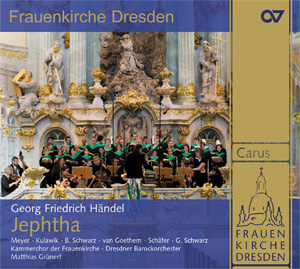
Jephtha
Oratorium HWV 70


 Listen
(66)
Listen
(66)
- Ouverture
- Menuet
- Accompagnato (Zebul): It must be so
- Air (Zebul): Pour forth no more
- Chorus of Israelites: No more to Ammon’s god
- Recit. (Zebul, Jephtha): But Jephtha comes
- Air (Jephtha): Virtue my soul shall still embrace
- Recit. (Storgè): ’Twill be a painful separation
- Air (Storgè): In gentle murmurs will I mourn
- Recit. (Hamor): Happy this embassy
- Air (Hamor): Dull delay, in piercing anguish
- Recit. (Iphis): Ill suits the voice of love
- Air (Iphis): Take the heart you fondly gave
- Recit. (Hamor): I go
- Duet (Iphis and Hamor): These labours past
- Recit. (Jephtha): What mean these
- Accompagnato (Jephtha): If, Lord, sustain’d
- Recit. (Jephtha): ’Tis said
- Chorus of Israelites: O God, behold
- Recit. (Storgè): Some dire event
- Air (Storgè): Scenes of horror, scenes of woe
- Recit. (Iphis and Storgè): Say, my dear mother
- Air (Iphis): The smiling dawn of happy days
- Recit. (Zebul, Jephtha): Such, Jephtha
- Chorus of Israelites: When His loud voice
- Recit. (Hamor): Glad tidings of great joy
- Chorus of Israelites: Cherub and Seraphim
- Air (Hamor): Up the dreadful steep ascending
- Recit. (Iphis): ’Tis well. Haste, haste
- Air (Iphis): Tune the soft melodious lute
- Recit. (Zebul): Again Heav’n smiles
- Air (Zebul): Freedom now
- Recit. (Jephtha): Zebul, thy deeds were valiant
- Air (Jephtha): His mighty arm
- Chorus of Israelites: In glory high
- Symphony
- Recit. (Iphis): Hail, glorious conqueror
- Air (Iphis): Welcome, as the cheerful light, Chorus of Israelites: Welcome thou
- Recit. (Jephtha): Horror, confusion!
- Air (Jephtha): Open thy marble jaws, O tomb
- Recit. (Zebul, Jephtha): Why is my brother
- Accomp., Arioso (Storgè): First perish thou
- Recit. (Hamor): If such thy cruel purpose
- Air (Hamor): On me let blind mistaken zeal
- Quartet (Zebul, Storgè, Hamor, Jephtha): Oh, spare your daughter
- Recit. (Iphis): Such news flies swift
- Accompagnato (Iphis): For joys so vast too little
- Air (Iphis): Happy they!
- Accompagnato (Jephtha): Deeper, and deeper
- Chorus of Israelites: How dark, O Lord
- Arioso (Jephtha): Hide thou thy hated beams
- Accompagnato (Jephtha): A father, off’ring up
- Air (Jephtha): Waft her, angels
- Accompagnato (Iphis): Ye sacred priests
- Air (Iphis): Farewell, ye limpid springs
- Chorus of Priests: Doubtful fear
- Symphony
- Recit. (Angel): Rise, Jephtha
- Air (Angel): Happy, Iphis shalt thou live
- Arioso (Jephtha): For ever blessed be
- Chorus of Priests: Theme sublime of endless praise
- Recit. (Zebul): Let me congratulate
- Air (Zebul): Laud her, all ye virgin train
- Recit. (Iphis): My faithful Hamor
- Quintet (Iphis, Hamor, Storgè, Jephta, Zebul): All that is in Hamor mine
- Chorus of Israelites: Ye house of Gilead
Contents
-
Composer
Georg Friedrich Händel
| 1685-1759George Frideric Handel put his exceptionally versatile compositional abilities to the test at an early age. After moving to London in 1712, where he was appointed Composer of Musick for His Majesty’s Chapel Royal in 1723, he wrote numerous masterpieces for the royal court as well as his major opere serie. For many years he enjoyed triumphant successes with his operas, which were sung by outstanding performers, with serenades, and later also with oratorios such as Saul and Israel in Egypt. Over the years Handel’s reputation grew far beyond the city where he worked; some of his choral works, particularly Messiah, have enjoyed a performance tradition which remains unbroken to this day, and are sung by choirs throughout the world. Personal details
-
Preface writer
Dorothea Schröder
-
Ensemble
Kammerchor der Frauenkirche
The Kammerchor der Frauenkirche was founded by Matthias Grünert, choirmaster of the Frauenkirche, in January 2005. The choir’s main activities include providing the music for services and singing in concerts and other events at the church. The choir is also an ambassador for the Frauenkirche’s church music and gives concerts in Germany and abroad (France, Italy and Japan). Its debut recording was the CD “Vom Himmel hoch” for Carus (Carus 83.233). The thirty semi-professional singers specialize in a cappella repertoire and 17th and 18th century oratorios. Personal details
-
Orchestra
Dresdner Barockorchester
One of the distinguishing features of the Dresdner Barockorchester, founded in 1991, is the fact that its membership includes both early music specialists and orchestral musicians drawn from the Dresdner Staatskapelle and the Dresdner Philharmonie. Working together with baroque instruments, with their specific clarity of sound and articulation they achieve a variegated, eloquent music-making in which their different areas of musical experience are combined. The musicians are united in their desire to follow the splendid example set by the Dresden Court Orchestra of Augustus the Strong. The heritage of that era is the music of such conductors and instrumentalists of the Court Orchestra as Hasse, Heinichen, Zelenka, Quantz and Pisendel, whose works have a prominent place in the repertoire of the Dresdner Barockorchester. This repertoire extends from the end of the 17th century through Mozart. The Dresdner Barockorchester works closely with the Dresdner Kammerchor and its conductor Hans- Christoph Rademann. Personal details
-
Conductor
Matthias Grünert
| 1973Matthias Grünert was born in Nuremberg in 1973. He took an advanced course in church music and majored in organ performance in Bayreuth and at the Musikhochschule in Lübeck, studying with Hartmut Rohmeyer and others. He also attended courses with F. Tagliavini, J. Laukvik, M. Radulescu and others. While studying, he was an assistant at Lübeck Cathedral and worked as a church musician at St. Petri in the health resort of Bosau (Schleswig-Holstein). From 2000–05 he was city and district choirmaster at St. Marien in Greiz, and in 2003 performed the complete organ works of Bach. In 2004 Matthias Grünert was appointed principal choirmaster at the Frauenkirche in Dresden, and since 2005 has been artistic director with responsibility for all church music events there. He has founded a large choir of 120 singers, the Kammerchor der Frauenkirche and the ensemble frauenkirche, comprising musicians from the Sächsische Staatskapelle and the Dresden Philharmonic Orchestra. He has won prizes in several organ competitions, given concerts as an organist, conductor and keyboard player in Germany and abroad, and made many CD, television and radio recordings. Personal details
-
Soloist - soprano
Miriam Meyer
Soprano Miriam Meyer completed her voice training in Hanover and Lübeck in 2002 with distinction. She has participated in master classes with Renata Scotto, Irwin Gage, Charles Spencer, Kai Wessel and Esther de Bros. While still studying, she sang in the company of the Stadttheater Hildesheim and since 2002 has been a member of the company and guest artist at the Komische Oper Berlin, where she has sung roles including Susanna in Le nozze di Figaro, Ännchen in Der Freischütz and Musette in La Bohème. Miriam Meyer has appeared at numerous international festivals. She has sung on radio and television, and in CD and DVD recordings such as the ARD (German national) television production of Haydn’s Die Jahreszeiten under Ennoch zu Guttenberg, a DVD of Handel’s opera Teseo under Wolfgang Katschner and the complete recording of Dieterich Buxtehude’s vocal works with Ton Koopman. Personal details
-
Soloist - soprano
Birte Kulawik
Birte Kulawik studied singing, violin and baroque violin at the Musikhochschule Dresden. She completed her studies by attending various master classes with Barbara Schlick, Semjon Skigin and others. She has performed with conductors including Morten Schuldt-Jensen, Ludwig Güttler, Matthias Grünert and Matthias Jung and ensembles including the Immortal-Bach-Ensemble, LauttenCompagney Berlin, Ensemble Amarcord and Sächsisches Vocalensemble. She has sung at festivals such as the Rheingau Musikfestival, the Handel Festival Halle and the Musikfestival Mecklenburg-Vorpommern. Various recordings for CD and radio document her versatility. Personal details
-
Soloist - mezzo-soprano
Britta Schwarz
The alto Britta Schwarz studied singing in Berlin and Dresden and then joined the studio at the Staatsoper Dresden. In the following years she won numerous international prizes. She has performed regularly with renowned orchestras such as the Berliner Philharmoniker, the Staatskapelle Dresden, the Dresden Philharmonic Orchestra and the Academy of St. Martin in the Fields and sung with leading conductors including Philippe Herreweghe, Helmuth Rilling, Bruno Weil, Reinhard Göbel, Marcus Creed and Hans-Christoph Rademann. Concerts and Lieder recitals in international music centers complement her musical activities. For several years she has specialized in Baroque music, and works with leading ensembles such as the Freiburger Barockorchester, Cantus Cölln, Ensemble Musica Antiqua Köln and the Akademie für Alte Musik, Berlin. Her extensive repertoire has been recorded in numerous radio programs and CDs. Personal details
-
Soloist - countertenor
Patrick Van Goethem
The Belgian countertenor Patrick Van Goethem studied under Paul Esswood, Julia Hamari and Andreas Scholl. He specializes in early music, with a repertoire that includes vocal works by Heinichen, Monteverdi, Purcell and Zelenka, Bach’s Passions, cantatas and the B-minor Mass, Handel’s Oratorio’s and Vivaldi’s Stabat Mater. His concert schedule has taken him to Europe, North America and Japan. He has appeared with, among others, the Bach Collegium Japan (Masaaki Suzuki), The Amsterdam Baroque Orchestra (Ton Koopman), Orchestra of the Eighteenth Century (Frans Brüggen), The Netherlands Bach Society (Gustav Leonhardt and Jos van Veldhoven), Bach-Collegium Stuttgart (Helmuth Rilling), Barockorchester Stuttgart (Frieder Bernius), and the Gulbenkian Orchestra (Michel Corboz). Patrick Van Goethem appears at major baroque festivals. and he performs regularly with the baroque ensemble The Flanders Baroque Consort, of which he is a founding member. Personal details
-
Soloist - tenor
Markus Schäfer
-
Soloist - bass
Gotthold Schwarz
Gotthold Schwarz received his first musical training at the Dresden Kirchenmusikschule and at the Hochschule für Musik Felix Mendelssohn Bartholdy in Leipzig. This bass studied singing with Gerda Schriever and conducting with Max Pommer and Hans-Joachim Rotzsch. He appears regularly throughout Europe with such celebrated artists as Frieder Bernius, Peter Schreier and Philippe Herreweghe. In additoin to his extensive concert activity, some of it in the USA, he has given courses in the interpretation of Bach’s works. Numerous CD and radio productions document his wide repertoire, which along with concert and opera singing includes song recitals featuring literature ranging from the baroque era to the present day. Personal details
Reviews
Zwei Dresdner Spitzenaufnahmen von Händel-Oratorien sind gerade bei Carus (Note 1) erschienen. [...] „Jephta” ist nicht nur Händels letztes Oratorium, sondern wohl auch sein vielschichtigstes. Das komplizierte Auf und Ab wird von Frauenkirchen-Kantor Matthias Grünert souverän gehandelt. Sein junger Kammerchor besteht die Feuertaufe bestens, und die überirdische „Farewell”-Arie von Miriam Meyer (Sopran) krönt die exzellente Leistung der Solisten.
Das Fazit dieser Silberlinge lautet: Funkelnd oder glänzend - zweimal Händel-Gold.
Jens-Uwe Sommerschuh
Sächsische Zeitung Dresden, 24. Januar 2009
Reviews on our website can only be submitted by customers with a registered user account. A check whether the rated products were actually purchased does not take place.
Frequent questions about this work
 There are no questions and answers available so far or you were unable to find an answer to your specific question about this work? Then click here and send your specific questions to our Customer Services!