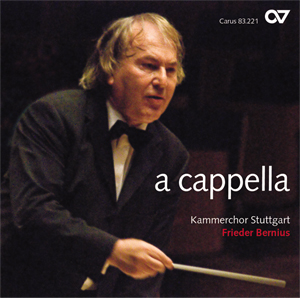
a cappella (Bernius)
 Listen
(13)
Listen
(13)
- Evensong
- Beati mortui in Domino morientes
- Ave Maria
- Warum ist das Licht gegeben dem Mühseligen
- From depth of grief I call to Thee
- Why are the heathen so angry (Psalm 2)
- Denn er hat seinen Engeln befohlen
- Have you seen him hov'ring near
- Judge me, o God (Psalm 43)
- Lift thine eyes to the mountains
- Da es nun Abend ward
- Herr, wenn Trübsal da ist
- Die richtig für sich gewandelt haben (1)
 Additional material
-
 Digital text (without sheet music) incl. printing licence, html file, singing text, english translationhtml file, singing text, english translation (Sample)Warum toben die Heiden (Psalm 2) Why rage fiercely the heathen, and the people mediate a vain thing?
The kings of the earth they set themselves up,
and the rulers counsel take together against the Lord, and against his anointed.
“Now let us break their bands asunder, and cast away their cords from us!”
He that sitteth in the heav’ns shall laugh them to scorn,
and the Lord shall deride them.
In wrath he shall speak to them, and shall vex them in his sore displeasure.
“Yet have I set my King on Zion’s holy hill, yea, on my holy hill of Zion.”
I will declare the law where-of the Lord hath said, as the Lord hath said unto me:
“Thou art my Son, thee this day have I begotten.
Ask thou of me, and I shall give the heathen for thine inheritance,
utmost parts for thy possession.
Thou shalt break them in pieces with sceptres of iron,
like a potter’s vessel thou shalt dash them.”
O therefore be ye wise, o kings, ye judges of the earth be instructed.
Serve ye the Lord with fear, rejoice to him with trembling.
Kiss ye the Son, lest he be angry,
and ye perish from the right way.
Kiss ye the Son, for his wrath shall soon rekindle;
...
-
Digital text (without sheet music) incl. printing licence, html file, singing text, originalhtml file, singing text, original (Sample)Warum toben die Heiden (Psalm 2) Warum toben die Heiden, und die Leute reden so vergeblich?
Die Könige im Lande lehnen sich auf,
und die Herrn ratschlagen miteinander wider den Herrn und seinen Gesalbten:
„Lasst uns zerreißen ihre Bande, und von uns werfen ihre Seile!“
Aber der im Himmel wohnet, lachet ihrer, und der Herr spottet ihrer.
Er wird einst mit ihnen reden in seinem Zorn, und mit seinem Grimm wird er sie schrecken:
„Aber ich habe meinen König eingesetzt auf meinem heiligen Berge Zion.
Ich will von einer solchen Weise predigen, dass der Herr zu mir gesagt hat:
„Du bist mein Sohn, heute hab’ ich dich gezeuget;
heische von mir, so will ich dir die Heiden zum Erbe geben, und der Welt Ende zum Eigentum.
Du sollst sie mit eisernem Szepter zerschlagen, wie Töpfe sollst du sie zerbrechen.“
So lasset euch nun weisen, ihr Könige, und lasset euch züchtigen, ihr Richter auf Erden.
Dienet dem Herrn mit Furcht und freuet euch mit Zittern!
Küsset den Sohn, dass er nicht zürne und ihr umkommet auf dem Wege.
Küsset den Sohn; denn sein Zorn wird bald anbrennen.
Aber wohl allen, die auf ihn trauen.
Ehre sei dem Vater und dem Sohne und
...
-
Digital text (without sheet music) incl. printing licence, html file, singing text, english translationhtml file, singing text, english translation (Sample)For he shall give his angels charge over thee,
that they shall protect thee in all the ways thou goest.
That their hands shall uphold and guide thee,
lest thou dash thy foot against a stone.
...
-
Digital text (without sheet music) incl. printing licence, html file, singing text, originalhtml file, singing text, original (Sample)Denn er hat seinen Engeln befohlen über dir,
dass sie dich behüten auf allen deinen Wegen,
dass sie dich auf den Händen tragen
und du deinen Fuß nicht an einen Stein stoßest.
Psalm 91,11+12
...
-
Digital text (without sheet music) incl. printing licence, html file, singing text, english translationhtml file, singing text, english translation (Sample)Kyrie
Lord, have mercy on us.
Gloria
Christ, have mercy on us.
Lord, have mercy on us.Glory be to God on high
and on earth peace to men of good will.
We praise thee; we bless thee; we adore thee; we glorify thee.
We give thee thanks for thy great glory.
Lord God, heavenly King,
God the almighty Father.
O Lord, the only-begotten Son, Jesus Christ,
O Lord God, Lamb of God,...
-
Digital text (without sheet music) incl. printing licence, html file, singing text, german translationhtml file, singing text, german translation (Sample)Kyrie
Herr, erbarme dich unser.
Gloria
Christus, erbarme dich unser.
Herr, erbarme dich unser.Ehre sei Gott in der Höhe
und Friede auf Erden den Menschen, die guten Willens sind.
Wir loben dich, wir preisen dich, wir beten dich an, wir rühmen dich.
Wir danken dir, denn groß ist deine Herrlichkeit.
Herr und Gott, König des Himmels,
Gott, allmächtiger Vater.
Herr Jesus Christus, eingeborener Sohn,
Herr und Gott, Lamm Gottes,...
-
Digital text (without sheet music) incl. printing licence, html file, singing text, originalhtml file, singing text, original (Sample)Kyrie
Kyrie eleison,
Gloria
Christe eleison,
Kyrie eleison,Gloria in excelsis Deo.
Et in terra pax hominibus bonae voluntatis.
Laudamus te, benedicimus te, adoramus te, glorificamus te,
gratias agimus tibi propter magnam gloriam tuam.
Domine Deus, Rex coelestis,
Deus Pater omnipotens.
Domine Fili unigenite, Jesu Christe.
Domine Deus, Agnus Dei,...
-
Digital text (without sheet music) incl. printing licence, html file, Introductory text, englishhtml file, Introductory text, english (Sample)Text from the CD Carus 83.113
Annett Reischert-Bruckmann (1999)
Translation: John CoombsAfter the mid-18th century the place of women in the world of music underwent a remarkable change. Until then women had restricted their music making to a domestic setting, but from the middle of the century onwards they appeared more and more frequently as participants in public performances. Music education for girls was expressly included in the syllabus of schools, and in 1834 singing even became a compulsory subject in the elementary schools in Berlin.
This development led to an increase in the activity of female-voice choirs during the late 19th and early 20th centuries, since composers of repute such as Hector Berlioz, Johannes Brahms, Claude Debussy, Franz Liszt, Gustav Mahler and Giuseppe Verdi wrote works for female-voice choirs. Nevertheless, male-voice choirs still remained predominant. While the number of male-voice
...
-
Digital text (without sheet music) incl. printing licence, html file, Introductory text, germanhtml file, Introductory text, german (Sample)Booklet-Text der CD Carus 83.113
Annett Reischert-Bruckmann (1999)
Seit Mitte des 18. Jahrhunderts veränderte sich die Stellung der Frau im gesellschaftlichen Musikleben in bemerkenswerter Weise. Hatten sich Frauen bis dahin darauf beschränkt, im häuslichen Kreis zu musizieren, traten sie nun auch als Musikerinnen mehr und mehr an die Öffentlichkeit. Im Lehrplan der Schulen sah man jetzt ausdrücklich Musikerziehung für Mädchen vor, und im Jahre 1834 wurde das Singen nach Noten sowie das Chorsingen an den Elementarschulen Berlins sogar zu Pflichtfächern erhoben.
Diese Entwicklung setzte sich fort in einem Aufschwung des Frauenchorgesangs Ende des 19. und Anfang des 20. Jahrhunderts, als namhafte Komponisten wie Hector Berlioz, Johannes Brahms, Claude Debussy, Franz Liszt, Gustav Mahler und Giuseppe Verdi Werke für Frauenchor verfassten. Dennoch blieb das Männerchorwesen
...
Contents


-
Preface writer
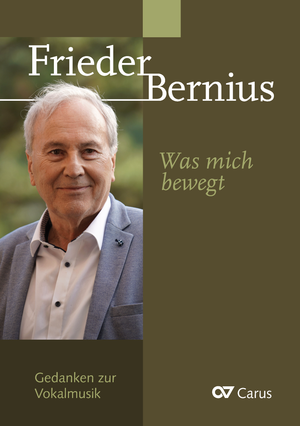
Frieder Bernius
| 1947Frieder Bernius’s work has earned great worldwide recognition. He is in demand internationally as a conductor and as a teacher. His principal artistic collaborators are the ensembles he founded himself, the Kammerchor Stuttgart, the Barockorchester Stuttgart, the Hofkapelle Stuttgart and the Klassische Philharmonie Stuttgart. As a guest conductor, he has collaborated repeatedly with, for example, the SWR Vokalensemble Stuttgart, the Deutsche Kammerphilharmonie Bremen, the Stuttgarter Kammerorchester and the Streicherakademie Bozen. Great stylistic versatility is Frieder Bernius’s hallmark. Whether he conducts vocal works by Monteverdi, Bach, Händel, Mozart, Beethoven, Fauré and Ligeti, stage music by Mendelssohn or symphonies by Haydn, Burgmüller and Schubert, his work always aims for a sound that is at once unmistakably personal and at the same time oriented towards the original period sound ideal. He devotes himself equally to the rediscovery of 18th century operas and to first performances of contemporary compositions. He is particularly interested in the musical history of southwestern Germany. Carus-Verlag has awarded Frieder Bernius a Golden CD for his complete recording of the sacred music of Felix Mendelssohn Bartholdy. The award was presented to him during the German Choir Festival in Stuttgart 2016. The sale of over 250,000 recordings, which has been acclaimed with a number of awards, has made a not insignificant contribution to what today is the obvious presence of Mendelssohn's complete œuvre in the concert repertoire. Personal details
-
Choir
Kammerchor Stuttgart
The Kammerchor Stuttgart is regarded as one of the best ensembles of its kind. Over its fifty-year existence, Frieder Bernius has developed the choir into an exceptional ensemble acclaimed by audiences and press alike. This has led to invitations for the choir to perform at all the important European festivals. In Germany the chamber choir performs at festivals and in concert halls in repertoire ranging from the 17th to the 21st century. Frieder Bernius and his ensemble have received numerous accolades for their contribution to new music. The Kammerchor Stuttgart has made over 80 CDs and LPs, numerous of which have been awarded international recording prizes (including the Edison award, Diapason d’or, Gramophone Choice, Classical Internet Award, International Classical Music Award, and German Record Critics’ Award prizes). The International Federation for Choral Music has invited the ensemble to sing at the 1st, 4th and 10th World Symposia on Choral Music in Vienna, Sydney and Seoul. Regular tours of North America and Asia since 1988 and a South America tour reflect the Kammerchor Stuttgart’s international reputation. Since 1984 the top ensemble has also been invited to Israel biennially. Personal details
-
Conductor
Frieder Bernius
| 1947Frieder Bernius’s work has earned great worldwide recognition. He is in demand internationally as a conductor and as a teacher. His principal artistic collaborators are the ensembles he founded himself, the Kammerchor Stuttgart, the Barockorchester Stuttgart, the Hofkapelle Stuttgart and the Klassische Philharmonie Stuttgart. As a guest conductor, he has collaborated repeatedly with, for example, the SWR Vokalensemble Stuttgart, the Deutsche Kammerphilharmonie Bremen, the Stuttgarter Kammerorchester and the Streicherakademie Bozen. Great stylistic versatility is Frieder Bernius’s hallmark. Whether he conducts vocal works by Monteverdi, Bach, Händel, Mozart, Beethoven, Fauré and Ligeti, stage music by Mendelssohn or symphonies by Haydn, Burgmüller and Schubert, his work always aims for a sound that is at once unmistakably personal and at the same time oriented towards the original period sound ideal. He devotes himself equally to the rediscovery of 18th century operas and to first performances of contemporary compositions. He is particularly interested in the musical history of southwestern Germany. Carus-Verlag has awarded Frieder Bernius a Golden CD for his complete recording of the sacred music of Felix Mendelssohn Bartholdy. The award was presented to him during the German Choir Festival in Stuttgart 2016. The sale of over 250,000 recordings, which has been acclaimed with a number of awards, has made a not insignificant contribution to what today is the obvious presence of Mendelssohn's complete œuvre in the concert repertoire. Personal details
Reviews on our website can only be submitted by customers with a registered user account. A check whether the rated products were actually purchased does not take place.
Frequent questions about this work
 There are no questions and answers available so far or you were unable to find an answer to your specific question about this work? Then click here and send your specific questions to our Customer Services!