Ave Maria
Music for choir and wind ensemble
 Listen
(17)
Listen
(17)
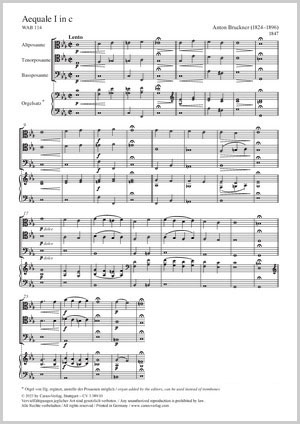
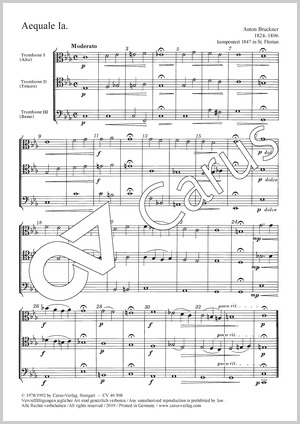
- Aequale I
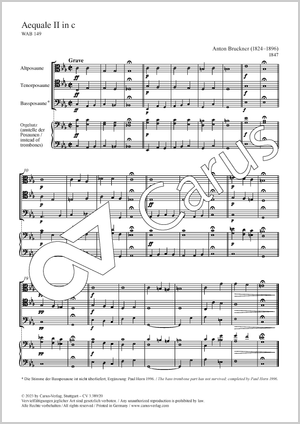
- Aequale II
- Mass in C major
- There were brought in gladness virginews pure and lovely
- Speak, my tongue
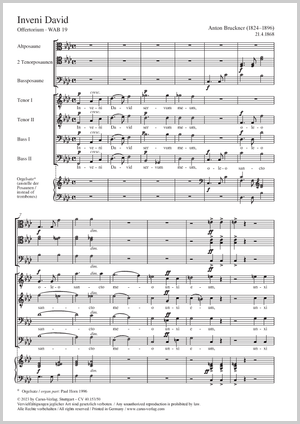
- I have found David
- Ave Maria
- Your are beautiful, o Mary
- Ave Maria
- Locus iste
- Os justi
- Christus factus est
- Salvum fac populum tuum
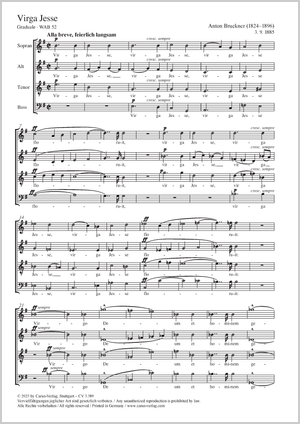
- Virga Jesse
- This is a priest most mighty
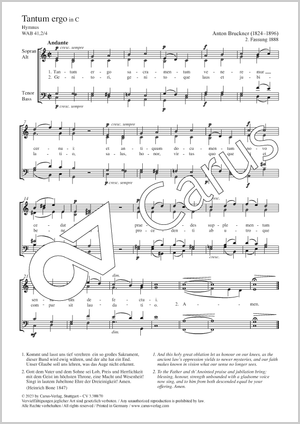
- Tantum ergo in D major
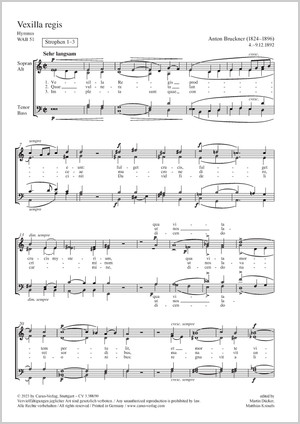
- Vexilla regis prodeunt
Contents


-
Composer
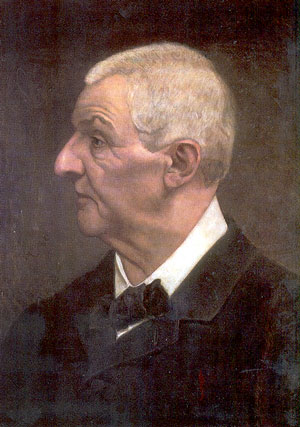
Anton Bruckner
| 1824-1896Anton Bruckner was born in Ansfelden (Austria) in 1824 and did not have a particularly easy life. The Austrian composer came from a simple, rural background and was plagued by self-doubt throughout his life. After the death of his father, he was accepted as a choirboy at St Florian's Abbey at the age of 13. After several years as a school assistant and self-taught organ and piano studies, he initially worked as an organist in St Florian. In 1855 he was appointed cathedral organist in Linz. After an introduction to music theory and instrumentation by Simon Sechter and Otto Kitzler, Bruckner discovered Richard Wagner as an artistic role model, whom he admired throughout his life and also visited several times in Bayreuth.
In 1868 Anton Bruckner became professor of basso continuo, counterpoint and organ at the Vienna Conservatory, ten years later court organist. In 1891 he was awarded an honorary doctorate from the University of Vienna. He was regarded as an important organ virtuoso of his time, but his compositional recognition was a long time coming. It was not until the Symphony No. 7 in E major, composed between 1881 and 1883, with the famous Adagio, which was written under the impression of Wagner's death, that he received the recognition he had hoped for, even if he did not want to accept it in view of his tendency towards scepticism and self-criticism.
Anton Bruckner was a solitary composer who did not want to follow any school or doctrine. He wrote both sacred and secular works in all their facets. In addition to numerous motets, Bruckner composed three masses, the Missa Solemnis in B flat minor (1854) and the Te Deum (1881-84; CV 27.190/00), which is available from Carus-Verlag. As a symphonist, he wrote a total of nine symphonies and many symphonic studies from 1863 onwards, whereby he tended to revise finished versions several times. Bruckner's orchestral works were long considered unplayable, but for the tonal language of their time they were merely unusually bold sound monuments on the border between late Romanticism and Modernism, uniting traditions from Beethoven to Wagner and folk music.
Personal details
-
Preface writer
Jens Schünemeyer
-
Ensemble
NDR Chor Hamburg
Ever since the NDR Choir came into existence in 1946, it has been committed not only to the classical and romantic repertoire but also to contemporary music, which had been banned for a considerable period prior to the choir’s establishment. As a result, the preparation and performance of Schönberg’s unfinished opera Moses und Aron was the focus of worldwide attention in the post-war years. Especially under the direction of Helmut Franz, Max Thurn’s successor, a-cappella literature became a special trade- mark of the choir, a tradition maintained by subsequent conductors such as Roland Bader, Horst Neumann, Robin Gritton and Hans-Christoph Rademann. The choir has also enjoyed the stimulus of working with notable guest conductors such as Eric Ericson, Marcus Creed, Michael Gläser and Rupert Huber. Since the 2008/09 season, Philipp Ahmann has been choral director of the NDR Choir. Among the highpoints of recent years have been performances of Handel’s Israel in Egypt, the Ligeti Requiem and Schönberg’s Gurrelieder. Of the choir’s many CD recordings, the a-cappella works by Max Reger (dir. by H.-Chr. Rademann), which received the 2005 “Prize of the German Record Critics,” deserves special mention. Plans for the 2009/2010 season include Haydn’s The Creation under Martin Haselböck and a concert performance of Bizet’s opera Carmen as well as the choir’s own subscription series under the direction of Philipp Ahmann. Personal details
-
Conductor
Hans-Christoph Rademann
| 1965Conductor Hans-Christoph Rademann is an immensely versatile artist with a broad repertoire who devotes himself with equal passion and expertise both to the performance and rediscovery of early music and to the first performances and cultivation of Contemporary Music. Born in Dresden and raised in the Erzgebirge mountains, he was influenced at an early age by the great Central German kantorial and musical tradition. He was a student at the traditional Kreuzgymnasium, a member of the famous Kreuzchor, and studied choral and orchestral conducting at the Carl Maria von Weber University of Music in Dresden. During his studies, he founded the Dresdner Kammerchor and formed it into a top international choir which is still under his direction today. Since 2013, Hans-Christoph Rademann has been the academy director of the International Bach Academy Stuttgart. He regularly collaborates with leading choirs and ensembles of the international music scene. From 1999 to 2004 he was chief conductor of the NDR Choir and from 2007 to 2015 chief conductor of the RIAS Chamber Choir. Guest conducting engagements have led and continue to lead him to the Nederlandse Bachvereniging, the Collegium Vocale Gent, the Akademie für Alte Musik, the Freiburger Barockorchester, the Deutsche Radiophilharmonie Saarbrücken Kaiserslautern, the Sinfonieorchester Basel, the Orchestre Philharmonique de Luxembourg, among others. Hans-Christoph Rademann has been awarded prizes and honors for his artistic work, including the Johann Walter Plaque of the Saxon Music Council (2014), the Saxon Constitutional Medal (2008), the Sponsorship Prize as well as the Art Prize of the state capital Dresden (1994 and 2014 respectively). He received the Preis der Deutschen Schallplattenkritik several times for his numerous CD recordings (most recently in 2016), as well as the Grand Prix du Disque (2002), the Diapason d’Or (2006 & 2011), the CHOC de l’année 2011 and the Best Baroque Vocal Award 2014. In 2016 he was awarded the European Church Music Prize of the city of Schwäbisch Gmünd. His exemplary interpretation and recording of the complete works of Heinrich Schütz with the Dresdner Kammerchor in the Stuttgart Carus-Verlag, which was completed in 2019, was awarded the newly endowed Heinrich Schütz Prize as well as the OPUS KLASSIK 2020 in the same year. Hans-Christoph Rademann is professor of choral conducting at the Carl Maria von Weber University of Music in Dresden. He is also artistic director of the Musikfest Erzgebirge, ambassador of the Erzgebirge and patron of the Christian Hospice Service Dresden. Personal details
-
Soloist - horn
Gerhard Schröder
-
Soloist - organ
Eberhard Lauer
-
Soloist - trombone
Gerhard Poppe
-
Soloist - trombone
Herbert Schneider
| 1920
-
Soloist - trombone
Walter Preu
-
Soloist - trombone
Eckart Wiewinner
Reviews
Clemens Haustein, Fono Forum, 06/2024
Reviews on our website can only be submitted by customers with a registered user account. A check whether the rated products were actually purchased does not take place.
Frequent questions about this work
 There are no questions and answers available so far or you were unable to find an answer to your specific question about this work? Then click here and send your specific questions to our Customer Services!