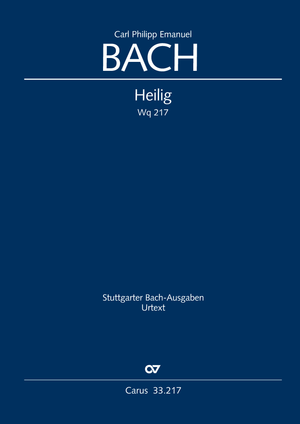
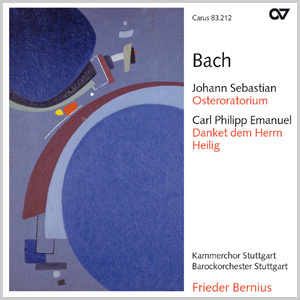
His Heilig Wq 217 is just 6 minutes long. Bach, however, put all his art into these few minutes, as he himself wrote to his publisher: „ Here I have proved the most daring and hard work ... It will be my swan song of this nature, and serve to ensure that you do not forget myself too soon after my death“. The work requires an extraordinary instrumentation: two full orchestras with 3 Trumpets, 2 Oboes and Strings and two mixed choirs. A sensitive alto solo initiates the work and prepares the dialogue between the choirs of angels and of peoples. It is a musical highlight, when the angel choir modulates from F minor via the tritone interval to B major, initiating the tutti fortissimo. A strong four-part fugue concludes the short work .
Explore
 View
View

 Listen
(6)
Listen
(6)
- Ariette (A): Herr, wert, daß Scharen
- Heilig (Chor der Engel/Chor der Völker)
- Recitativo (B): Das Übrige vom Pilgerpfade
- Aria (B): Ich weiche nicht
- Recitativo (A): Ich weiche nicht
- Soli e Coro: Lobet den Herrn
Purchase
Additional product information
Contents
-
Composer
Carl Philipp Emanuel Bach
| 1714-1788Carl Philipp Emanuel Bach (1714–1788) was an extremely prolific composer who enjoyed a high reputation during his lifetime with the result that his music became known far and wide. The early works were influenced by the Berlin School. In his later works, however, this composer developed a thoroughly individual style, independent of contemporary fashions, which is to be found especially in the sacred vocal works written during his years as Director of Music in Hamburg (1768–1788). Personal details
-
Editor
Günter Graulich
| 1926The publisher, church musician and teacher Günter Graulich is one of the major personalities in German publishing of the post-war period. With his wife Waltraud he founded Carus-Verlag Stuttgart in 1972, which he built up from a 2-person family firm to a medium-sized business with around 60 employees. A trained church musician and Kantor for many years at the Matthäuskirche Stuttgart, he also directed the Motettenchor Stuttgart for 50 years. With his choir he made LP and CD recordings, and undertook numerous concert tours to other European countries and America. Personal details
Reviews on our website can only be submitted by customers with a registered user account. A check whether the rated products were actually purchased does not take place.
No feedback available for this product.
Frequent questions about this work
 There are no questions and answers available so far or you were unable to find an answer to your specific question about this work? Then click here and send your specific questions to our Customer Services!