

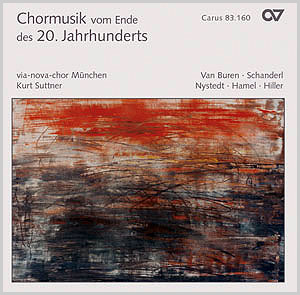
carus novus - Musik vom Ende des 20. Jahrhunderts / Music from the late 20th century
 Listen
(17)
Listen
(17)
- Ave Maria
- Gloria
- Psalm 90
- I
- Leise im Munde der Nacht
- Chor der Geretteten
- Lacrimosa
- II
- Wir klagen an
- III
- Mitternacht
- Erinnerung
- Eifersucht
- Pierische Rosen
- Die zehnte Muse
- Kallisteia
- Kleis. Meine Tochter


-
Preface writer
Kurt Suttner
| 1936Kurt Suttner studied school music and singing at the Staatliche Hochschule für Musik in Munich. His work as music teacher at various schools in Munich was followed by his appointment as music teacher at the German School in Addis Ababa (Ethiopia) and as music adviser to the Ministry of Culture in Antananarivo (Madagascar). After teaching choral conducting at the Musikhochschule in Munich he became professor of music education at Augsburg University. For ten years he directed the Bayerische Singakademie, which is an institution fostering vocal talents. In 1997 he was awarded the Bundesverdienstkreuz, first class, by the then Federal German President Roman Herzog. Kurt Suttner frequently acts as a juror at national and international choral competitions, and he directs instructional courses for choirs and choral conductors. He is the editor of the “carus novus” series published by Carus-Verlag, Stuttgart. Personal details
-
Preface writer
Tim Koeritz
-
Ensemble
via-nova-chor München
The via-nova-chor, Munich, was founded by its conductor Kurt Suttner in 1972. It exists to perform new choral music, mainly by contemporary composers, but without abandoning the tradition of European choral music. World premières of new choral works figure largely in its programmes. This has led the via-nova-chor to notable national and international successes and awards. The choir makes regular tours in Germany and elsewhere, and it appears at important choral festivals. Personal details
-
Conductor
Kurt Suttner
| 1936Kurt Suttner studied school music and singing at the Staatliche Hochschule für Musik in Munich. His work as music teacher at various schools in Munich was followed by his appointment as music teacher at the German School in Addis Ababa (Ethiopia) and as music adviser to the Ministry of Culture in Antananarivo (Madagascar). After teaching choral conducting at the Musikhochschule in Munich he became professor of music education at Augsburg University. For ten years he directed the Bayerische Singakademie, which is an institution fostering vocal talents. In 1997 he was awarded the Bundesverdienstkreuz, first class, by the then Federal German President Roman Herzog. Kurt Suttner frequently acts as a juror at national and international choral competitions, and he directs instructional courses for choirs and choral conductors. He is the editor of the “carus novus” series published by Carus-Verlag, Stuttgart. Personal details
-
Soloist - flute
Vera Becker
-
Soloist - violin
Eckhart Hermann
Eckhart Hermann, born in Siebenbürgen, has played the violin from the age of seven. From 1962 until 1968 he was a pupil of Elma Doflein, from whom he received decisive violinistic and musical inspiration. He also studied at the Hochschule in Freiburg under Günther Falkenroth and in Munich under Hermann Endres, and he completed his studies under Wolfgang Schneiderhan in Vienna. He has won prizes in various competitions, and since 1978 he has been a member of the Bayerisches Staatsorchester in Munich. Since 1987 he has taught the violin and chamber music at the Hochschule für Musik und Theater in Munich, and as a teacher he does intensive chamber music coaching in various courses. He is on close terms of musical friendship with the via-nova-chor and its conductor. Personal details
-
Soloist - violoncello
Andreas Suttner
Reviews
Chormusik vom Ende des 20
Chormusik vom Ende des 20. Jahrhunderts
Als Label eines ausgesprochenen Chormusik-Verlages, bedeuten Veröffentlichungen mit Chormusik bei Carus stets mehr als nur das Abdecken eines Repertoirebereiches. Ohne den Anspruch zu haben, repräsentativ zu sein, bieten die versammelten Werke doch die Möglichkeit, sich einen akustischen Eindruck über die Kompositionsweise für gemischten Chor am Ende des 20. Jahrhunderts zu machen, die vom politischen Engagement in HameIs „Oh, Erde...” bis hin zur zeitlos gültigen griechischen Antike in Hillers „Sappho” reichen.
Quelle: Note 1, 1/04
Chormusik vom Ende des 20. Jahrhunderts
Let me spoil the game straightaway: this is a most interesting, varied and rewarding collection of choral works composed in the last fifteen years or so of the 20th century by composers from various stylistic horizons.
The Norwegian-born Knut Nystedt, almost the Grand Old Man here, is represented by his beautifully crafted and inventive Ave Maria composed in 1986 as a chamber concerto for violin and mixed chorus, a somewhat unusual, but quite effective combination. The demanding violin part even includes a cadenza!
All the other pieces are by German composers belonging to different generations. The opening item, John Van Buren’s Gloria, is a short setting of just a few lines from the traditional Gloria, worked-out quite effectively in a fairly gentle, melodic way. This is clearly the kind of stuff that should appeal to any choir willing to explore some accessible 20th century repertoire.
Hans Schanderl’s setting of Psalm 90 is rather more ambitious in scope, superbly matching the various moods suggested by the text, and again quite rewarding in its own right.
„Oh, Erde...” by Peter Michael Hamel is, stylistically speaking, in a rather different league than the other works featured here, in that the idiom is on the whole more modern, but never extravagantly or rebarbatively so. This is a substantial setting of poems by Walter Flemmer and Nelly Sachs as well as of the Lacrimosa section from the Requiem Mass framed by a short section from the Book of Job of which varied restatements introduce and close the work while also serving as an interlude between the Lacrimosa movement (female voices) and Flemmer’s Wir klagen an. The opening statement Oh, Erde... uses quarter tones and glissandi and confronts vibrato and non-vibrato singing to great expressive effect, whereas the interlude setting is somewhat simpler and the epilogue version again relies on somewhat more advance techniques (including whispering and speaking chorus) as well as more traditional singing. These settings, while quite varied in character and vocal technique, aptly reflect the various moods of these often beautiful words. There is no denying the intense and deeply sincere humanity underlying this often moving and strongly communicative piece of music. A major work by any count, but one that does not yield all its secrets easily but rather repays repeated hearings.
Wilfried Hiller’s Sappho for female voices, flute and cello was – ironically enough, I think – composed for either children’s or youth choirs; but, needless to say, works perfectly well when sung by professional singers. As a whole, this is however a fairly simple, straightforward work with enough to challenge young singers and to reward singers (and any listener, for that matter). Flute and cello accompany most sections adding some telling instrumental touches while providing for some help at intonation as well. This beautiful, attractive work provides for a fine conclusion to this most desirable release well served by magnificent, well recorded singing. Well worth having.
Hubert Culot
Quelle: Classical Music Web
Chormusik vom Ende des 20. Jahrhunderts
20. Jahrhundert? Chor? Das könnte anstrengend werden. Man könnte Schreien, Wispern, Stossen, Klatschen erwarten, nur wenig Gesang. Das zwanzigste Jahrhundert ist schließlich nicht gerade arm an amorphen Tongebilden, die keiner Empfindung, sondern lediglich einer knickrigen intellektuellen Idee zu entspringen scheinen und sich dann zu länglichen, unerträglichen Konstrukten auswachsen, denen so jeglicher empfundener Esprit fehlt. So immerhin die allgemeine Meinung: dass es da aber auch zahlreiche Komponisten gibt, die sich dem Diktat des bloßen Andersseinwollens leichthin widersetzen, wird mehrheitlich verkannt. Hören kann man mit Berechtigung beide Pole auf der CD ‚Chormusik vom Ende des 20. Jahrhunderts’ (Carus 83.160): Scharfkantiges als auch Liebliches. Unter der Leitung von Kurt Suttner singt der via-nova-chor München.
Zu den Stücken, denen man den eigenen Weg des Komponisten anhört, ohne sich intellektuell verbrämt ins Eck setzen zu müssen, gehört das ‚Gloria’ (1996) von John Van Buren. Ein wenig fühlt man sich an Goreckis orchestrale Klagelieder erinnert, wenn sich im Gloria der Chor von einem verhaltenen Beginn zu einem wahrhaft emphatischen achtstimmigen Fortissimo steigert. Von Kühle und Distanz keine Spur.
Auch der 1960 geborene Hans Schanderl scheint kein Freund trockener scharfer Klänge zu sein. Sein ’Psalm 90’(1996) klingt beinahe monastisch, er selbst schreibt, er wolle durch das langsame Grundmetrum die Unendlichkeit Gottes der zeitlichen Vergänglichkeit des Menschen (symbolisiert durch rhythmisch straffe, kleingliedrige melodische Linien) gegenüberstellen.
Knut Nystedt gesteht selbst, dass seine Wurzeln im Gregorianischen Choral liegen. Diese geistige Nähe wird auch in seinem ‚Ave Maria’ (1986) deutlich. Dem Chor ist eine sehr virtuos gespielte Violine (Eckhart Hermann) zur Seite gestellt. Das Stück hat kontemplativen Charakter.
Peter Michael Hamels ‚Oh Erde...’(1995) sei ein ‚Kompendium kompositorischer Stilmittel des 20.Jahrhunderts’ erfahren wir von Kurt Suttner im informativen und umfangreichen Booklet. In einem der Lieder wird nahezu schmerzhaft Nelly Sachs Gedicht über die Holocaustüberlebenden ‚Chor der Geretteten’ skandiert. Sollte hier wieder einmal Adornos bekanntes Diktum nach Auschwitz lasse sich keine Lyrik mehr schreiben, einen Verfechter im Komponisten gefunden haben? Jedenfalls scheint dem Text der Klang geopfert zu sein.
‚Sappho’ (1997) von Wilfried Hiller bildet den Abschluss der auf der CD versammelten Chorwerke. Es entstand im Auftrag des Arbeitskreises ‚Musik in der Jugend’ mit dem Ziel, ein Stück zeitgenössischer Chormusik für den Laienbereich zu verfassen. Hillers Tonsprache scheint postmodern: einzelne Stilelemente werden vermischt, kurze Melodiesequenzen brechen sich immer wieder Bahn. Der Verdacht des steten Klangexperiments drängt sich auf. Die Klangqualität divergiert mit den Aufnahmeorten (zwei Aufnahmen entstanden in Kirchen, zwei im Studio, eine im Konzertsaal der Hochschule München). Präsenter ist der Klang im Studio, authentischer wirkt er in den Kirchen.
Insgesamt ist die CD eine aussagekräftige Vereinigung neuester Stücke unterschiedlichster Couleur mit einem klangfreudigen Ensemble, oder, um mit Kurt Suttner zu sprechen: ein ‚Kompendium kompositorischer Stilmittel des 20.Jahrhunderts’.
Andrea Potzler
Quelle: klassik.com, 03.04.2004
[hbb] Der viva-nova-chor München singt unter Leitung seines Dirigenten Kurt Suttner Kompositionen von John Van Buren *1952 (Gloria für 4-8 stg. gem. Chor (1996)), Hans Schanderl *1960 (Psalm 90 für 4-7 stg. gem. Chor (1996)), Knut Nystedt *1915 (Ave Maria für 4-6 stg. gem. Chor und Violine (1986)), Peter Michael Hamel *1947 (,‚Oh, Erde...” für 4-5 stg. gem. Chor, Frauenchor SMA und Männerchor TB (1995)) und Wilfried Hiller *1941 (Sappho / Fragmente für Frauenchor SMA, Querflöte und Violoncello (1997)). Unbedingte Empfehlung für diese hervorragende Aufnahmen! Auch als Heranführung an zeitgenössische Chormusik ideal geeignet. Das selbst genannte Ziel des Chores ist es, „...neue Chormusik vor allem zeitgenössischer Komponisten aufzuführen, ohne dabei die Verbindung mit der Tradition der europäischen Chormusik aufzugeben.” Erfolge auf Konzertreisen, Einladungen zu Festivals und zahlreiche Auszeichnungen belegen Suttners äußerst erfolgreiche Chorarbeit mit dem viva-nova-chor seit 1972. Mein Favorit: Nystedts Ave Maria. Die Kombination Chor und Solovioline lässt aufhorchen und wird sicher helfen, letzte protestantische Ablehnungshaltungen zu überwinden.
Quelle: Württembergische Blätter für Kirchenmusik 5/2005, S.34
(B.F.) [] Le Ch?ur Via-Nova de Munich, certes très perfectible en termes de texture et d'homogénéité, fait preuve d'un engagement total qui facilite grandement l'accès à ces pages.
Quelle: Monde da la Musique, 3/05
Reviews on our website can only be submitted by customers with a registered user account. A check whether the rated products were actually purchased does not take place.
Frequent questions about this work
 There are no questions and answers available so far or you were unable to find an answer to your specific question about this work? Then click here and send your specific questions to our Customer Services!