

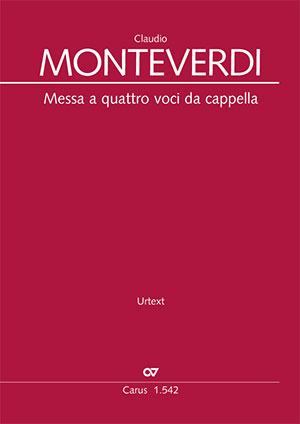
Messa à quattro voci da cappella
aus: Messa à quattro voci et salmi 1650
Claudio Monteverdi, a towering figure in the history of music, embodies the transition between old traditions and new practices. He is regarded as the last great Renaissance madrigalist, a pioneer of Baroque opera and a versatile church musician who was influenced by both the stile antico and the stile nuovo. The modern expressive style of his Marian Vespers is particularly impressive. His other sacred compositions in the traditional prima prattica style, which include motets, psalms, litanies and masses, distinguish themselves by their simple beauty and sublime grandeur, but are often overlooked.
Monteverdi’s Messa à quattro voci da cappella, from the collection published by Alessandro Vincenti in 1650, is one such unjustly neglected gem of his sacred music. Our edition has been modernized on the basis of the original source and carefully adapted to today's choral practice to enable ease of performance. As a result the Messa à quattro voci da cappella can now be heard and experienced in all its profound spirituality and musical sophistication.
Monteverdi’s Messa à quattro voci da cappella, from the collection published by Alessandro Vincenti in 1650, is one such unjustly neglected gem of his sacred music. Our edition has been modernized on the basis of the original source and carefully adapted to today's choral practice to enable ease of performance. As a result the Messa à quattro voci da cappella can now be heard and experienced in all its profound spirituality and musical sophistication.
Explore
 View
View

Purchase
Additional product information
-
Composer
Claudio Monteverdi
| 1567-1643During his youth in Cremona, Monteverdi received his first musical training from Marc'Antonio Ingegneri, the maestro di cappella at the Cathedral. After making his name with his first publications, including his First Book of Madrigals, he moved to the Gonzaga court in Mantua in 1590: he remained in the service of the family for twenty-two years, first as singer and violist, and later as maestro di cappella. There he composed further books of madrigals and, with L'Orfeo in 1607, one of the earliest operas in the history of music. The Vespers of the Blessed Virgin were also written in Mantua in 1610. In 1613 became Monteverdi maestro di cappella at St Mark's in Venice. He spent thirty musically fruitful years in this post. He composed sacred works, but remained interested in secular music and published his most extensive secular collections with books six to eight of his Madrigals. After the opening of the Venice opera house in 1637, the first public opera house ever , he returned to composing opera once more: both of his late operas, Il ritorno d'Ulisse in Patria and L'incoronazione di Poppea received their first performances here. Personal details
-
Editor
Rudolf Walter
| 1918-2009
Reviews on our website can only be submitted by customers with a registered user account. A check whether the rated products were actually purchased does not take place.
No feedback available for this product.
Frequent questions about this work
 There are no questions and answers available so far or you were unable to find an answer to your specific question about this work? Then click here and send your specific questions to our Customer Services!