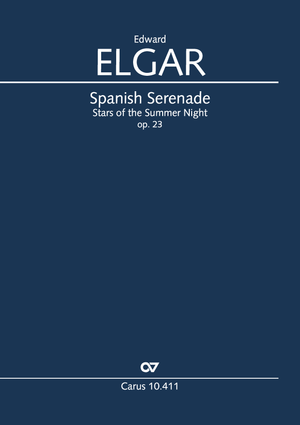
Spanish Serenade
Stars of the Summer Night. op. 23, 1892
Edward Elgar’s Spanish Serenade “Stars of the Summer Night,” written in 1892 for mixed choir and orchestra, paints an enchanting picture of a balmy night in Spain. The text comes from a play by Henry Longfellow, where it appears as a nocturnal serenade beneath the house of a pair of clandestine lovers. With muted strings, mysteriously restrained voices, and only occasional interjections from the woodwinds, Elgar’s choral song captures the hushed nocturnal mood of the scene. At the same time, the two violins come to the fore with lively chains of thirds, while dance rhythms, tambourine, and triangle lend the whole a distinctly Spanish flair.
The work is available in three original versions: the orchestral version and piano version can be performed with the present performance material (the piano version is identical to the vocal score of the orchestral version). Elgar’s third version for female choir (alternatively for mixed choir), piano, and two violins is currently under preparation.



-
Composer
Edward Elgar
| 1857-1934Edward Elgar was born on 2 June 1857 in Broadheath near Worcester. As a child he learnt to play the piano and violin with his father William Henry and local music teachers. As a composer he was self-taught, but he only became really well-known and successful with his compositions in the 1890s. He achieved his first notable successes with his first cantatas The Black Knight (1893) and King Olaf (1896), and his oratorio The Light of Life (1896). But his ultimate breakthrough as a composer came in 1899 with the Enigma Variations op. 36, and a year later with his major work, the oratorio The Dream of Gerontius.
Elgar is regarded as an important representative of late Romanticism in music, and was one of the few British composers after Purcell to achieve international recognition.
Personal details
-
Editor
Barbara Mohn
-
Songwriter / Librettist
Henry Wadsworth Longfellow
| 1807-1882Henry Wadsworth Longfellow was an American writer, poet, translator and playwright. Although much of his work has been forgotten, it lives on nonetheless. The epic poem The Song of Hiawatha, for example, inspired Antonin Dvorak to write the second movement of his symphony ‘From the New World’. Personal details
Reviews on our website can only be submitted by customers with a registered user account. A check whether the rated products were actually purchased does not take place.
Frequent questions about this work
 There are no questions and answers available so far or you were unable to find an answer to your specific question about this work? Then click here and send your specific questions to our Customer Services!