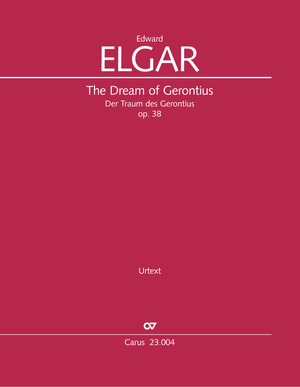
The Dream of Gerontius
Der Traum des Gerontius op. 38, 1900
- A milestone of late Romantic choral music, and a standard work in Great Britain
- First modern score with a full Critical Report and complete performance material
- English and German singing texts
 View
View


 Additional material
- Purchase additional material as a download product.
-
 Digital text (without sheet music) incl. printing licence, html file, singing text, german translationhtml file, singing text, german translation (Sample)Unbenanntes Dokument Teil I
Gerontius
Jesus, Maria, meine Stunde kam,
und du, Herr, du bist’s, der mich ruft; kein Zweifel frommt.
Lässt mich erkennen meines Atems Not,
des Herzens Krampf, des Blicks erlöschend Licht?
(Jesus, erbarm dich! Heilge Maria, hilf!)
Ein neu Gefühl sagt’s, nie zuvor gekannt,
(Herr, steh mir bei in meiner Todesstund!)
dass ich davon muss, dass mein Ziel ich fand.
Welch fremd innerste Verlassenheit,
(Hort aller Seelen, Herr, ich blick auf dich.)
Erschöpfung aller eignen Wesenheit;
...
-
Digital text (without sheet music) incl. printing licence, html file, singing text, originalhtml file, singing text, original (Sample)2300400380000st.en Part I
Gerontius
Jesu, Maria – I am near to death,
And Thou art calling me; I know it now.
Not by the token of this falt’ring breath,
This chill at heart, this dampness on my brow, –
(Jesu, have mercy! Mary, pray for me!)
’Tis this new feeling, never felt before,
(Be with me, Lord, in my extremity!)
That I am going, that I am no more.
’Tis this strange innermost abandonment,
(Lover of souls! great God! I look to Thee,)
This emptying out of each constituent
...
-
Digital text (without sheet music) incl. printing licence, html file, Introductory text, germanhtml file, Introductory text, german (Sample)Vorwort
„This is the best of me; for the rest, I ate, and drank, and slept, loved and hated, like another; my life was as the vapour, and is not; but this I saw and knew: this, if anything of mine, is worth your memory“, schrieb Elgar hinter den Schlusstakt seiner Partitur,1 als er am 3. August 1900 die Arbeit am Dream of Gerontius, einem Auftragswerk für das Musikfest zu Birmingham, vollendet hatte.Das Zitat ist ein ganz persönliches Bekenntnis des Komponisten, für dieses religiöse Werk mehr als je zuvor sein Herz geöffnet und eine einzigartige emotionale Ebene erreicht zu haben. Umso enttäuschter reagierte er auf die missglückte Uraufführung zwei Monate später: „I have allowed my heart to open once – it is now shut against every religious feeling and every soft, gentle impulse for ever.“2
Das Libretto
The Dream of Gerontius war das erste große geistliche Werk Elgars überhaupt – komponiert vier Jahre nach dem 1896 für das Three Choirs Festival entstandenen „short oratorio“ The Light ofLife (Lux Christi) op. 29. Doch anders als bei diesem Werk über die Heilung des...
-
Digital text (without sheet music) incl. printing licence, html file, Introductory text, englishhtml file, Introductory text, english (Sample)Foreword
“This is the best of me; for the rest, I ate, and drank, and slept, loved and hated, like another; my life was as the vapour, and is not; but this I saw and knew: this, if anything of mine, is worth your memory,” Elgar wrote after the final bar of his score1 when he completed work on The Dream of Gerontius, a commission for the Birmingham Musical Festival, on 3 August 1900. The quotation is a very personal confession by the composer that he had opened his heart more than ever before for this religious work and had reached a unique emotional level. Two months later, his disappointment in view of the failed premiere was all the greater: “I have allowed my heart to open once – it is now shut against every religious feeling and every soft, gentle impulse for ever.”2
The librettoThe Dream of Gerontius was Elgar’s first major sacred work; it was composed four years after the “short oratorio” The Light of Life (Lux Christi) op. 29, which was written in 1896 for the Three Choirs Festival. But – unlike the latter composition which dealt with the healing of the blind man from the
...
Contents
-
Composer
Edward Elgar
| 1857-1934Edward Elgar was born on 2 June 1857 in Broadheath near Worcester. As a child he learnt to play the piano and violin with his father William Henry and local music teachers. As a composer he was self-taught, but he only became really well-known and successful with his compositions in the 1890s. He achieved his first notable successes with his first cantatas The Black Knight (1893) and King Olaf (1896), and his oratorio The Light of Life (1896). But his ultimate breakthrough as a composer came in 1899 with the Enigma Variations op. 36, and a year later with his major work, the oratorio The Dream of Gerontius.
Elgar is regarded as an important representative of late Romanticism in music, and was one of the few British composers after Purcell to achieve international recognition.
Personal details
-
Editor
Barbara Mohn
-
Songwriter / Librettist
John Henry Newman
-
Translator
Julius Buths
Reviews
Die komplett zweisprachige Partitur versteht sich als erste kritische Edition des Werks. Sie löst die Diskrepanzen, die im bisher vorliegenden gedruckten Aufführungsmaterial vor allem in der Dynamik und Artikulation vorhanden waren, nachvollziehbar auf. Erwähnenswert ist der sehr umfangreiche kritische Bericht, der alle fraglichen Details umfassend auflistet. Für Expert:innen sicher eine lohnende Anschaffung...
Chorzeit, No. 101, Feb 2023
Wer die Möglichkeit hat, dieses Opus Magnum aufzuführen, der hat hier endlich alle Materialien in bester Qualität dazu aus einer Hand.
Kirchenmusik im Erzbistum Köln, Heft 2/2022
All das lässt sich nun studieren in der neuen, wunderbar lesbaren Ausgabe bei Carus, ergänzt um das Libretto und einen sorgfältigst dokumentierenden kritischen Bericht.
Das Ochester, 12/2022
I am in awe of this new offering from Carus and I reel at the energy and expertise that has been marshalled in order to create the new edition of Gerontius.
Choir & Organ, Oktober 2022
Die neue Urtext-Ausgabe bringt uns schon im gut lesbaren Vorwort auf Tuchfühlung mit den verschiedenen Facetten des Werks...
FAZ, 24.07.2022
Reviews on our website can only be submitted by customers with a registered user account. A check whether the rated products were actually purchased does not take place.
Frequent questions about this work
How are the chorus and semi-chorus scored?
Are the measure numbers compatible with other editions?
 There are no questions and answers available so far or you were unable to find an answer to your specific question about this work? Then click here and send your specific questions to our Customer Services!