

Text:
The prayer for peace "Seigneur, faites de moi un instrument de votre paix" originates from France from an anonymous lyricist and is first documented in the magazine La Clochette (no. 12 of December 1912). The editor titled it "Belle prière à faire pendant la messe". It quickly became popular as it represented a pacifist counter-position to the European enthusiasm for war, which then led to the First World War. Since 1927, the popular prayer has been attributed to St. Francis of Assisi, but there are no Latin or Italian sources for it. Consequently, it is not included in the critical complete edition of the writings of St. Francis.
The prayer for peace "Seigneur, faites de moi un instrument de votre paix" originates from France from an anonymous lyricist and is first documented in the magazine La Clochette (no. 12 of December 1912). The editor titled it "Belle prière à faire pendant la messe". It quickly became popular as it represented a pacifist counter-position to the European enthusiasm for war, which then led to the First World War. Since 1927, the popular prayer has been attributed to St. Francis of Assisi, but there are no Latin or Italian sources for it. Consequently, it is not included in the critical complete edition of the writings of St. Francis.
Instrumentation:
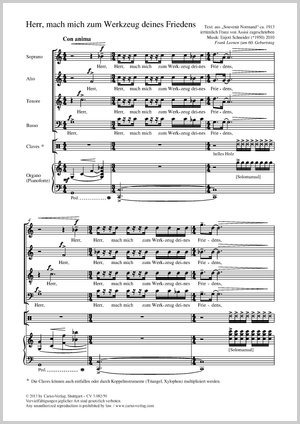
Mixed choir (SATB). The organ can be replaced by piano/keyboard/harpsichord and arranged accordingly. The claves can be played by a choir member (bright joyful sound as leitmotif), ad libitum also multiplied with other percussive instruments such as glockenspiel, xylophone.
Explore



 Listen
(1)
Listen
(1)
- Herr, mach mich zum Werkzeug deines Friedens
Purchase
Additional product information
-
Composer
Enjott Schneider
| 1950Enjott Schneider, a musicologist, musician, German scholar and linguist, was born in Weil am Rhein in 1950. From 1979 to 2012, he taught church music composition, among other subjects, as a professor at the Music University in Munich. In addition to eight operas, he composed numerous orchestral and chamber music works, sacred music with oratorio works, organ concertos and 13 organ symphonies, as well as over 500 film scores. Schneider has been recognized for his work with numerous awards, including the Bavarian Film Prize for film music, an Emmy Award, and the German Television Award. In 2015, he was awarded the “Soundtrack Cologne” film festival prize for his life’s work. In his versatile oeuvre, Schneider often combines opposites in creative symbiosis. His compositional work is also closely linked to intensive reflection as a writer. Personal details
Reviews on our website can only be submitted by customers with a registered user account. A check whether the rated products were actually purchased does not take place.
No feedback available for this product.
Frequent questions about this work
 There are no questions and answers available so far or you were unable to find an answer to your specific question about this work? Then click here and send your specific questions to our Customer Services!