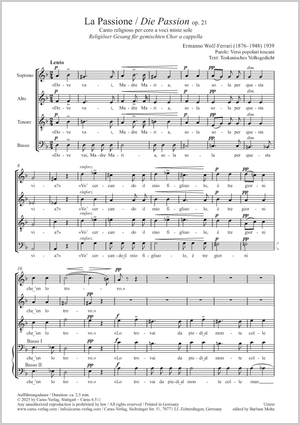
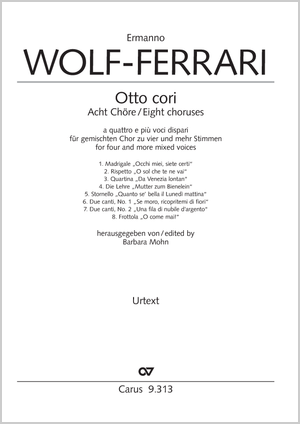
Otto cori
a quattro e più voci dispari 1897
The German-Italian composer Ermanno Wolf-Ferrari (a pupil of Josef Rheinberger) enjoyed great success with his comic operas at the beginning of the 20th century. His early work Die neugierigen Frauen (Inquisitive Women), which premiered in Munich in 1903, was later performed under Toscanini at New York’s Met. Wolf-Ferrari’s work reflects that fact that he grew up with two nationalities. The Otto cori for mixed choir display his attachment to the traditional forms of Italian music (madrigals, stornello, rispetto etc.) and are largely based on Tuscan folksong texts. Exploring love, longing, and death, Wolf-Ferrari’s Otto cori are both humorous and sophisticated, featuring piquant harmonies and varied instrumentation. Into this collection of Italian poems, Wolf-Ferrari smuggled a German-language song, which he had already composed in Munich when studying under Rheinberger.
Carus is presenting these songs as a collection – in print and digital versions. All songs are available as separate editions.


Contents

-
Composer
Ermanno Wolf-Ferrari
| 1876-1948Ermanno Wolf-Ferrari was born in Venice in 1876. He studied in Rome (1891–92) and Munich (1892–95), where he was a pupil of Joseph Rheinberger. In Munich, he celebrated his greatest successes in the years before the outbreak of the First World War, mainly with his compositions of comic operas. After the First World War, he was unable to build on his pre-war successes, perhaps because his music, written in a late or post-Romantic style, had no connection to the contemporary musical language of modernism. Personal details
-
Editor
Barbara Mohn
-
Songwriter / Librettist
Heinrich Heine
| 1797-1856Heinrich Heine (1797–1856) is regarded as one of the most important German poets of the 19th century. He was born in Düsseldorf and is best known for his lyric poetry, which combines Romanticism with sharp social criticism. Many of his works deal with love, nature and freedom. Because of his political views, Heine lived in exile in Paris for many years.
He also occupies a prominent place in the history of music. His lyrical texts were set to music by numerous composers and had a particularly profound influence on the Romantic art song. Robert Schumann, Franz Schubert, Felix Mendelssohn Bartholdy and Hugo Wolf, in particular, created musical works of enduring significance based on Heine’s poems. The poetic combination of linguistic simplicity, emotional depth and often ironic ambiguity offered composers a wide range of possibilities for musical interpretation. As a result, Heine’s poetry became a central part of the Romantic art-song repertoire and continues to influence vocal music to this day.
Personal details
-
Songwriter / Librettist
Michelangelo Buonarotti
| 1475-1564
Reviews on our website can only be submitted by customers with a registered user account. A check whether the rated products were actually purchased does not take place.
Frequent questions about this work
 There are no questions and answers available so far or you were unable to find an answer to your specific question about this work? Then click here and send your specific questions to our Customer Services!